

A business advisor service proposal almost always leads with the price and stops there. The retainer number is on the page, sometimes with a discount attached. But the contract that actually governs the relationship rarely gets read closely until something goes wrong. A deliverable slips, the engagement quietly renews, or the advisor’s work turns out to belong to nobody in particular. By then the owner is negotiating from a position with no leverage at all, because the terms were fixed the day the invoice started.
That gap exists because the owner is doing this negotiation alone. An accountant or a lawyer will review a contract if asked. But reviewing a business advisor service agreement line by line is not typically part of either relationship. And a generic AI search can summarize what a termination clause usually says, without ever reading the specific one in front of you. Therefore, the practical fix is not more legal help. It is knowing, before the proposal arrives, what a retainer at this level should actually cost and which clauses do the real work of protecting you. It is knowing where the pricing and terms are genuinely negotiable, too.
What a Business Advisor Service Retainer Should Actually Cost
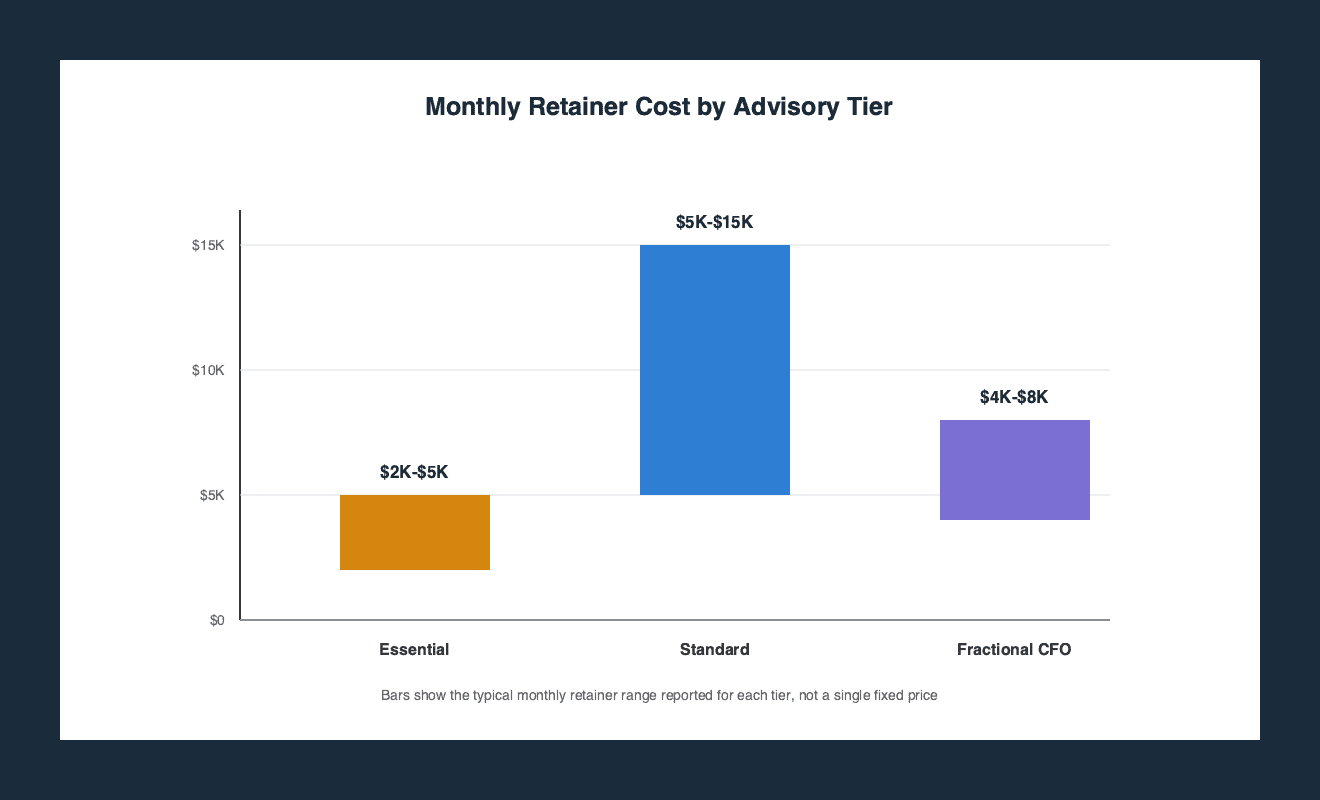
Once a business advisor service moves past a single hourly question into an ongoing retainer or package, the pricing math changes. So does the risk of getting it wrong. For businesses generating between $1 million and $50 million in revenue, a fair monthly retainer for an experienced specialist typically runs $5,000 to $15,000. That is the benchmark from Schmidt Consulting Group. Entry-level or “essential” advisory packages tend to start closer to $2,000 to $5,000 a month. Standard ongoing support lands in that same $5,000 to $15,000 range, per pricing analysis from Zanfia. Fractional CFO and strategic advisory retainers specifically often fall between $4,000 and $8,000 a month for small and mid-sized businesses.
These ranges also reflect a broader shift in how advisory firms price their work. Value-based retainer pricing is tied to the scope and outcome of the engagement, rather than hours logged. It became the dominant model industry-wide through 2024 and 2025, and remains standard heading into 2026, per Zanfia’s analysis. That shift matters when you sit down to negotiate. A retainer priced on the firm’s judgment is more negotiable than a number generated by a fixed hourly formula. There is no formula to defend, only a judgment call the firm made about your specific business.
The Clauses That Actually Determine Your Business Advisor Service Contract
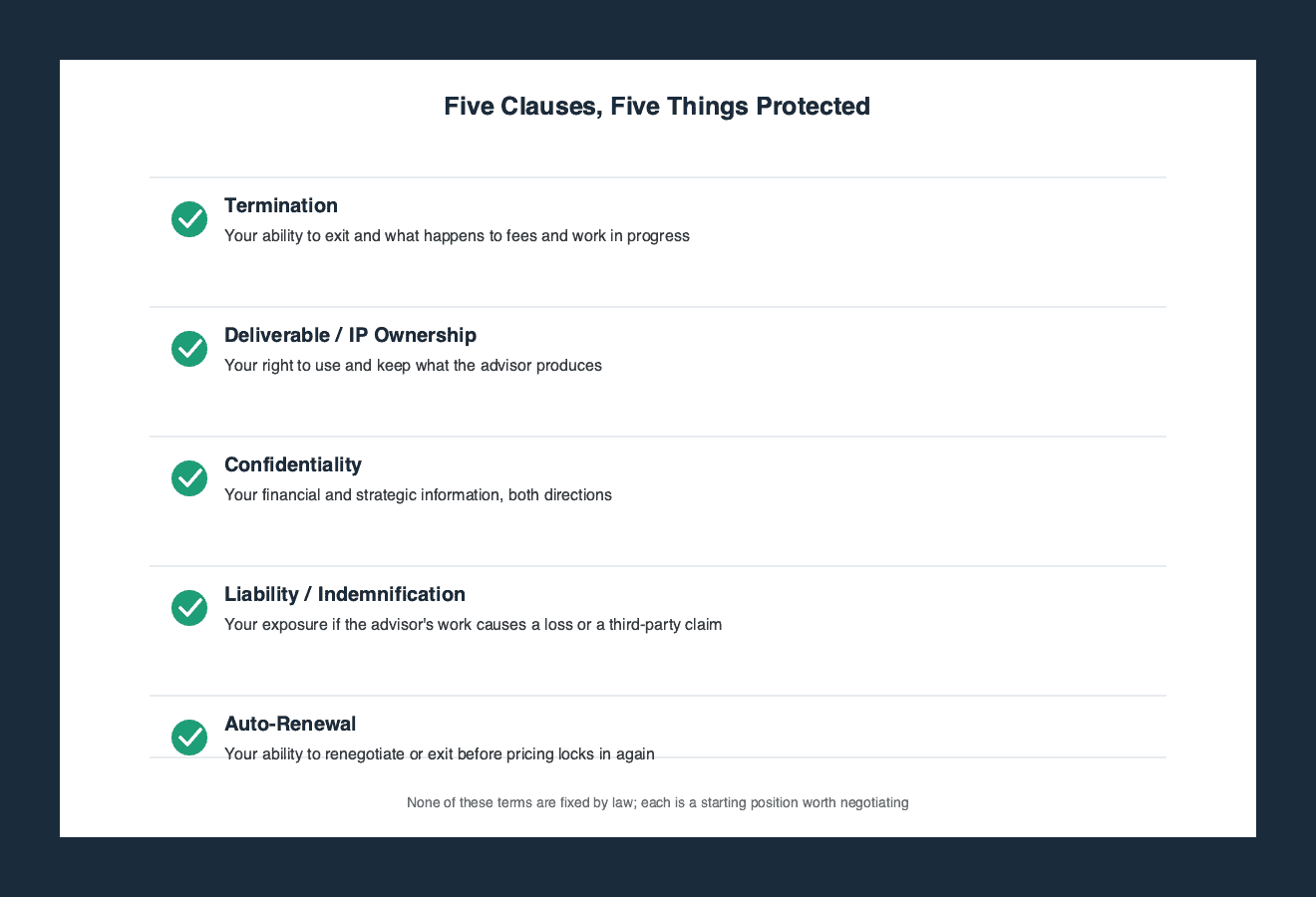
The price on the proposal describes what you pay. The contract describes what you are actually buying. Five clauses do most of that work.
Termination. A well-drafted termination clause specifies whether either party can end the agreement at will or only for cause. It also covers how much notice is required, and what happens to fees already paid and work already in progress, according to guidance from Taft Law. A 30-day notice period is common on both sides. If the agreement only lets the advisor terminate for convenience while locking you in, that asymmetry is worth raising before you sign, not after.
Deliverable and IP ownership. Ownership of the strategy decks, financial models, or written plans an advisor produces should be assigned to you explicitly, not implied. A common mistake in advisory contracts is having no IP assignment clause at all. Or the language is limited to “deliverables submitted to the company.” That leaves interim work and drafts in a gray area, per JonesSpross. A work-for-hire clause that states outright that the client, not the consultant, owns the copyright to what gets produced closes that gap.
Confidentiality. The agreement should protect your financial and strategic information under a mutual confidentiality obligation. It should not be one-sided, protecting only the advisor’s methodology.
Liability, Indemnification, and Auto-Renewal
Liability and indemnification. A limitation of liability clause typically caps what the advisor can be held responsible for, often at the total fees paid under the contract. It usually excludes indirect or consequential damages. An indemnification clause, separately, defines who compensates whom if a third party brings a claim tied to the advisor’s work. Mutual indemnification, where both sides carry some responsibility, tends to produce fairer terms than a clause written entirely in the advisor’s favor.
Auto-renewal. An automatic renewal, or evergreen, clause extends the contract unless you give notice by a specific deadline. That notice window commonly runs 30 to 90 days before the contract expires, per research from Ironclad. Missing that window locks you into another term at pricing that may no longer reflect the market or your actual usage.
What’s Actually Negotiable, and How to Negotiate It
None of the five clauses above are fixed by law. They are starting positions the advisory firm drafted in its own favor. Most firms expect at least some pushback. Consulting firms commonly offer discounts of 10 to 15 percent simply as a gesture of goodwill once a client asks, according to ConsultingQuest’s negotiation research. It rarely hurts to push further than that opening offer.
Two levers do most of the work in that conversation. Gathering two to three competing quotes gives you a credible benchmark and real leverage before you negotiate with your preferred firm. Showing you have viable alternatives is often enough on its own to move a price. A willingness to commit to a longer term, or to more favorable payment terms, is a bargaining chip in the other direction. Firms value the certainty of a longer engagement, and will frequently improve pricing or terms to lock it in.
On the contract terms themselves, three requests are reasonable to make before signing rather than after a dispute. Ask for a shorter notice period than the firm’s default, and an explicit IP assignment clause rather than vague “deliverables” language. Also ask for a shorter auto-renewal window with a required confirmation step, rather than silent renewal. None of these requests are unusual. A firm’s willingness to accommodate them tells you more about how the relationship will actually run than anything in the sales conversation.
Before you commit to a monthly number in that negotiation, it helps to know where your margin actually stands today. A two-minute Profit Gap Analysis gives a fast, numbers-based starting point without committing to any engagement at all.
Where a Subscription Model Skips the Negotiation Entirely
There is a fourth option that sidesteps this entire negotiation: deciding with economics and AI instead of committing to a scoped, priced engagement at all.
Every clause above exists because a scoped, human engagement needs boundaries. It needs a start date, an end date, a defined deliverable, and a way to unwind the relationship if it stops working. But those boundaries are also what create the negotiation in the first place. A subscription AI business advisor has nothing to scope. There is no termination clause to negotiate and no deliverable ownership question, because the output is a conversation logged in your own account. There is no auto-renewal trap either, because the subscription can be cancelled the same way it started.
Econblox works this way: 24/7 conversational access at a flat monthly subscription. Every recommendation is backed by video citations, so the reasoning is auditable without a written deliverable changing hands. Decisions and their outcomes are logged in a Decision Vault, which plays the role a contract’s deliverable clause would play in a traditional engagement. There is no ownership question, since it is your account and your record from the start.
This is not an argument that a subscription model replaces every retainer. A one-time valuation or a legal negotiation still calls for a human advisor. So does a relationship built on years of industry-specific trust, and the contract that goes with one. Understanding how those retainer, hourly, and project pricing models are typically structured matters regardless of which one you choose.
But for the recurring, lower-stakes strategic questions that come up between formal engagements, a subscription is worth testing. It may solve, for a flat monthly fee, what would otherwise mean negotiating a year-long contract. A 10-query free trial, no credit card required, is built for exactly that comparison.
Frequently Asked Questions
What should be in a business advisor service contract?
At minimum, a business advisor service contract should clearly state the termination terms and notice period. It should name who owns the deliverables the advisor produces, and cover the mutual confidentiality obligations. It should also state the limitation of liability and indemnification approach, and whether the agreement renews automatically. Vague or missing language in any of these areas is a sign to ask questions before signing, not after.
Is a business advisor service retainer negotiable?
Yes. Retainer pricing has shifted toward value-based models set by the firm’s judgment, rather than a fixed hourly formula. That makes it more negotiable, not less. Gathering competing quotes and offering a longer commitment are the two levers that typically produce the most movement on price.
What happens if I need to end a business advisor service contract early?
That depends entirely on the termination clause. A termination-for-convenience provision lets either party exit with notice, commonly 30 days, without needing a specific cause. Without that clause, or if it only runs in the advisor’s favor, ending the relationship early can mean owing fees for time not worked. It can also mean losing access to work already paid for.
Who owns the work product from a business advisor service?
It depends on how the contract is written. A clear work-for-hire or IP assignment clause gives the client explicit ownership of the deliverables. Contracts that are silent on ownership, or that only reference “deliverables submitted,” can leave interim drafts, models, and working documents in a gray area. That gray area benefits the advisor by default.
 No Credit Card Required For Trial