

Every business owner carries real operating risk. Pricing calls, capital decisions, hiring choices, and exit timing all shape the company’s future, yet most owners make those calls without a strategic layer to pressure-test them. That is why AI for business strategy has moved from a curiosity to a central conversation in boardrooms and owner offices alike. The research is clear that AI can strengthen and accelerate strategy work, but the tools available are not all the same. Some answer with confidence and nothing else. This article explains what AI can genuinely do for strategy, where it falls short, and how you can make it work for your business.
Why AI Has Entered the Strategy Room
Strategy has always depended on the quality of analysis and the speed of insight. McKinsey reported in 2025 that AI has the potential to transform how strategists work by strengthening and accelerating activities such as analysis and insight generation. Therefore, the appeal is obvious. PwC goes further, arguing that AI accelerates the business flywheel, including the speed of insights, decision-making, capability building, and organizational change. But faster insight only matters if the insight is sound. Generic AI models draw on broad internet training data, not on the operating experience of someone who has actually run companies. They answer with confidence, but confidence is not the same as grounding.
The shift from hype to impact is also visible in how executive education has evolved. Harvard now runs a program called AI Strategy for Business Leaders: From Hype to Impact, a title that acknowledges how much of the early AI conversation was noise. The program helps leaders align AI with organizational strategy, evaluate opportunities and risks, and lead AI-driven transformation. That framing matters. It positions AI as a strategic discipline, not a technology novelty.
The Real Gap for Owner-Operators
The decision maker in a company generating $1M to $100M in annual revenue typically has no strategic layer. The only regular outside relationships are with accountants and lawyers, who handle compliance and transactions, not strategic judgment. Therefore, when a pricing decision or market expansion is on the table, there is no one to test the reasoning, which is the exact gap driving more owners to look at how AI can improve business strategy decisions before committing to a call. Generic AI tools seem like a fix, but they lack memory of past decisions and have no way to learn what actually happened afterward.
That creates a dangerous dynamic. A tool that never tracks outcomes will keep producing confident answers without ever being held accountable for them. The owner, meanwhile, carries the real operating risk. Every decision has a consequence, and most of those consequences land on the person who made the call. Therefore, an AI tool for business strategy must do more than generate analysis. It must be grounded in real operating experience, remember the decision, and track whether the advice held up over time.
What the Research Shows About AI and Strategy
The strongest evidence on AI for business strategy comes from institutions that study how executives actually work. The pattern across these sources is consistent, and it points to a shared conclusion.
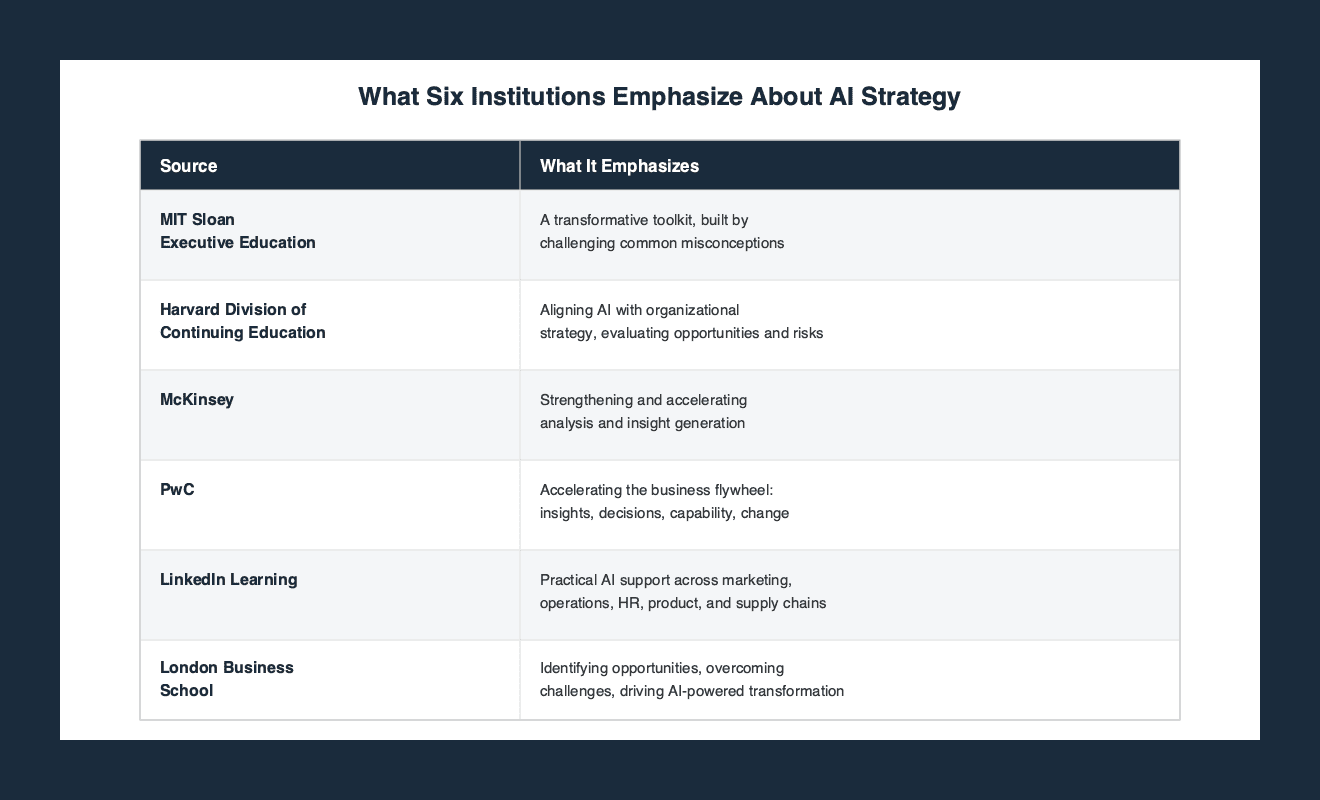
Harvard’s program, for example, is built for leaders with no technical background required. That is important, because strategy is not an engineering task. The London Business School course frames AI as a way to identify opportunities, overcome challenges, and drive AI-powered transformation. LinkedIn Learning’s course treats AI as a practical support across marketing, operations, HR, product development, and supply chains. Practitioners are also exchanging real insights in open forums, a sign that the conversation has moved beyond theory into day-to-day application.
But none of these programs claim that AI replaces the judgment of the owner. The framing from MIT Sloan is the most honest: the course challenges common misconceptions surrounding AI and encourages leaders to embrace AI as part of a transformative toolkit. A toolkit is only as good as the judgment of the person using it. Therefore, the question is not whether AI can produce strategy, but whether it is grounded in the kind of judgment that strategy requires.
The Weak Spot in Most AI Strategy Conversations
Most AI strategy conversations stop at the promise. They describe efficiency gains and faster analysis, but they rarely mention the two things an owner actually needs: grounding and memory. Grounding means the AI reasons from real operating experience, not from general internet data. Memory means the AI can look back at decisions, track whether they held up, and learn from the outcome. Without both, the tool is just a fast guesser.
MIT’s program exists because misconceptions are widespread. Owners are told that AI will make strategy easier, but they are rarely told what it will not do. It will not remember the context of a decision unless it is built to do so. It will not distinguish between a margin problem and a pricing problem unless it is grounded in economics. Therefore, the limitation is not the technology. The limitation is whether the tool has been built for the realities of operating a business.
Deloitte’s guidance points in this direction. The firm reports that many of the strongest AI strategies start in the same way: by pushing clear objectives down to business leadership so they can identify gaps and opportunities. That approach treats leadership judgment as the starting point and AI as the amplifier. Therefore, an effective AI strategy begins with the owner defining what matters, not with the tool defining it for them.
How to Put AI for Business Strategy to Work
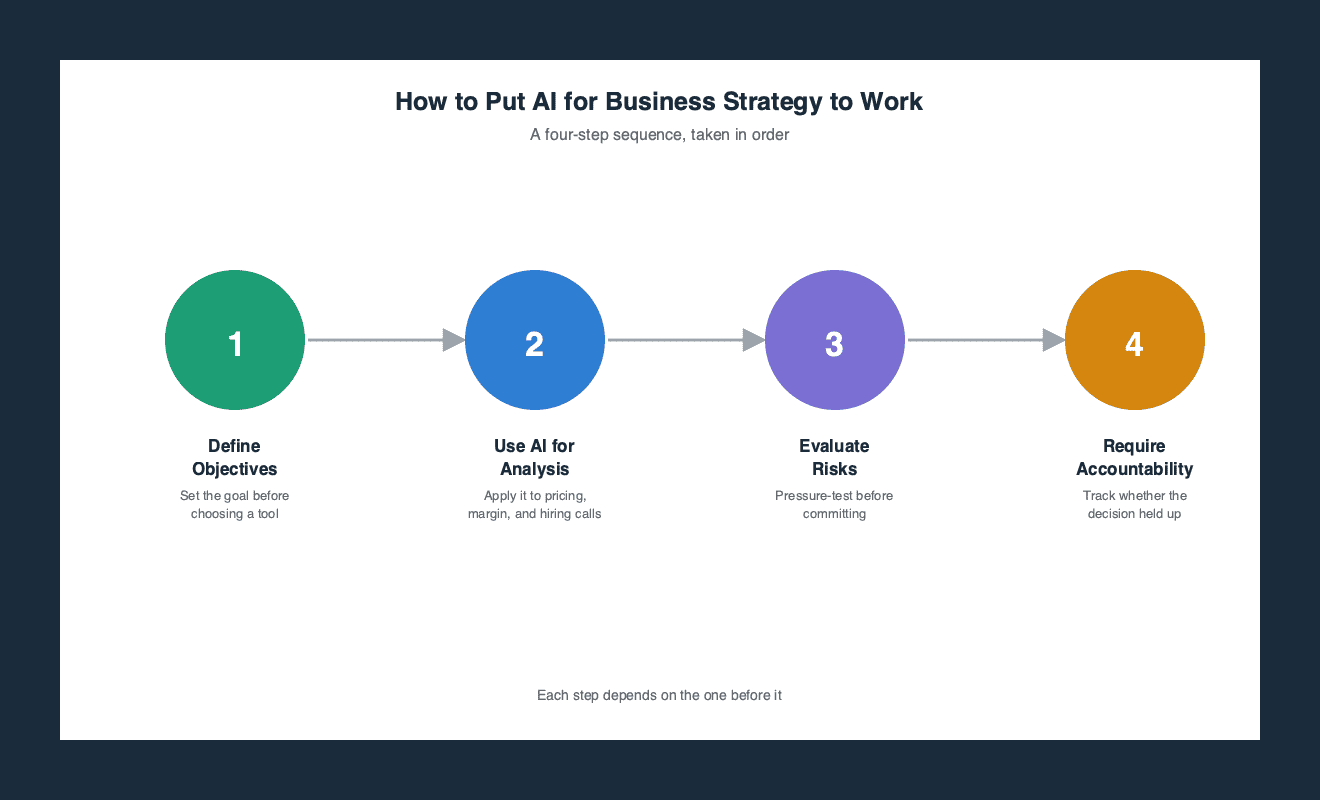
Putting these findings into practice requires a clear sequence. Start with a decision you actually face, not with the technology. The owners who get the most from AI treat it as a thinking partner on a live problem, not as a research project.
- Define the objectives first. Deloitte’s research shows that strong AI strategies begin with clear objectives pushed down to business leadership, so gaps and opportunities can be identified before tools are chosen.
- Use AI where it strengthens analysis. McKinsey’s research highlights analysis and insight generation as the areas where AI has the most potential to transform strategy work. Apply it to pricing, margin, hiring, and expansion decisions.
- Evaluate risks before committing. Harvard’s executive program is built around evaluating opportunities and risks, and that discipline belongs in every adoption decision.
- Require accountability after the decision. A tool built around something like a decision vault that remembers the decision and tracks the outcome is worth more than one that forgets the conversation the moment it ends.
That last point is where most tools fail. A generic AI assistant will produce a thoughtful answer, but it will not remember that answer next quarter. It will not know whether the pricing change worked or whether the market expansion met expectations. Therefore, the tool you choose should create a permanent record.
Econblox was built with that standard in mind. It is an AI business advisor grounded in a 400+ video library of real operating judgment built over 20 years, with video-cited reasoning outputs so the logic can be traced. The Decision Vault turns each session into a permanent, compounding strategic record. That combination closes both gaps, grounding and memory, and it is priced like software instead of a $30,000 engagement.
A 10-query free trial lets you test that standard on a real decision before committing.
Frequently Asked Questions
Here are the questions owners ask most often about using AI for business strategy.
What is AI for business strategy?
AI for business strategy means using artificial intelligence to support the analysis and reasoning behind major business decisions. Research from McKinsey shows it can strengthen and accelerate analysis and insight generation. LinkedIn Learning’s course notes that it can support marketing, operations, HR, product development, and supply chains. The goal is not to replace judgment but to give owners a faster, more grounded way to pressure-test their thinking.
Can AI replace a business consultant or advisor?
No. The programs from MIT, Harvard, and London Business School all treat AI as a toolkit for leaders, not as a substitute for strategic judgment. Generic tools answer with confidence, but they have no memory of past decisions and no way to learn from outcomes. An AI advisor that is grounded in real operating experience and tracks decisions over time can serve a similar role, but the owner stays in charge of the call.
Do I need a technical background to use AI in strategy work?
You do not need a technical background. Harvard’s AI Strategy for Business Leaders program is designed specifically for business leaders, and the course materials state that no technical background is required. The skills that matter are the ability to set clear objectives, identify where analysis is weak, and evaluate opportunities and risks. Those are owner skills, not engineering skills, and they matter more than the technology itself.
What should I look for in an AI business advisor?
The two most important qualities are grounding and memory. Grounding means the tool reasons from real operating judgment rather than general internet data, and it should cite its reasoning so you can verify the logic. Memory means it records decisions and tracks outcomes over time, so you can see whether the advice held up. A tool with both qualities compounds its value with every decision.
 No Credit Card Required For Trial