

Every business leader faces a constant stream of choices: whether to raise prices, enter a new market, hire more staff, or invest in technology. The quality of those decisions often determines whether a company grows or stalls.
Yet, applying core economic principles to daily operations is rarely a natural thought for most business owners. We are conditioned to look at accounting software, sales pipelines, and immediate cash flow. But accounting only tells you what happened; it doesn’t tell you what will happen if you alter your strategy.
Economics offers a practical, predictive lens for making better business decisions. By combining traditional microeconomic frameworks with the realities of human psychology, owners and operators can dramatically reduce costly errors, protect their profit margins, and build more resilient business strategy decisions.
Why Economics Belongs in the Boardroom
Many business owners rely heavily on intuition, past experience, or simple gut feelings when making strategic calls. Instinct might help you launch a company, but at scale, it hits a ceiling. Relying on guesswork leaves your business incredibly vulnerable to invisible cash drains, from mispriced contracts to a dangerous customer concentration risk profile that stays hidden until one account walks away.
Consider a global reality: hidden operational fees and resource friction cost small-to-medium-sized businesses an estimated $153 billion annually, according to research from Wise and the Centre for Economics and Business Research (Cebr). When a business scales between $1M and $100M, a minor 2% error in asset allocation, exactly where weak capital allocation strategies mid-market teams tend to slip, becomes a six-figure-plus mistake.
To achieve high-velocity growth, business leaders need data-driven framework support, also known as Decision Intelligence. Cloverpop’s 2024 Decision IQ Benchmark Survey found that top-performing companies make decisions twice as fast, in half as many meetings, and generate innovative solutions 75% more often than the rest. Bringing economic logic into the boardroom isn’t about academic theory, it is about execution speed and margin protection.
The Two Sides of Strategic Decision Intelligence
To consistently make better business decisions, a business leader must evaluate how their internal choices interact with external market realities. This requires balancing two distinct economic forces.
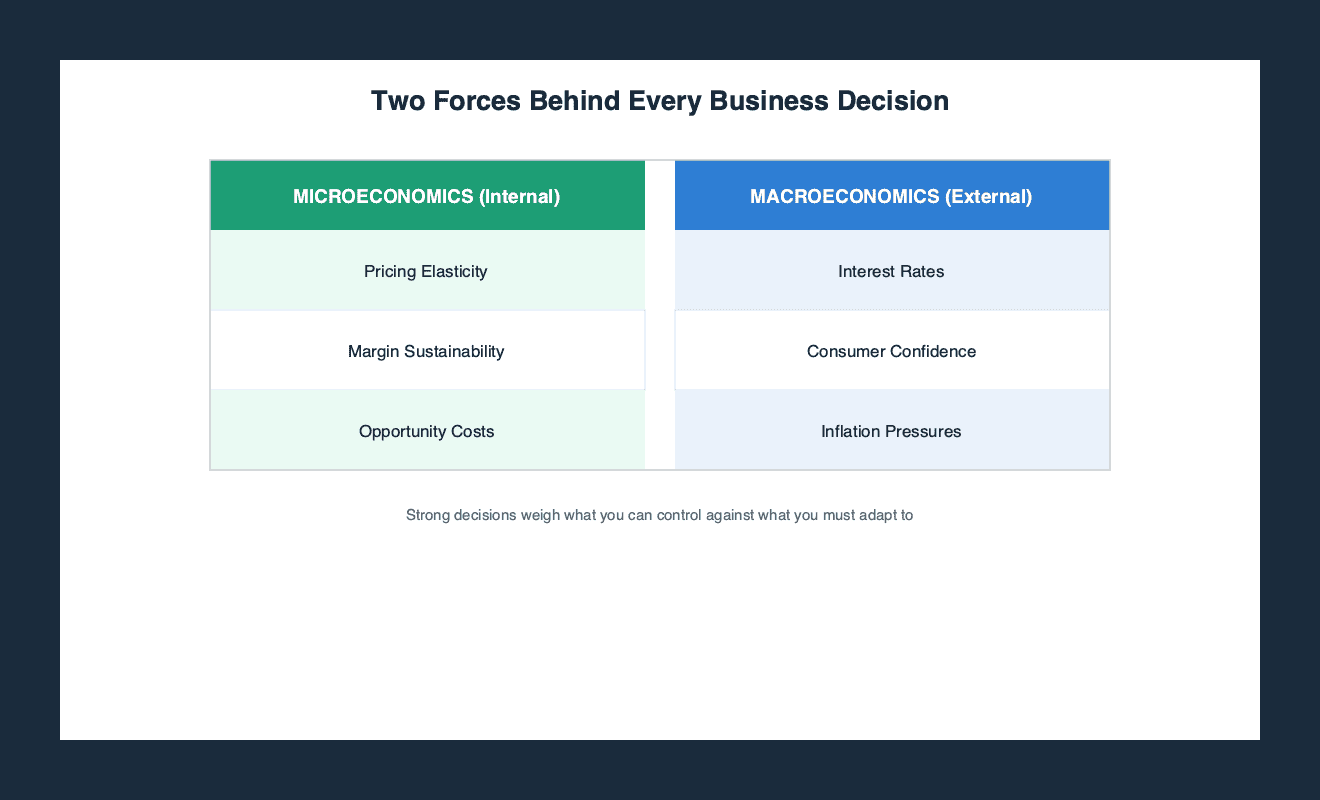
1. Microeconomic Analysis: Maximizing Internal Leverage
Microeconomics focuses on the variables you can directly influence: your cost structures, pricing power, and competitive advantages. For instance, before implementing a price increase, a business must accurately model its price elasticity of demand: how sensitive its customer base is to a change in cost. Getting this calculation right is what separates a pricing move that sticks from one that quietly erodes your base, the difference between a plan to raise prices without losing customers and one that just raises prices.
2. Macroeconomic Signals: Navigating the Market Environment
Macroeconomics covers the sweeping environmental forces you cannot control but must adapt to: inflation, interest rates, labor conditions, and overall consumer confidence. Leading indicators, such as consumer spending trends tracked by Morning Consult, act as early warning systems. A sudden dip in consumer confidence is an explicit signal to optimize inventory and protect capital before a market pullback occurs.
Behavioral Economics: Overcoming the Human Factor
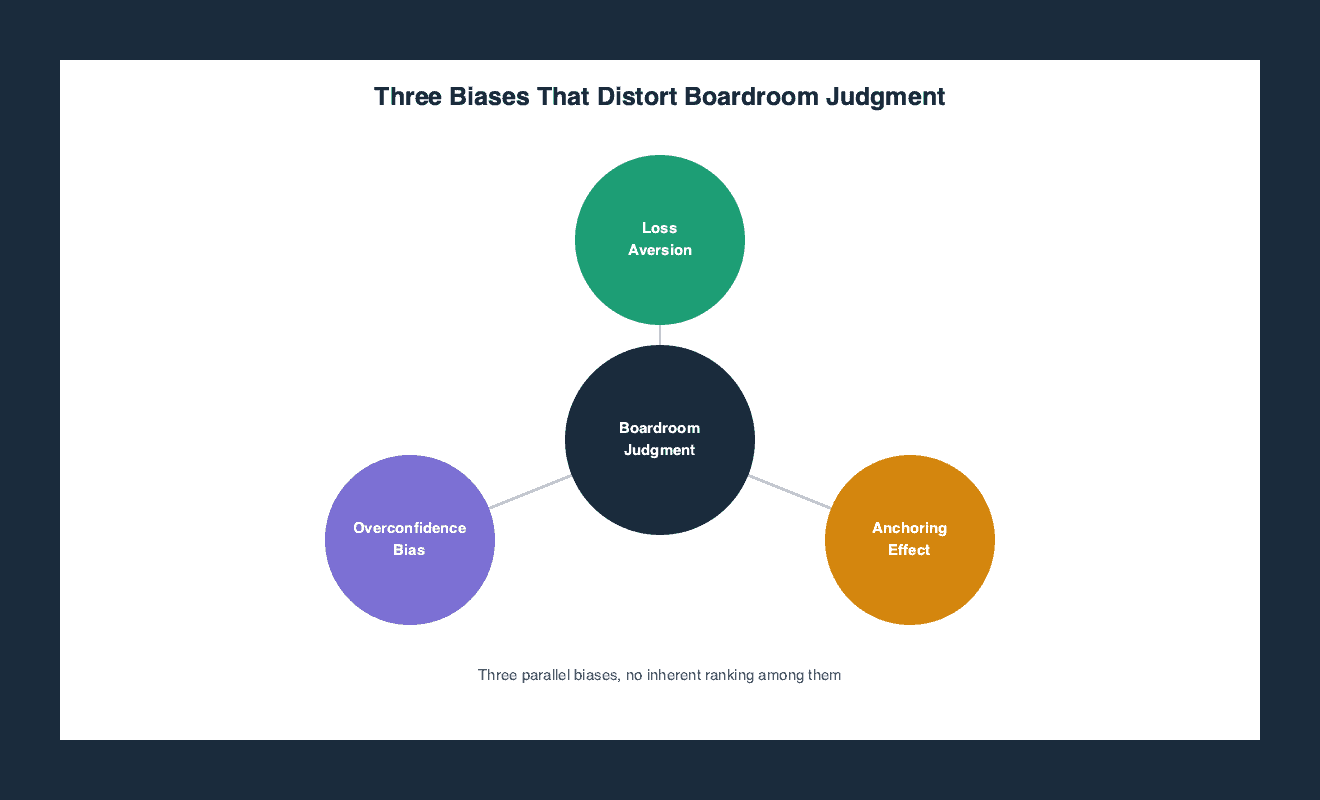
Traditional economic theories assume humans are perfectly rational actors who always make optimal financial choices. Behavioral economics proves otherwise. Both your customers and your executive team are heavily influenced by natural cognitive biases. Identifying these biases is essential to making better business decisions.
- Loss Aversion: Psychologically, people fear a financial loss far more than they value an equivalent gain. In the boardroom, loss aversion often manifests as “sunk cost fallacy,” holding onto a failing product line or an unproductive employee simply because shutting it down feels like admitting defeat.
- The Anchoring Effect: Decision-makers rely disproportionately on the first piece of information they receive. In B2B contract negotiations or product launches, the initial number introduced establishes the “anchor.” Presenting a premium tier first naturally makes your mid-tier offerings appear significantly more cost-effective.
- Overconfidence Bias: This cognitive trap leads business owners to underestimate project completion timelines and overestimate raw market demand. To neutralize overconfidence, a leader must actively counter their assumptions with cold, objective data.
Streamlining the Framework with Econblox
You do not need a PhD in economics to bring data-driven precision into your business operations. Econblox serves as your on-demand, 24/7 AI Business Advisor, translating complex academic concepts into immediate strategic wins.
Instead of relying on standard, unverified “black box” AI text generators that frequently mirror human biases, the Econblox platform relies on a proprietary knowledge base deeply rooted in fundamental economic laws.
How Econblox Powers Better Business Decisions:
- Input Your Dilemma: Describe your current high-stakes challenge, whether you are dealing with sustainable margins, competitive price wars, or expansion timing.
- Audit the Analysis via Video Citations: Econblox strips out emotional guesswork and models your problem using core frameworks like Opportunity Cost and Diminishing Returns. Crucially, every recommendation features direct video citations to professional economic content, allowing you to independently audit and verify the logic.
- Log Outcomes in the Business Decision Vault: Record your chosen path inside your permanent, searchable dashboard. Once real-world financial results materialize, you manually enter your metrics (e.g., “Revenue increased by $14,200/month”).
This systematic ledger removes trial-and-error from your management strategy, turning your historical choices into a highly organized corporate asset that adds clear value during future company valuations or business exits.
Frequently Asked Questions
How can a mid-sized business apply economic analysis without expensive consultants?
Hiring traditional corporate strategy consultants costs tens of thousands of dollars and rarely provides answers exactly when a crisis hits. Digital platforms like Econblox democratize this process, giving owners 24/7 access to an objective, economics-based AI Business Advisor at a fraction of the cost.
What is “Decision Intelligence” and why does it matter?
Decision intelligence is the practice of combining data analytics, microeconomic principles, and behavioral psychology to improve the accuracy and speed of corporate choices. In Oracle’s 2023 Decision Dilemma study, 93% of business leaders said having access to the right type of decision intelligence could make or break their organization’s long-term success.
How does the Business Decision Vault at Econblox improve judgment?
The Business Decision Vault builds a permanent strategic ledger of your company’s choices. By forcing you to align an initial strategic move with an economic framework, and later allowing you to manually input the actual bottom-line ROI, it highlights where your strategic assumptions are accurate and reveals where cognitive biases might be creeping into your boardroom.
Move From Gut Instinct to Economic Precision
Relying entirely on a founder’s intuition has a clear ceiling. True strategic scalability requires a repeatable framework that exposes hidden costs, maps consumer behavior, and tracks financial outcomes.
By filtering your daily operations through traditional microeconomics and archiving your strategic logic inside the Econblox Business Decision Vault, you protect your profit margins and build a highly defensible, asset-backed company. Once you begin thinking like an economist, the daily habit compounds: sharper pricing calls, cleaner capital allocation, and a business that holds up under real scrutiny, whether from a bank, a partner, or a future buyer.
 No Credit Card Required For Trial