

Most owners start the search for a small business advisor the same way: they open a firm’s website, see a monthly price or a “book a call” button, and have no clear picture of what is actually included. The price is visible; the engagement is not. That gap is expensive, because a business advisor service can be packaged as an hourly arrangement, a monthly retainer, a fixed-scope project, or a flat subscription, and each structure changes what the advisor is incentivized to do, what the owner pays for, and where the relationship can go wrong. The same title can describe a free hour of consulting funded by a government program or a continuous advisory relationship that never schedules a single meeting. Knowing which one you are buying is the first step.
For most of that search, the owner is doing it alone. Accountants and lawyers show up for compliance and transactions, not for the judgment calls that come before them, and a generic AI search answers with confidence but no memory of the business asking the question. But that gap is exactly what a pricing model has to account for. An hourly consultant, a retainer, a project fee, and a subscription each assume a different amount of ongoing contact, and picking the wrong one means paying for access you will not use, or going without the strategic layer you actually needed.
How Small Business Advisor Pricing Models Work
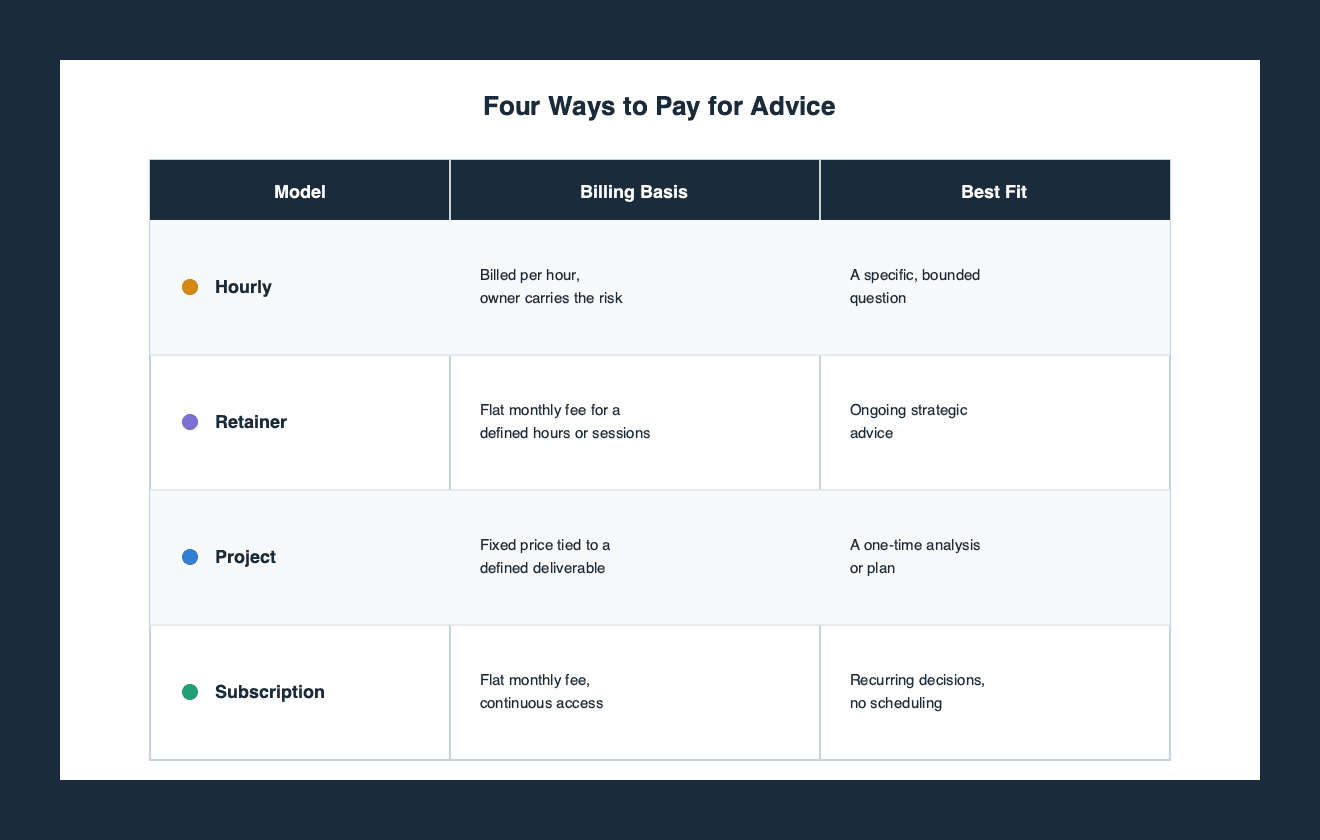
Four pricing models dominate the market. None is inherently better; each fits a different kind of decision and a different level of ongoing need.
Hourly billing is straightforward: the advisor charges for time spent, often in agreed increments. It works well for a specific question, but it creates two variables that need clarification in advance. Preparation time and travel time may or may not be billed, and the owner carries all the risk if the question turns out to be more complex than expected.
The monthly retainer is the most common structure for ongoing strategic advice. The owner pays a flat fee each month and receives a defined number of hours or sessions, ongoing access, and a predictable cost for budgeting. The value depends entirely on how clearly the scope is written, because a retainer can quietly turn into an open-ended commitment on both sides. Before signing one, it helps to know where your margin actually stands today; a two-minute Profit Gap Analysis gives a fast, numbers-based starting point without committing to an engagement.
Project or flat-fee pricing attaches a fixed price to a defined deliverable, such as a growth plan, a pricing audit, or a market entry analysis. This model is attractive because the cost is known before work starts. The tradeoff is that any change in the project’s direction can reopen the price, so the scope document becomes the most important part of the agreement.
Subscription and software-plus-advice pricing is a flat monthly fee for continuous access, with no scoped end date. The advisory service itself is the product. This model is common in newer digital advisory offerings, and it shifts the emphasis from selling blocks of time to maintaining an ongoing relationship.
Free Advising Programs and Private Firm Pricing
The market also includes publicly funded options. Small Business Development Centers offer no-charge, confidential one-on-one advising on business start-ups, loans and financing, financial statement analysis, marketing, accounting, and record keeping. California’s Small Business Support Centers similarly connect owners to no-cost one-on-one advisors and a pathway to funding.
Private firms, by contrast, price according to the goals and complexity of the client. For a breakdown of advisor types and their typical cost ranges, see our comparison of business advisor roles.
What’s Actually Included in a Service Agreement
A service agreement is where a business advisor service becomes concrete. Before signing, the owner should be able to point to the common inclusions and the common exclusions.
Common inclusions are:
- Scheduled strategy sessions
- Written recommendations and deliverables
- A defined response-time commitment
Some firms also include access to specialists across functions, since business advisory services often provide customized support across strategy, operations, and finance. An advisory and accounting team may help reduce taxes, secure bank financing, or craft solutions for problems the owner has not yet articulated.
Common exclusions are equally important:
- Implementation and execution work, which is usually outside scope
- Specialized licensing, such as legal opinions or tax filing, which is typically handled by separate professionals
- Ad hoc requests that fall outside the retainer’s defined scope, which are usually billed separately or declined
This list matters before signing, not after. Business advisory services are broad by design, and breadth is a feature until the agreement has to define it. An agreement that promises “advice as needed” means something different to the advisor than it does to the owner, and the difference shows up in the first month.
The Scope Creep Problem
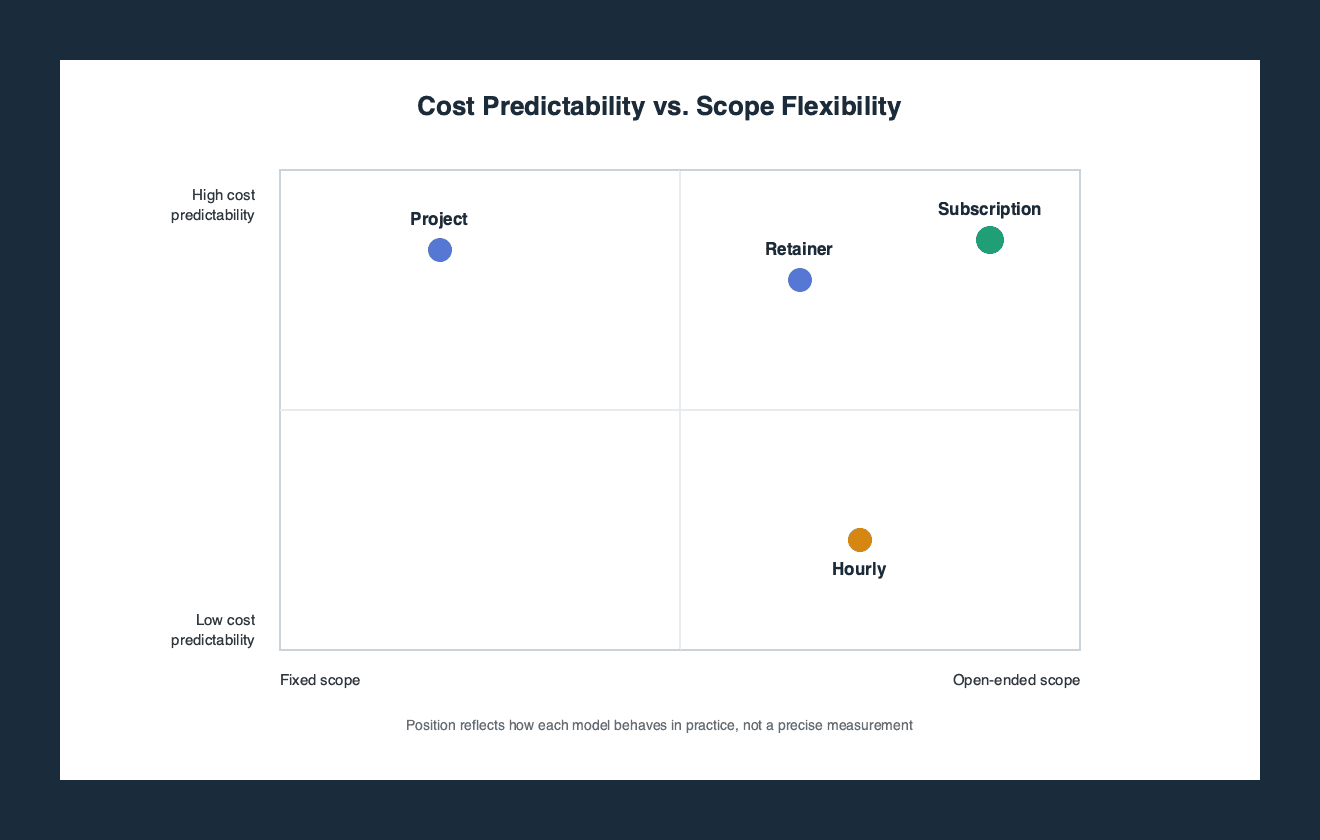
Flat-fee and subscription engagements face a predictable problem: scope creep. What starts as a defined project expands through “quick questions” that were never priced in. Each individual question seems small, and the owner reasonably assumes the advisor will absorb it. The advisor reasonably assumes the owner knows the agreement has limits. By the time the friction surfaces, the working relationship is already strained.
Hourly engagements create the opposite problem. The incentive structure rewards time, not efficiency, and the owner is left wondering whether a faster advisor would have reached the same answer in half the hours. Neither model fails because of bad intentions. Both fail because the scope was not bounded.
A service agreement with clearly bounded scope protects both sides. The owner knows what to expect and what will cost extra. The advisor can deliver good work without policing every request. That is why it is a fair question to ask a prospective advisor directly: what happens when the work expands beyond the original scope? The answer tells you more about the firm than the price on its website.
A Different Service Model: Continuous Access Instead of Scheduled Engagement
Every traditional model above ties delivery to a scheduled event: a session, a project milestone, or a billed hour. Therefore, the harder question is not which of the four models is priced best, but whether scheduled delivery is still the right constraint at all. A subscription AI business advisor removes that scheduling step entirely. The engagement does not have a start date because access starts immediately, and it does not have a defined end date because the relationship is continuous.
Econblox provides this kind of service. Subscribers get 24/7 conversational access to an AI-powered business advisor that delivers economics-based strategic analysis for established business owners. The reasoning is supported by video citations, which makes the deliverable auditable in real time rather than trusting a summary from a consultant’s deck. The Decision Vault plays the role a written deliverable would play in a traditional engagement, giving the owner a place to track decisions and their outcomes over time.
This model changes the economics of advice. Instead of paying for a block of time, the owner pays a flat monthly subscription and can consult the advisor whenever a decision comes up: pricing, hiring, market expansion, or competitive pressure.
Traditional Advisor Service vs. Subscription AI Advisor Service
The table below compares the two service structures across the factors that matter most before signing.
| Factor | Traditional human advisor service | Subscription AI advisor service (Econblox) |
|---|---|---|
| Pricing model | Hourly, monthly retainer, or project fee | Flat monthly subscription |
| Typical monthly cost | Free through taxpayer-funded SBDC programs; market rates set by private firms | Flat monthly subscription, no scoped hours |
| Access and availability | Scheduled sessions during business hours | 24/7 conversational access |
| Response time | Depends on the advisor’s calendar and the agreement | Immediate within the platform |
| Contract length | Monthly, per project, or per the terms in the agreement | Ongoing subscription, no scoped end date |
| Best fit | Owners who want a human relationship and customized support across business functions | Established owners who want continuous, on-demand strategic analysis without scheduling |
This comparison is about structure, not quality. Both models can deliver useful advice. The right choice depends on how often you need advice, how predictable your questions are, and whether immediate access changes decisions for you. A traditional advisor may be the right call for a one-time valuation, a turnaround, or a relationship-based negotiation. A subscription model fits recurring decisions where waiting for the next available appointment creates real cost.
How to Evaluate a Small Business Advisor Service Before You Sign
A few direct questions will reveal the quality of any advisory engagement. Ask what the actual deliverable is. Is it a written recommendation, a session, an audit, or ongoing access? Ask what the response-time commitment is and whether it is stated in the agreement. Ask what happens when the scope changes mid-engagement, and get the answer in writing.
Ask who actually does the work. Some firms assign the engagement to the person you met; others delegate it to a team. The market includes individual expert advisors, multidisciplinary firms, and support-network matching services. Ask about confidentiality, since public programs like SBDC advertise 100 percent confidential advising, and private firms should match that standard. Ask whether a trial or smaller first engagement is available. Econblox offers a 10-query free trial for this reason, with no credit card required; a confident advisor should be willing to demonstrate value before a long commitment.
The best time to evaluate a business advisor service is before you sign, not after the first invoice. A clear agreement recognizes that business advice takes the shape of the engagement, and the engagement is the one thing you can control.
Frequently Asked Questions
These answers cover the questions owners ask most when comparing advisory engagements.
What does a business advisor service include?
Most business advisor services include scheduled strategy sessions, written recommendations, and a defined response-time commitment. Exclusions vary but often cover implementation work, specialized licensing such as legal opinions or tax filing, and ad hoc requests outside the agreed scope. Because advisory services can cover strategy, operations, and finance, the agreement should state both inclusions and exclusions clearly before you sign.
Are free small business advisor services available?
Yes, publicly funded programs offer free advising. Small Business Development Centers provide no-charge, confidential one-on-one advising on business start-ups, loans and financing, financial statement analysis, marketing, accounting, and record keeping. California’s Small Business Support Centers also connect owners to no-cost one-on-one advisors and a pathway to funding.
Is a subscription AI business advisor a real alternative to a human advisor?
It depends on the engagement you need. A subscription AI advisor provides continuous, on-demand analysis at a flat monthly fee, with auditable reasoning and no scheduling. That suits owners who need frequent strategic input and want predictable cost. Owners who prefer a human relationship, or who need specialized implementation work, may still benefit from a traditional advisor.
What should I ask before signing a business advisor agreement?
Ask what the deliverable is, what the response-time commitment is, and what happens when scope changes. Confirm whether implementation is included, whether specialized licensing is excluded, and who actually performs the work. Ask about confidentiality and whether a trial or smaller first engagement is available. A clear answer on scope protects both sides.
 No Credit Card Required For Trial