

Every business owner eventually needs outside help from an advisor for business, but almost none of them are taught which kind. A founder might pay a corporate attorney’s hourly rate to answer a question a bookkeeper could handle, or let a pricing decision sit for weeks waiting for a consultant’s calendar to open up. Ten distinct types of advisor for business exist, from tax and legal counsel to M&A specialists and AI-powered tools, and each one is built for a different kind of decision. Therefore, picking the wrong advisor, or the right one at the wrong moment, is one of the more expensive mistakes an owner can make without ever seeing a bill for what it actually cost.
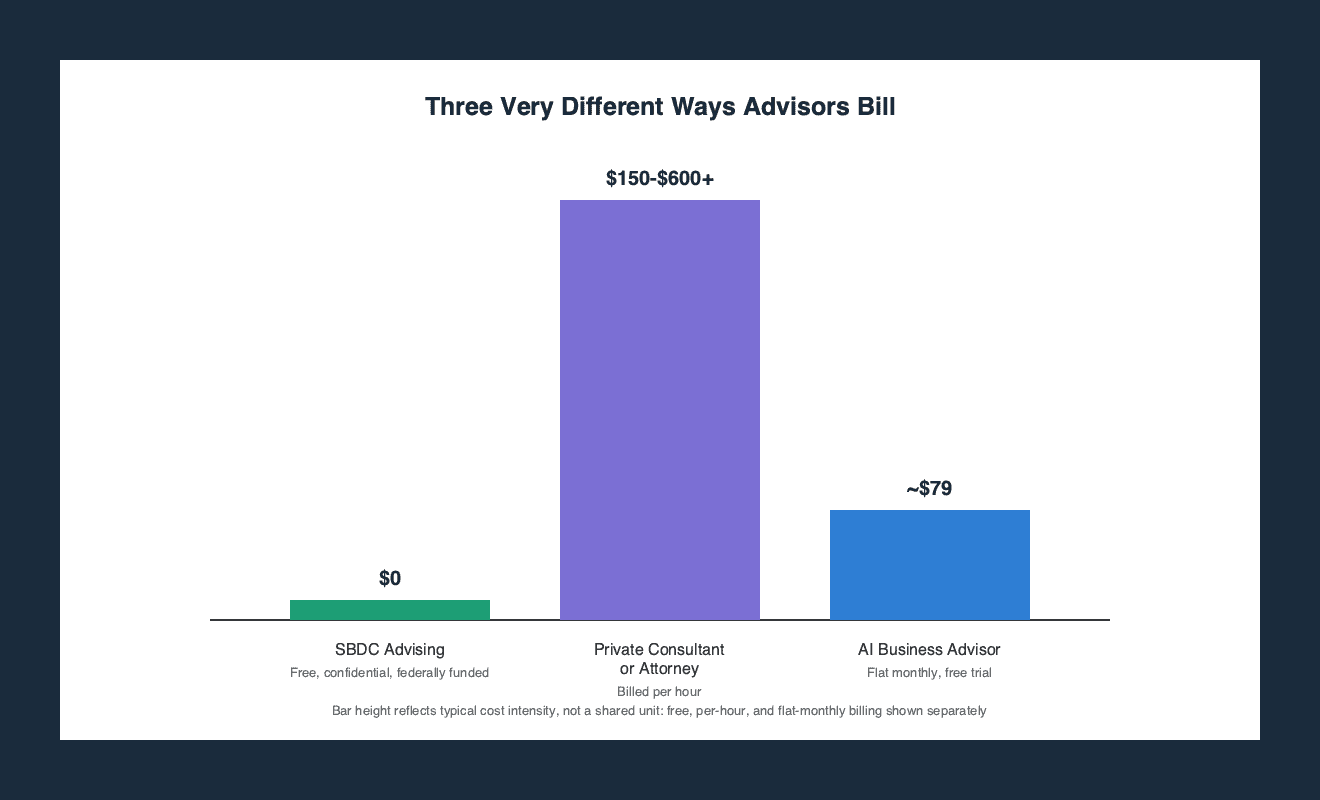
Because a company’s operational and financial needs shift as it moves through different growth phases, most founders and owners work with multiple advisory specialists over time. The exact combination depends heavily on your current business stage, existing management capabilities, and immediate strategic objectives. High-caliber advice is also accessible across every budget level, ranging from federally funded resources like Small Business Development Centers (SBDC), which offer zero-cost and strictly confidential one-on-one consulting, to elite specialized advisory firms and continuous, on-demand AI tools.
To help you navigate this landscape, this guide breaks down the 10 essential types of advisors every owner should know, how they drive measurable ROI, and how to combine human expertise with modern AI systems to make better business decisions with economics.
The 10 Essential Types of Advisors for Business
1. Strategic Business Advisors
Strategic business advisors operate at the macro level of corporate governance and direction. Rather than troubleshooting daily administrative tasks, a strategic advisor focuses on multi-year trajectory, market expansion, competitive positioning, and revenue model design. They challenge executive assumptions, evaluate emerging market opportunities, and help refine business plans before substantial capital is committed.
Many organizations access strategic support through executive peer networks, advisory boards, or structured growth programs that match founders with seasoned operators. Integrating economic frameworks into this process ensures that strategic pivots are grounded in rigorous analysis rather than intuition. By combining high-level human counsel with tools for AI business strategy decisions, executive teams can model complex market scenarios and validate strategic growth pathways with higher precision.
2. Accountants and CPAs
Certified Public Accountants (CPAs) and tax advisors maintain the fundamental financial integrity of an enterprise. Their primary mandate spans historical financial accounting, tax compliance, cash flow auditing, and balance sheet optimization. Without rigorous CPA oversight, even highly profitable businesses risk crippling tax liabilities, regulatory audits, and unexpected liquidity shortfalls.
Beyond tax compliance, a CPA’s financial statements serve as the primary source of truth for every other professional advisor. Lenders, venture capitalists, and private equity buyers inspect CPA-audited balance sheets before extending credit or executing buyouts. When expanding or managing cash flow, integrating your CPA’s reporting with sound working capital management practices ensures operational stability during rapid growth.
3. Corporate Attorneys and Business Lawyers
Corporate attorneys protect the legal structure, assets, and liability exposure of the enterprise. Their legal scope covers foundational corporate governance, operating agreements, customer and vendor contracts, intellectual property protection, employment law compliance, and dispute resolution.
A proactive business lawyer acts as a defensive shield, reviewing commercial agreements before execution rather than litigating breach-of-contract claims after damage has occurred. As companies scale and enter new jurisdictions, their regulatory risk profile increases significantly. Having dedicated legal counsel ensures that customer terms, vendor agreements, and partner contracts remain legally enforceable while safeguarding proprietary assets.
4. Operations Consultants
Operations consultants specialize in internal execution, workflow efficiency, and process optimization. Strategic advisors define where the company should go, but operations consultants focus on how to execute that vision with minimal friction and maximum margin performance.
Typically engaged to solve specific operational bottlenecks, quality control issues, or supply chain disruptions, operations consultants perform deep diagnostics on daily workflows. They establish clear Key Performance Indicators (KPIs), redesign inefficient processes, and remove operational redundancies. For growing enterprises vulnerable to the growth trap of scaling too fast, operations advisors provide the structure necessary to scale capacity without degrading unit economics.
5. Financial Advisors and Wealth Managers
Financial advisors bridge the gap between corporate balance sheets and personal wealth creation. They assist business owners with capital structure management, commercial debt structuring, investment portfolio management, and long-term exit planning.
For many small-market and mid-market company owners, the business represents their primary illiquid asset. A specialized business financial advisor evaluates reinvestment returns against external yield opportunities, designs tax-advantaged profit distribution strategies, and ensures the owner builds independent wealth outside the enterprise. They also work closely with legal and tax teams to prepare the business for seamless generational transfers or private equity buyouts.
6. Marketing and Sales Advisors
Marketing and sales advisors focus directly on top-line growth and commercial execution. They analyze customer acquisition costs (CAC), lifetime customer value (LTV), pricing mechanics, positioning, and sales pipeline conversion rates.
These advisors help companies define their ideal customer profile, refine value propositions, and implement scalable go-to-market strategies. Slight refinements in pricing strategy, channel selection, or sales messaging can generate exponential revenue increases without proportional increases in ad spend. For companies seeking to enhance their pricing power, marketing advisors provide the competitive intelligence required to capture higher margins.
7. Commercial Insurance Brokers
Commercial insurance brokers specialize in risk transfer and corporate indemnification. They evaluate operational liabilities, property risks, cyber threats, and workforce coverage needs, matching those risks with tailored commercial insurance policies across multiple carriers.
Because risk profiles change constantly when companies add headcount, purchase machinery, or launch new product lines, an insurance broker conducts annual risk audits. Proper coverage guarantees that unexpected events, such as property damage, product liability claims, or data breaches, do not result in catastrophic financial loss or bankruptcy.
8. Merger and Acquisition (M&A) Advisors
M&A advisors and investment bankers guide business owners through buying, merging, or selling commercial enterprises. They handle company valuations, confidential pitch memorandums, buyer identification, deal structuring, and purchase agreement negotiations.
Executing a successful acquisition or exit often requires managing a complex transaction involving CPAs, corporate attorneys, and private equity groups. An M&A advisor leads this process, ensuring that the business achieves maximum valuation metrics. Even for owners who are years away from an exit, understanding how buyers calculate enterprise multiples and applying a business valuation framework helps align current decisions with future valuation milestones.
Even for owners years away from an exit, learning how buyers calculate enterprise multiples helps align today’s decisions with tomorrow’s business valuation milestones.
9. Capital Access and Grant Advisors
Capital access advisors specialize in securing debt, equity, and non-dilutive grant funding for growing enterprises. Public sector programs, SBA lenders, commercial banks, and regional economic development grants all carry distinct application procedures and underwriting guidelines.
These advisors help owners prepare audit-ready financial packages, improve credit positioning, and identify federal, state, or private funding opportunities. Additionally, they assist small businesses in navigating government procurement programs, opening up lucrative public sector contracting opportunities that serve as reliable long-term revenue streams.
10. AI Business Advisors
An emerging essential category for modern business leaders is the AI-powered advisor. But most generic AI tools have no memory of what was decided last quarter and no grounding in real operating experience, so owners get a confident answer with no way to check whether it held up. Platforms like Econblox close that gap by functioning as a continuous, on-demand AI business advisor, providing instant, economics-backed strategic analysis for critical business decisions.
Rather than replacing human attorneys or CPAs, AI business advisors complement traditional professionals by providing 24/7 analytical reasoning for routine decisions. Through features like the Business Decision Vault, owners can log strategic calls, track reasoning, and evaluate the long-term return on investment (ROI) of past decisions. Therefore, this hybrid approach allows executive teams to resolve strategic questions instantly while reserving high-cost human advisory hours for complex execution.
Strategic Framework: Selecting the Right Advisor for Your Stage
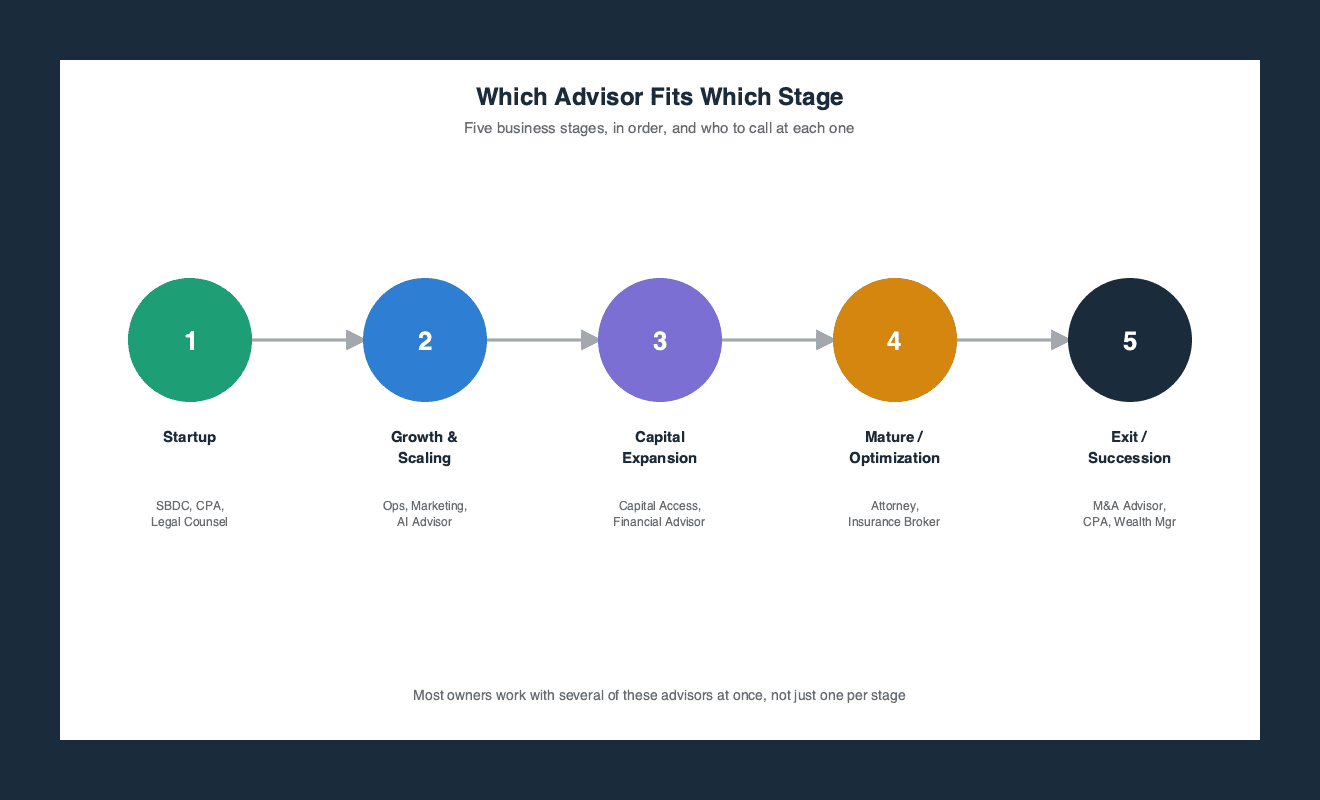
Engaging the right advisor at the wrong time can lead to misallocated capital and fragmented strategy. The decision matrix below outlines which advisory roles align best with specific business stages and operational objectives.
| Business Stage | Primary Advisory Need | Recommended Advisor Type | Core Value Delivered |
|---|---|---|---|
| Startup / Early Stage | Entity setup, financial baselines, and feasibility | SBDC Advisors, CPA, Legal Counsel | Risk mitigation, tax compliance, and business model validation. |
| Growth & Scaling | Process bottlenecks, cash flow, and team structure | Operations Consultant, Sales/Marketing Advisor, AI Advisor | Capacity expansion, margin protection, and high-frequency analytical support. |
| Capital Expansion | Debt/equity financing, grants, and capital allocation | Capital Access Advisor, Financial Advisor | Optimized capital structure, audit preparation, and non-dilutive funding. |
| Mature / Optimization | Risk management, IP protection, and governance | Corporate Attorney, Insurance Broker, Strategic Advisor | Asset defense, liability reduction, and long-term competitive positioning. |
| Exit / Succession | Valuation optimization, deal structuring, and wealth transfer | M&A Advisor, CPA, Wealth Manager | Maximizing transaction value, tax-efficient distributions, and deal execution. |
How to Maximize the Return on Investment from Business Advisors
Working with an expert advisor for business is an investment that should deliver clear operational or financial returns. But hiring the right specialist is not enough on its own. To maximize the value of your advisory engagements, implement these four proven best practices.
- Define Clear Objectives and Metrics: Before engaging any advisor, establish what success looks like. Whether it is reducing tax liability, improving sales pipeline conversion, or securing working capital, clear goals keep engagements focused.
- Maintain Transparent Data and Records: Advisors can only deliver sound recommendations when provided with accurate operational and financial data. Ensure your accounting records, legal contracts, and sales figures are up to date before consultations.
- Combine High-Frequency AI with High-Touch Human Guidance: Use an on-demand AI business advisor to conduct initial market research, model scenario economics, and log decision rationale. Evaluate the AI outputs and decide. In many case you will review with your management team. In some cases, you might decide to review your structured insights with your CPA, attorney, or any of the advisors for business listed above.
- Track Decision ROI Over Time: Regularly audit the decisions made under advisor guidance. Systematic tools like a Decision Vault let leadership teams evaluate which advisory recommendations yielded positive outcomes and adjust future engagements accordingly.
None of this requires replacing your CPA or your attorney. It just means no strategic question has to sit unanswered between billable hours, which is exactly the gap the Econblox Business Advisor Hub and its free trial are built to close.
Frequently Asked Questions
What does an advisor for business do?
An advisor for business provides strategic, financial, or operational expertise to help company leaders solve complex problems, improve efficiency, and make data-backed decisions. Their contributions range from tax strategy and risk management to growth modeling, marketing optimization, and executive decision support.
How much does it cost to hire a business advisor?
Costs vary significantly depending on the advisor’s specialization and business model. Public resources such as Small Business Development Centers (SBDC) provide confidential one-on-one advising at zero cost because they are federally funded. Private consultants and attorneys typically charge hourly rates in the $150 to $1,000-plus range depending on experience and location. AI business advisors like Econblox offer continuous strategic analysis through an inexpensive subscription model with a free trial, rather than hourly billing.
Is hiring a business advisor worth the investment?
Yes. When chosen strategically, an expert advisor prevents costly mistakes in tax compliance, legal contracts, capital allocation, and risk management. The return on investment often manifests as higher profit margins, faster execution, reduced liability, and increased enterprise valuation upon exit.
Are business advising discussions confidential?
Yes. Professional advisors operate under non-disclosure agreements (NDAs) and professional ethical standards that strictly protect client data. Government-funded programs like the SBDC are bound by federal confidentiality mandates, ensuring that your financial records and strategic plans remain confidential.
 No Credit Card Required For Trial