

Business Valuation & Exit Series
For many business owners, the company they built is deeply personal. The founder makes the key decisions, closes the biggest deals, and maintains the most important client relationships. That hands-on approach can build a profitable enterprise, but it also creates a serious problem when the time comes to sell. Owner dependency is one of the biggest hidden risks in business valuation, and it can dramatically reduce what a buyer is willing to pay.
Research from Strategic Exit Advisors shows that founder-dependent businesses often receive valuations 30 to 50 percent below market comparables. That discount is not arbitrary. It reflects the real risk a buyer assumes when the business stops working once the owner leaves. Understanding this silent killer of value is the first step toward protecting the wealth you have built, as it highlights the premier factors buyers discount purchase price against during an acquisition process.
How Owner Dependency Affects Business Valuation
Owner dependency means that the business relies on the owner for core operations, sales, client relationships, or key decisions. When the owner is the primary salesperson, the main decision-maker, and the person who holds client relationships, the company may be profitable but not highly transferable. That lack of transferability directly harms valuation because buyers see a risky asset that could decline in value after the owner departs.
Business valuation experts widely agree that reducing a business’s dependence on its owner increases both value and marketability. The opposite is also true. High owner dependency leads to lower multiples and smaller final sale prices, often forcing owners to accept offers far below what they believe the business is worth.
Valuation Multiples: A Clear Divide
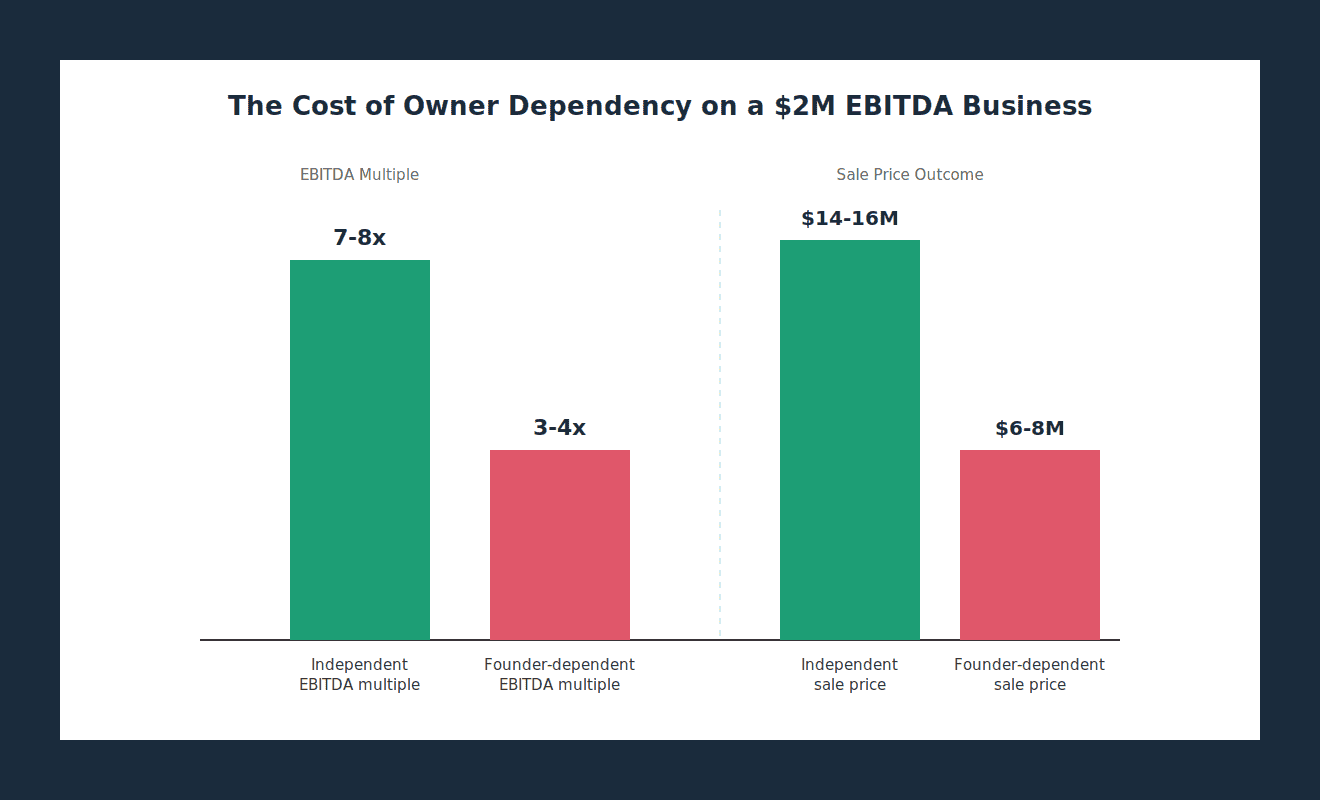
The difference in valuation multiples between independent and founder-dependent companies is stark. According to Strategic Exit Advisors, independent lower middle market businesses sell for 7 to 8 times EBITDA. In contrast, founder-dependent companies in the same market segment struggle to achieve multiples of 3 to 4 times EBITDA. That gap represents a loss of 40 to 50 percent of potential enterprise value.
For a business earning $2 million in EBITDA, the difference is enormous. An independent operator could sell for $14 million to $16 million. A founder-dependent version of that same business might fetch only $6 million to $8 million. The owner’s central role can cost millions of dollars in sale proceeds.
The Grim Success Rate for Selling
The impact of owner dependency extends beyond price. It also affects whether a sale happens at all. The Exit Planning Institute reports that only 20 to 30 percent of businesses that go to market actually sell. Many businesses fail to reach a closing table because buyers identify too much risk, and owner dependency is often at the top of that list.
A business that cannot operate without the founder is a business most buyers will walk away from. Those who do stay in negotiations will demand steep discounts or earn-out structures that transfer much of the post-sale risk back to the seller. Understanding this dynamic helps owners see why reducing dependence is not optional if a successful exit is the goal.
Why Buyers Penalize Owner-Dependent Businesses
Buyers do not purchase past performance. They purchase future cash flow. When a business is dependent on its owner, future cash flow becomes uncertain. The buyer must either pay the owner to stay on after the sale (often at a high consulting fee) or accept that revenue and profit may drop significantly once the founder leaves. Either outcome reduces the value of the deal.
Owner dependency also concentrates risk. If the owner gets sick, takes a vacation, or simply loses motivation, the business can suffer immediately. A buyer sees this and adjusts their offer downward. Some buyers refuse to consider such businesses at any price because of the unpredictability.
Concentration of Key Relationships and Decisions
A common pattern in owner-dependent businesses is that the founder controls the largest client relationships. If those clients have a personal bond with the owner, they may leave after the sale. The buyer cannot assume those relationships will transfer. Similarly, when the owner is the sole strategic decision-maker, there is no management team capable of running the company without direction. That gap is expensive to fill. An owner acting as both primary salesperson and sole holder of key client relationships creates a business that may be profitable but not highly transferable. That combination is precisely what valuation discount calculators penalize most heavily.
Reducing Owner Dependency to Increase Valuation
The good news is that owner dependency is not a permanent condition. With deliberate effort, owners can reduce their role and build a company that functions without them. Every step taken toward independence adds value to the business and improves the odds of a successful sale.
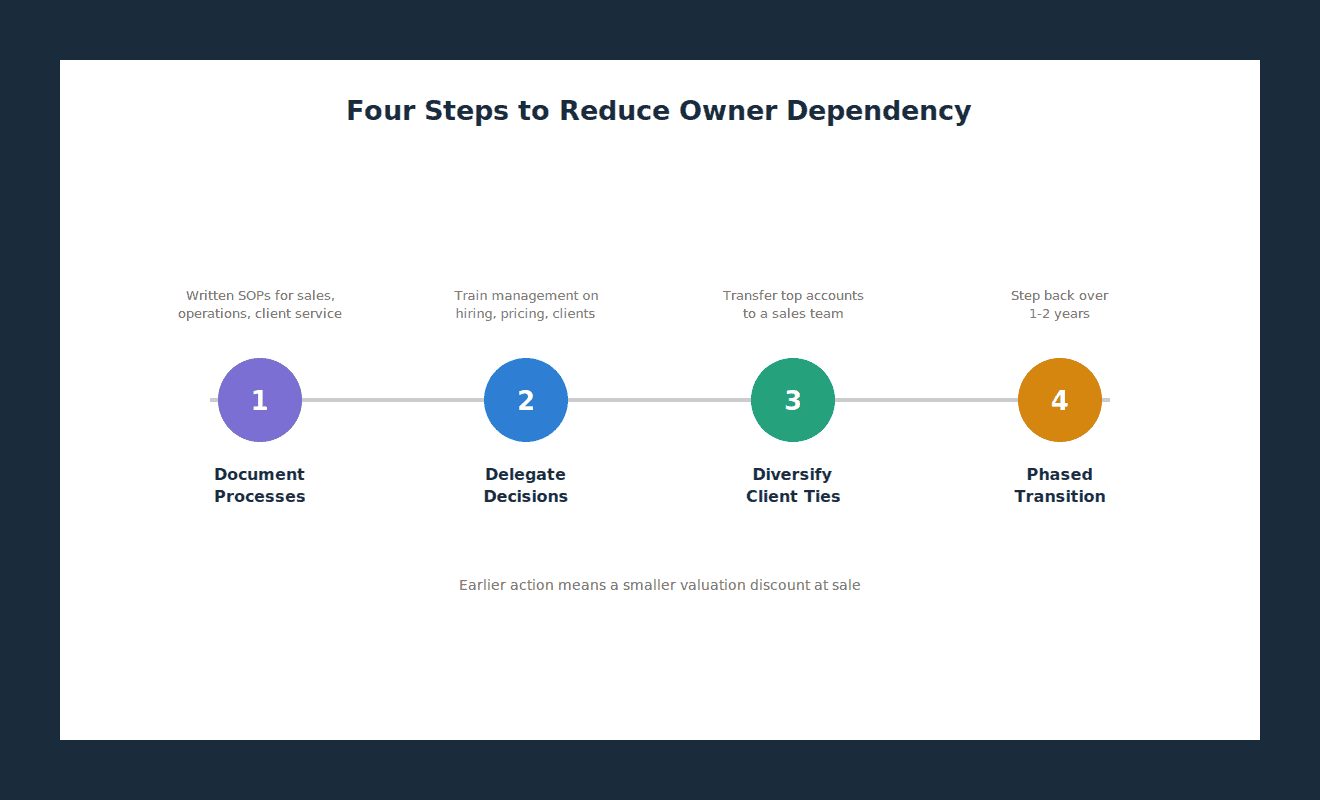
Start by documenting processes. When critical knowledge exists only in the owner’s head, it cannot be transferred to a buyer or a new manager. Written standard operating procedures for sales, operations, and client service give a buyer confidence that the business can run on its own. Next, delegate decision-making authority. Train a management team to handle hiring, pricing, and client communications without the owner’s sign-off on every detail. Implementing proven capital allocation strategies mid-market companies use also ensures your team can manage investments without depending on your personal judgment.
Another key step is to diversify client relationships. If the owner personally manages the top three accounts, those relationships need to be transferred to a sales team or account managers over time. Buyers want to see that revenue is attached to the company, not to the founder’s phone number.
Finally, consider a phased transition. Some owners gradually step back over one to two years while a buyer or internal team takes over. That can demonstrate to an appraiser or potential buyer that the business can sustain its performance without the founder. The earlier these steps begin, the smaller the valuation discount will be when a sale is initiated. Because reducing this vulnerability takes years, it belongs at the top of your exit prep checklist business owners timeline.
The Role of Professional Guidance
Reducing owner dependency requires honest self-assessment and often outside perspective. Business advisors, valuation professionals, and peer networks can help identify the most critical dependencies. Tools like Econblox’s AI-powered business advisor can provide unbiased economic analysis to help owners evaluate which changes will have the biggest impact on transferable value. You can begin offloading key analysis by incorporating AI business strategy decisions into your workflow. Because owner dependency is a financial risk, addressing it with data-driven decisions yields the best results.
Reducing reliance on a single owner is one of the most effective ways to boost company value. Owner-dependent businesses frequently face significant valuation discounts, sometimes 20 to 50 percent, because buyers see higher risks. The pattern is clear, but there are solutions for any owner willing to invest in building a self-sustaining operation.
Frequently Asked Questions
What is owner dependency in a business?
Owner dependency occurs when a business relies heavily on its founder for daily operations, sales, major decisions, or key client relationships. The company cannot function at the same level without the owner present. This dependency lowers the business’s transferability and reduces its valuation because buyers see the owner’s involvement as a risk to future cash flow.
How much does owner dependency reduce business valuation?
According to Strategic Exit Advisors, founder-dependent businesses often receive valuations 30 to 50 percent below market comparables. In terms of EBITDA multiples, independent lower middle market companies sell for 7 to 8 times EBITDA, while founder-dependent companies struggle to achieve multiples of 3 to 4 times EBITDA. The exact discount varies by industry and the severity of dependence.
Can owner dependency be fixed before a sale?
Yes, owner dependency can be reduced with deliberate effort. Documenting processes, delegating decisions, diversifying client relationships, and training a management team are effective steps. Starting early is important because buyers and appraisers want to see a proven track record of independent operation. A phased transition over one to two years can demonstrate the business’s ability to run without the founder.
Why do buyers penalize owner-dependent businesses so heavily?
Buyers pay for future cash flow, not past success. When the owner is essential, that future cash flow is uncertain. The buyer must either pay the owner to stay after the sale or accept the risk that revenue will drop. Either way, the value of the deal is reduced. Some buyers avoid these businesses entirely, which is part of why the Exit Planning Institute puts the overall success rate for selling a small business at only 20 to 30 percent.
Owner dependency is a silent killer of business value, but it does not have to be a permanent one. By recognizing the risks and taking systematic steps to build a self-sufficient company, owners can protect the wealth they have created and position their business for a successful, high-value exit.
 No Credit Card Required For Trial