

Expanding a business feels like proof of success. Revenue climbs, customers multiply, and new locations open. Yet beneath that surface, many companies quietly enter a condition called the growth trap. The growth trap occurs when a business fails to produce returns proportional to its increasing size and resources. Instead of becoming more efficient, the organization becomes more complex, costs rise faster than revenue, and the very energy that fuelled expansion begins to drain the company. Understanding this trap is essential for any owner who wants to build a sustainable enterprise rather than one that collapses under its own weight.
What Is the Growth Trap?
The Growth Trap is a broad, long-standing economic and business concept: you are stuck in the Growth Trap when you cannot fully leverage your organization to generate the results you want. Growth sucks cash. Revenue may increase, but costs rise at the same time, so profitability starts to drop. Survival depends on mastering working capital management mid-market metrics before deploying expansion cash, ensuring cash flow keeps pace with new operational demands. The organization becomes increasingly complex due to its own growth, and that complexity creates friction that slows decision-making and drains energy.
This trap does not announce itself with a single dramatic failure. It creeps in as progress and success create new demands that the existing structure was not built to meet. The more the business grows, the harder it becomes to coordinate, communicate, and execute. Owners find themselves working longer hours for thinner margins, wondering why their bigger company feels harder to run than their smaller one did.
Root Causes of the Growth Trap
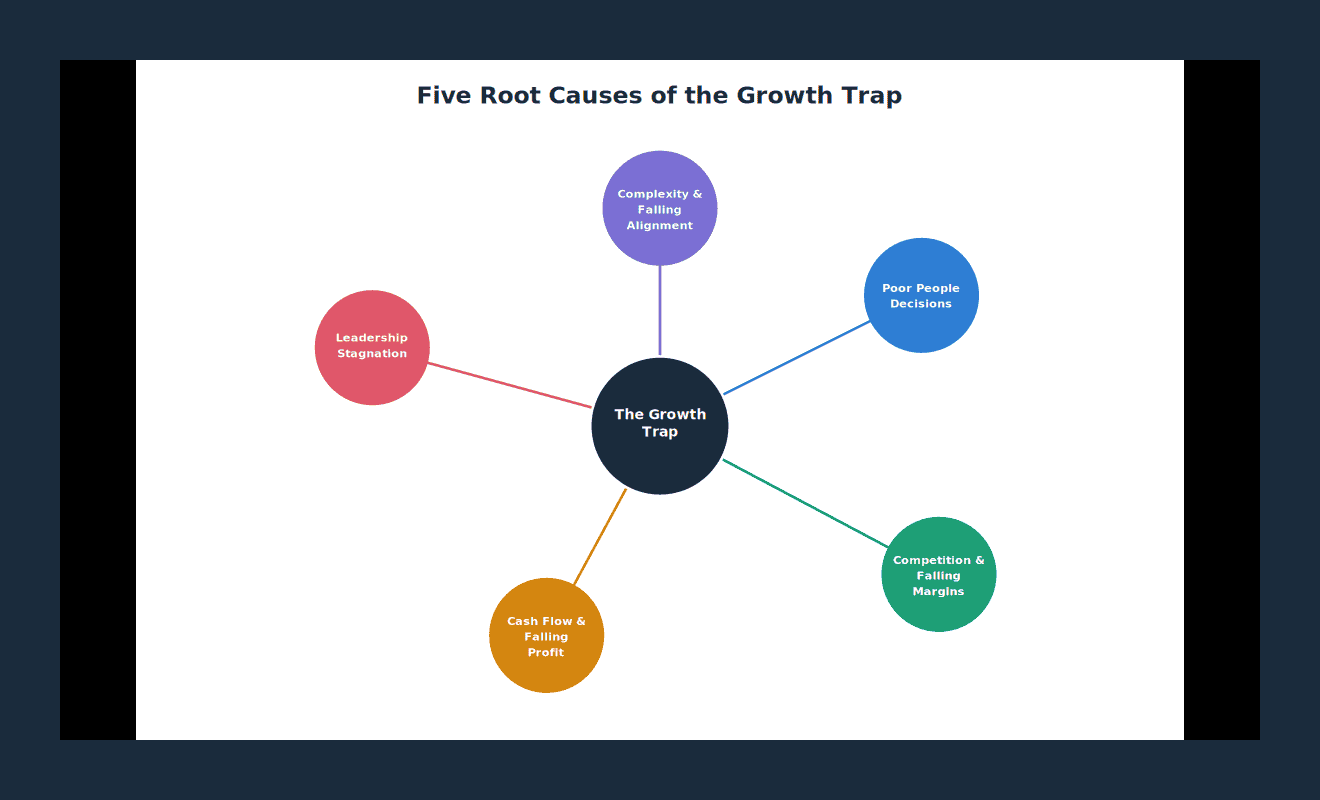
One Growth Trap framework identifies six possible underlying causes. They do not appear in isolation; they usually reinforce one another:
- Increasing Complexity: More customers, products, locations, and employees add layers of coordination that strain simple systems.
- Decreasing Alignment: As the team grows, people lose sight of common goals. Efforts become fragmented.
- Poor People Decisions: In a hurry to fill roles, owners hire the wrong people or promote beyond competence.
- Increasing Competition: Success attracts rivals, and the business may not have the resources to defend its position.
- Decreasing Margins: Costs from new hires, systems, and facilities eat into profit despite rising revenue, a dynamic covered in more depth in our look at margin erosion causes.
- Cash Flow Pressure: Fast growth demands upfront spending on inventory, payroll, and equipment before revenue catches up. Without strict budget guardrails, expanding companies quickly fall victim to the overspending trap scaling business lifecycle.
- Leadership Stagnation: Founders and managers fail to adapt their skills to a larger, more complex organization.
These root causes show that the growth trap is not simply a matter of growing too quickly in revenue. It is a systemic failure of structure, people, and strategy to keep pace with size.
Common Signs Your Business May Be in the Growth Trap
Recognizing the growth trap early gives owners a chance to correct course before damage becomes severe. Several indicators signal that the trap has already closed:
- Cycles of Progress and Setbacks: The business makes headway on a project or product launch, only to stumble on operational basics that had been handled easily before.
- Too Many Competing Priorities: Every department seems to be pulling in a different direction, and no one can agree on what matters most.
- Gaps Between Knowledge and Execution: The leadership team knows what needs to be done, but the organization cannot turn that knowledge into consistent action.
- Vanity Growth Versus Reality: Revenue and customer counts look impressive, but deeper metrics tell a different story. For instance, scaling operations on top of a single massive account exposes the enterprise to lethal customer concentration risk if that buyer leaves.
When these signs appear together, the business is likely running on momentum rather than on a sustainable engine. The owner may feel like they are constantly putting out fires, yet never making lasting progress.
Growth Versus Scaling
A central distinction in escaping the growth trap is the difference between growth and scaling. These terms are often used interchangeably, but they describe fundamentally different outcomes:
| Dimension | Growth | Scaling |
|---|---|---|
| Definition | Everything gets bigger: more customers, revenue, and people. | Revenue increases without a corresponding rise in resources. |
| Resource use | Inputs grow in proportion to outputs. | Outputs grow faster than inputs. |
| Profitability | Often declines or stays flat as costs mount. | Margins improve as fixed costs are spread over larger revenue. |
| Operational complexity | Increases quickly; systems become strained. | Managed or reduced through efficiency and automation. |
Most businesses that fall into the growth trap are stuck in a growth mindset. They equate expansion with success, so they add people, locations, and products without first ensuring that their core operations can handle the load. Scaling, by contrast, requires deliberate investment in systems, processes, and technology that allow revenue to grow while keeping costs flat or only slightly higher. A business that learns to scale can keep the benefits of expansion without the crushing overhead, protecting its underlying business valuation for owners in the process.
How the Trap Affects Businesses of Different Sizes
The growth trap does not only strike young startups. It affects a wide range of established companies. Some founder-led businesses become trapped with revenues of $2 million and 12 to 15 staff, while others feel the squeeze only after they have built a management team and revenues are approaching $100 million. The common thread is that growth outpaces the organization’s capacity to manage it, regardless of currency or country.
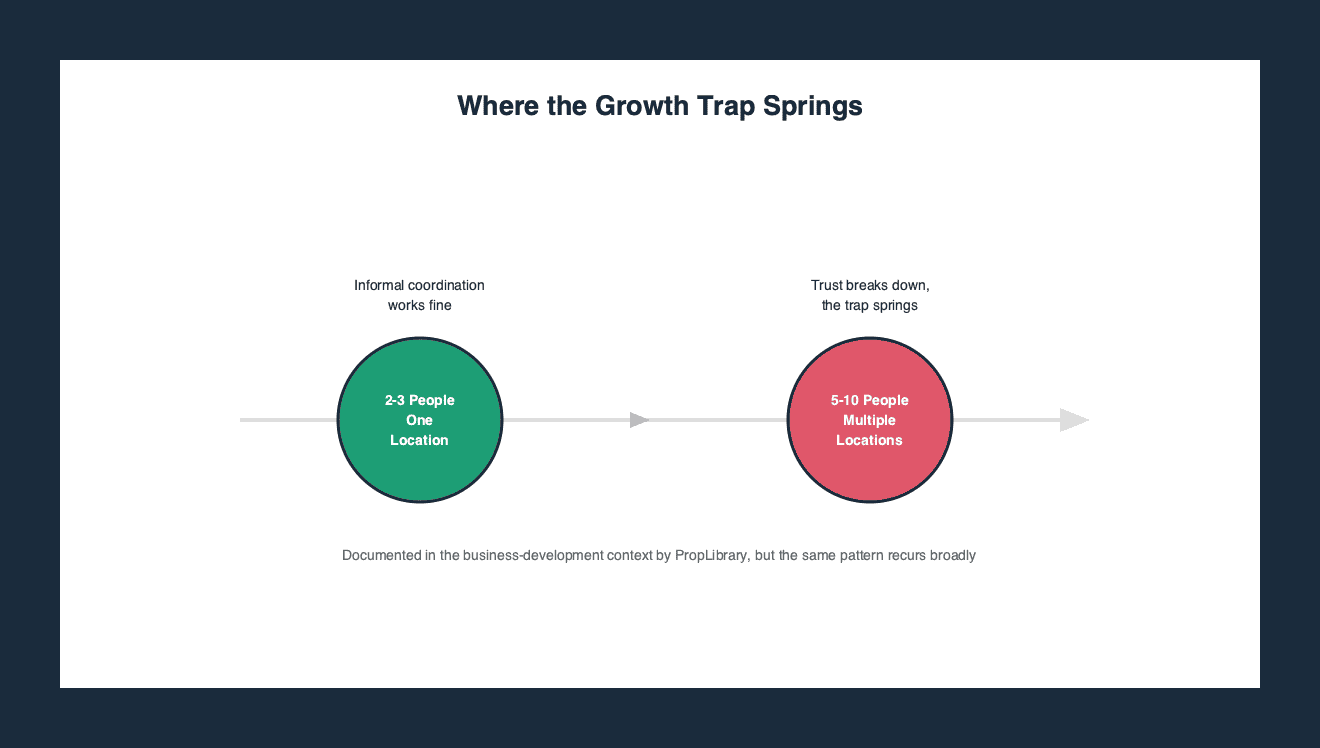
Often, the trap tends to fully spring once a firm opens new locations. The informal communication and trust that worked in a small team now breaks down. The same pattern of informal coordination breaking down as headcount and locations multiply shows up well beyond proposal teams. Formal processes become necessary, but the business may lack the discipline or expertise to build them quickly enough.
Rapid business growth is often an SME’s biggest threat. Owners who see rising revenue as an unqualified win may ignore warning signs until cash flow pressure forces a painful restructuring or a fire sale of assets.
Avoiding the Growth Trap
No single solution works for every business, but the principles that help avoid the trap are consistent. One critical insight is that you cannot grow forever, constantly, every moment of every day. There are points where you need to pause. Secure your unit economics and demonstrate you can reliably raise prices without losing customers to prove real pricing power before funding broad growth initiatives.
That pause is not a retreat. It is an opportunity to reduce complexity, improve alignment among team members, and build reliable systems before adding new volume. Scaling sustainably also requires enforcing strict capital allocation strategies mid-market companies use to avoid waste and maximize ROI. Owners should examine whether they are chasing growth for its own sake or whether each new customer and location genuinely strengthens the business. Tools like Econblox’s AI-powered business advisor can help track the underlying metrics, like profit per employee and cash reserves, that reveal whether growth is healthy before the trap fully closes.
Additionally, the distinction between growth and scaling must guide strategy. Adding resources should be a last resort, not the default response to higher demand. Before hiring more people or opening another location, ask whether existing capacity can be used more efficiently. Invest in training, standard operating procedures, and technology that allow a smaller team to produce more.
Finally, be honest about leadership. If the founder or management team has not built their skills to match the company’s size, help is needed. Leadership stagnation often prevents every other improvement from taking hold.
Growth pace is one piece of a larger discipline. The pricing, margin, and revenue-protection decisions that determine whether growth actually compounds are covered in Grow Profits.
Frequently Asked Questions
What triggers the growth trap in a small business?
A change from 5 people in one location to 10 people at multiple locations, is one example. The informal coordination that worked for a handful of colleagues breaks down, and the business lacks the systems to handle the increased complexity. Opening additional locations typically springs the trap fully, and the same pattern shows up in other industries too.
How do I know if my business is in the growth trap?
Common signs include cycles of progress followed by setbacks, too many competing priorities, gaps between what leadership knows and what the team executes, and vanity metrics such as rising revenue that hide declining profit per employee or worsening cash flow. If you feel constantly overwhelmed and margins are shrinking despite higher sales, you may be in the trap.
Is growth always bad for a business?
No. Sustainable growth that is planned and supported by solid processes and adequate cash reserves can be healthy. The problem is not growth itself, but growth that outpaces the organization’s ability to manage it. The smartest approach is sometimes to delay expansion in order to strengthen underlying operations, systems, and team alignment first.
What is the difference between growth and scaling?
Growth means everything gets bigger: more customers, revenue, and people. Scaling means revenue increases without a proportional increase in resources. Scaling preserves or improves profit margins, while unchecked growth often erodes them. Learning to scale rather than simply grow is one of the most important steps for escaping the growth trap.
Recognizing the growth trap early gives owners the chance to stop, simplify, and build a stronger foundation before adding new layers of complexity. The businesses that survive and thrive are not always the ones that grow fastest. They are the ones that grow smartly, with an eye on profitability, alignment, and the capacity to scale without breaking.
 No Credit Card Required For Trial