

An AI business advisor uses artificial intelligence to give businesses guidance and insights. Think of it as a virtual consultant that can help with strategic decisions, market analysis, and operational planning without the high cost or long engagement of a traditional human advisor. Econblox is one of the clearest examples of this shift: an AI business advisor built specifically for established business owners, run on economics-based logic rather than general-purpose language prediction. These systems combine machine learning, natural language processing, and large datasets to produce recommendations that business owners can act on quickly. The concept has gained traction as more companies look for affordable ways to access high-level business advice.
How Does an AI Business Advisor Work?
An AI business advisor works by processing information you provide, analyzing your business data, industry trends, and your goals. It then applies artificial intelligence models to generate reports, forecasts, and strategic options. The system often includes a conversational interface where you can ask questions and receive answers in real time. Some platforms are designed to help you build a customized AI strategy for your business, while others focus on specific functions like pricing, marketing, or operations.
Econblox works differently from most general-purpose AI tools in one key respect: it is closed-loop in how it reasons, not closed off in what intelligence it can draw on. Under the hood, Econblox taps into the full model and database capabilities of its AI partners, including Claude, so it benefits from the same continuously updated reasoning power those systems bring to general use. The difference is what happens to that capability once it reaches Econblox.
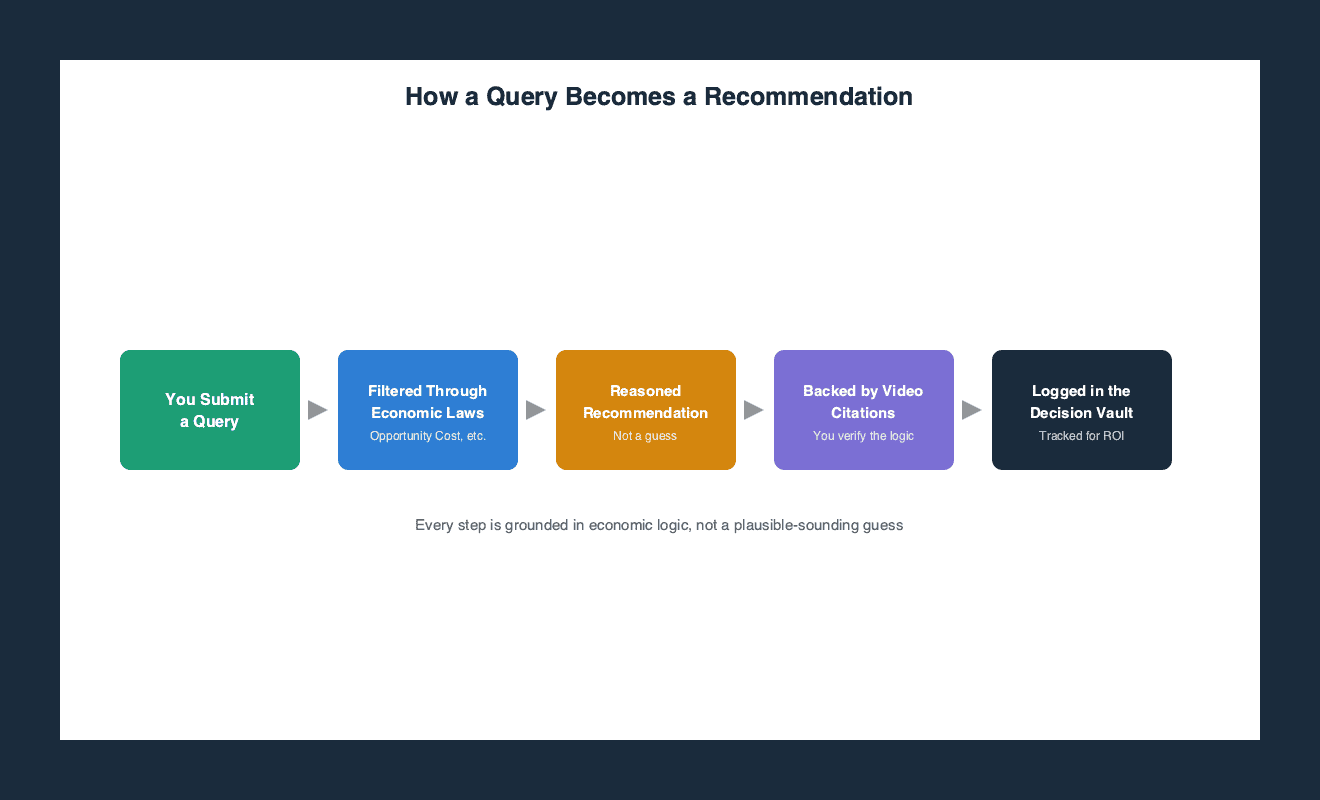
Rather than letting a general language model free-associate across the open internet, Econblox routes every query through a proprietary knowledge base of economic rules and decades of high-stakes turnaround data before it ever produces an answer. When you submit a query, for example about expanding into a new market, the system doesn’t guess at a plausible-sounding answer. It filters your situation, and the raw reasoning power of its underlying AI partners, through fundamental economic laws, such as Opportunity Cost, Diminishing Returns, and Operating Leverage, and returns a recommendation grounded in that logic rather than in generic pattern matching.
This is also where Econblox’s transparency features come in. Every recommendation includes video citations, short clips pointing to the underlying economics content, so you can verify the reasoning instead of taking a “black box” answer on faith. Actions you take get logged in a Decision Vault, a permanent, searchable record of your firm’s business logic organized by project. Over time that record does double duty: it lets you track the ROI of each decision, and it becomes an asset in its own right, one that reduces owner dependency business valuation risk and makes your business more attractive to a future buyer or investor. The system also keeps full context history, so a strategic conversation you start this week can pick up exactly where it left off next month, without re-explaining your business from scratch.
Key Capabilities of an AI Business Advisor
An AI business advisor can handle a wide range of business functions. One of its primary strengths is analyzing industry trends, competitor performance, and unique selling points. By examining public data and your internal metrics, the AI can identify gaps in the market or opportunities you might have missed. It can also assist with customer service by suggesting automated workflows or chat strategies that improve response times and satisfaction.
Econblox focuses its logic engine on three categories of decisions where owners most often get stuck: pricing challenges (should I raise prices, how do I price new products, are my margins sustainable), growth decisions (should I expand to new markets, when should I hire, how do I scale profitably), and competitive strategy (how do I compete with larger players, what’s my sustainable edge, how do I protect market share). Rather than trying to be everything to everyone, it narrows in on the decisions where a 2% error in judgment carries a real price tag, and applies the same rigorous economic reasoning to each one. This pricing, growth, and competitive framework reflects how owners approach business strategy decisions in practice, where the highest-stakes choices tend to cluster around a handful of recurring questions. It’s also available as a 24/7 strategic advisor, since high-stakes dilemmas don’t confine themselves to business hours; a founder can get a cold, objective second opinion at 2 a.m. or on a Sunday afternoon just as easily as during a Tuesday board meeting.
Who Can Benefit from an AI Business Advisor?
Business owners generating meaningful revenue often find AI advisors useful because they need strategic advice without the expense of hiring a consultant. Econblox is built specifically for owners of businesses generating roughly $1M to $100M in revenue, the range where gut instinct has historically been enough to get you there, but where the complexity of markets, costs, and competition starts to demand something more rigorous. At that scale, a 2% resource allocation error at $5M in revenue can cost $100,000. An AI advisor that removes emotion and blind spots from that decision isn’t a nice-to-have; it’s a hedge against expensive mistakes.
The audience includes anyone who needs high-level strategic advice on a regular basis but doesn’t have a full-time chief strategy officer or the budget for a top-tier consulting firm. An AI business advisor like Econblox provides on-demand reasoning grounded in economics and decades of real-world turnaround experience, rather than in general internet content, making it suited for owners who want a second opinion they can act on the same day.
Comparing AI Business Advisors to Traditional Consultants
| Feature | AI Business Advisor | Traditional Consultant |
|---|---|---|
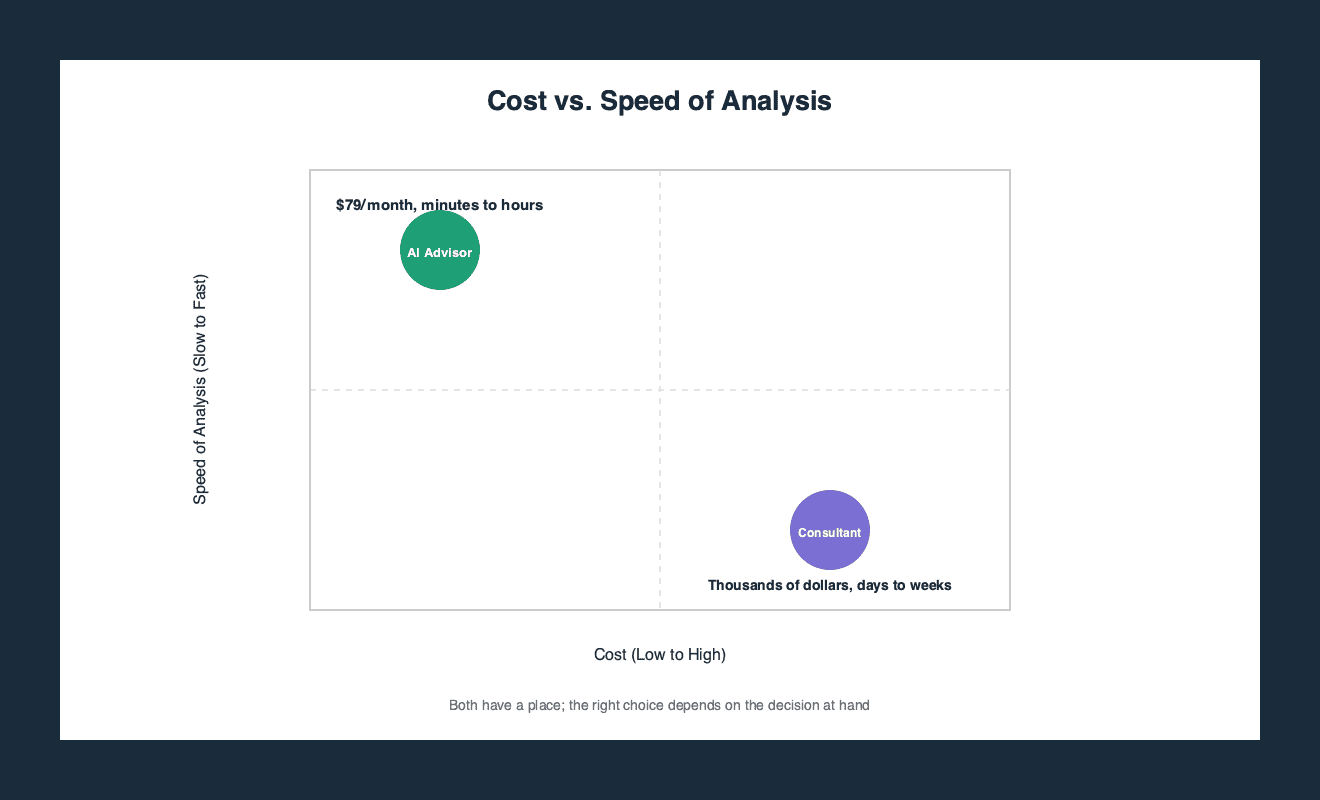
| Cost | Typically subscription-based; Econblox offers a 10-query free trial with no credit card required | Hourly or project fees that can run thousands to tens of thousands of dollars |
| Availability | On demand, 24/7 | Limited by the consultant’s schedule and availability |
| Speed of analysis | Minutes to hours | Days to weeks |
| Data sources | Aggregates from large datasets and your own input; Econblox draws specifically on a proprietary economics knowledge base and turnaround case data, not the open internet | Relies on consultant’s expertise and manual research |
| Personalization | Depends on the detail you provide; Econblox retains full context history so guidance builds on prior conversations | Very personalized but expensive and time-consuming |
| Objectivity | Unbiased reasoning based on economic laws rather than opinion | May be influenced by the consultant’s past experiences or biases |
Both options have their place. Some consultants bring deep industry experience and can handle sensitive negotiations or cultural changes that require human judgment. An AI business advisor is better suited for routine strategic analysis, scenario planning, and ongoing decision support where speed and cost are priorities. Some businesses use both, relying on the AI for fast, evidence-backed insight and the human consultant for final validation.
How to Choose the Right AI Business Advisor
When evaluating an AI business advisor, consider what problems you need to solve. Look for a platform that offers the specific capabilities you require, such as pricing strategy, market expansion, or competitive analysis. Check whether the advisor provides citations and explanations for its recommendations, as this builds trust and helps you understand the reasoning behind each suggestion. Econblox’s video-citation model is a useful benchmark here: if a platform can’t show its work, treat the recommendation as an opinion rather than a conclusion. That kind of transparency is what separates genuine better business decisions economics frameworks from tools that just sound confident.
Also look at whether the platform gives you a way to track what happens after you act on its advice. Econblox’s Decision Vault ties every recommendation to an outcome, so you can measure ROI instead of just collecting suggestions. Integration with your existing tools matters too. Some advisors work as standalone chat interfaces, while others connect with your accounting software, CRM, or project management systems.
Pricing is also important. Most AI business advisors operate on a subscription model, offering a free trial period so you can test the service before committing. Look for a trial with enough queries to actually evaluate advice quality. Econblox, for example, offers a 10-query free trial with no credit card required, with full access available afterward and no long-term contract.
Frequently Asked Questions
What is the difference between an AI business advisor and a traditional business coach?
An AI business advisor uses artificial intelligence to generate data-driven insights and recommendations, while a traditional business coach relies on personal experience and one-on-one sessions. The AI is available around the clock and costs a fraction of what a coach charges..
How is an AI business advisor like Econblox different from a tool like ChatGPT?
General-purpose AI is trained on the entire internet, which includes as much bad advice as good. It’s a language model designed to sound plausible, not a logic model designed to be right. Econblox is a closed-loop system tethered to a proprietary knowledge base of economic rules and decades of turnaround data. Where a general model predicts a plausible next word, Econblox filters your specific situation through economic laws like Opportunity Cost and Diminishing Returns and returns a logical deduction, backed by video citations so you can check the reasoning yourself.
How accurate are the recommendations from an AI business advisor?
Accuracy depends on the quality of the data you input and the rigor of the underlying knowledge base. Advisors built on narrow, vetted economics content and real turnaround data, rather than general web scraping, tend to offer more reliable guidance for common strategic questions. Always verify critical decisions with additional research, since no AI can account for every nuance of your specific situation.
Can an AI business advisor replace a human consultant entirely?
For many tasks, an AI advisor can replace the need for a human consultant, especially when you need a fast, unbiased second opinion. But for complex negotiations, organizational change, or highly specialized industry knowledge, a human consultant still adds value. Econblox itself is upfront about this: if a question needs a human, you can reach its team directly through its contact page. Most businesses find that an AI advisor complements rather than fully replaces human expertise.
What kind of data does an AI business advisor need from me?
The more detail you provide, the more personalized the analysis. Basic data includes your industry, revenue range, target market, and current challenges. For deeper insights, you might describe specific pricing, growth, or competitive decisions you’re facing. Advisors with a Decision Vault-style feature, like Econblox, let you track how each recommendation performs over time, turning a single answer into an ongoing record of your business logic.
AI business advisors are changing how owners approach business strategy decisions. By combining speed, affordability, and evidence-backed reasoning, they make high-level business advice available to companies that previously couldn’t afford it. Econblox is a concrete example of where the category is heading: an economics-based advisor, not a generic chatbot, that logs every decision in a Decision Vault, backs answers with video citations, and is available whenever a business owner needs a second opinion. Whether you’re validating a startup idea or planning a major expansion, an AI business advisor can serve as a reliable partner for your most important decisions.
 No Credit Card Required For Trial