

Business Valuation & Exit Series
Business owner diversification means something different than it does for anyone else. An owner works out how much of their net worth sits inside the business they run. The obvious next question is what to do about it. Most advice sitting under the word “diversification” is written for someone with a portfolio to rebalance. It assumes a mix of holdings they can trade with a phone call. An owner’s biggest asset is not a position in an account. It is a private, illiquid company they show up to manage every day. Reducing dependence on it takes business decisions, not investment ones.
That distinction changes where an owner should actually look for solutions. The problem is not solved by finding somewhere else to put money. It is solved by changing how much of the owner’s future depends on this one company converting to value on this one timeline. That conversion is, therefore, the whole point of building and realizing the value of a business, not just watching it grow on paper.
Business Owner Diversification Is a Business Decision, Not a Portfolio Move
For someone with a diversified investment portfolio, reducing concentration risk means shifting money between holdings. An owner’s concentrated asset does not trade on an exchange. But it becomes less concentrated when the owner takes deliberate steps to convert some of that locked-up value into something liquid. It also becomes less concentrated by reducing how much the owner’s financial future depends on one exit, on one timeline.
This is a business economics problem, not a portfolio problem. But the fixes look like business decisions. They change how the business is structured, when the owner starts extracting value, and how dependent the business is on the owner personally.
Levers That a Business Owner Can Use to Diversify
Four moves do most of the work. None of them require the owner to become an investor in something unrelated to the business they already understand.
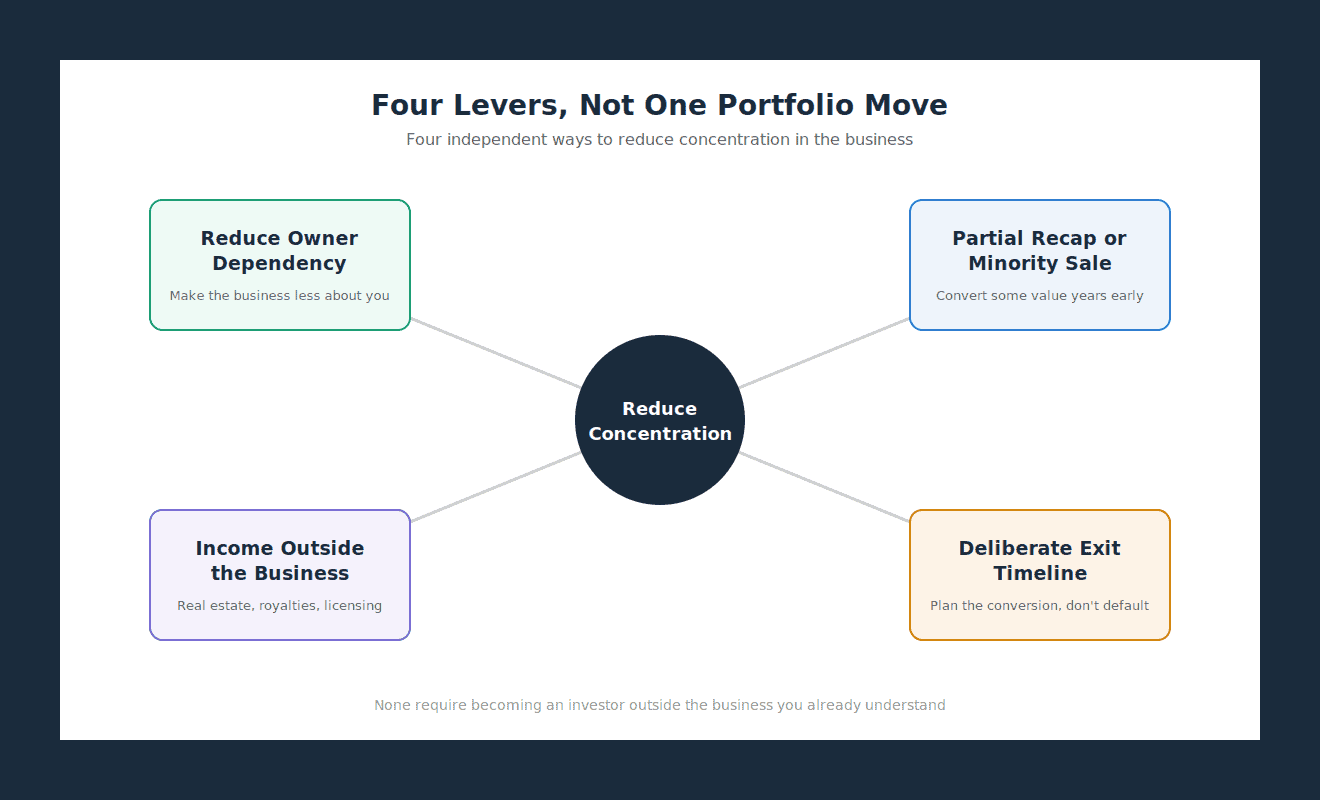
Reduce owner dependency before you need to. A business that cannot run without you is worth less to anyone else. It also traps you personally, since you cannot step back even partially without the value dropping. Our article on owner dependency as a silent valuation killer covers the specific fixes. They are the same fixes that make partial diversification possible in the first place.
Consider a partial recapitalization or minority sale. Selling a minority stake to a partner, an employee group, or an outside investor converts some concentrated business value into liquid wealth years before a full exit. The owner keeps running the company throughout. It is one of the few moves that directly reduces concentration without requiring a full transition.
Build income outside day-to-day ownership. A separate holding entity for real estate the business occupies is one option. A royalty or licensing arrangement tied to something the business created is another. Both can generate value that does not rise and fall with the operating business itself.
Set the exit timeline deliberately, not by default. Every year an owner delays deciding on a succession path is another year of net worth concentrating further in one place. Our 3-year exit prep checklist turns that decision into a plan with a timeline. It replaces something that otherwise happens only when circumstances force it.
Why Waiting Until the Sale Is the Riskiest Version of Business Diversification
The owners who get hurt most are not the ones with a concentrated business. Nearly every owner has that. It is the ones who treat diversification as something to figure out after the sale closes. By then, the concentrated value has already converted to cash on a single day, at a single price. Whatever market conditions happen to exist that year, the owner is stuck with them. That is the version of this problem with the least control and the most exposure.
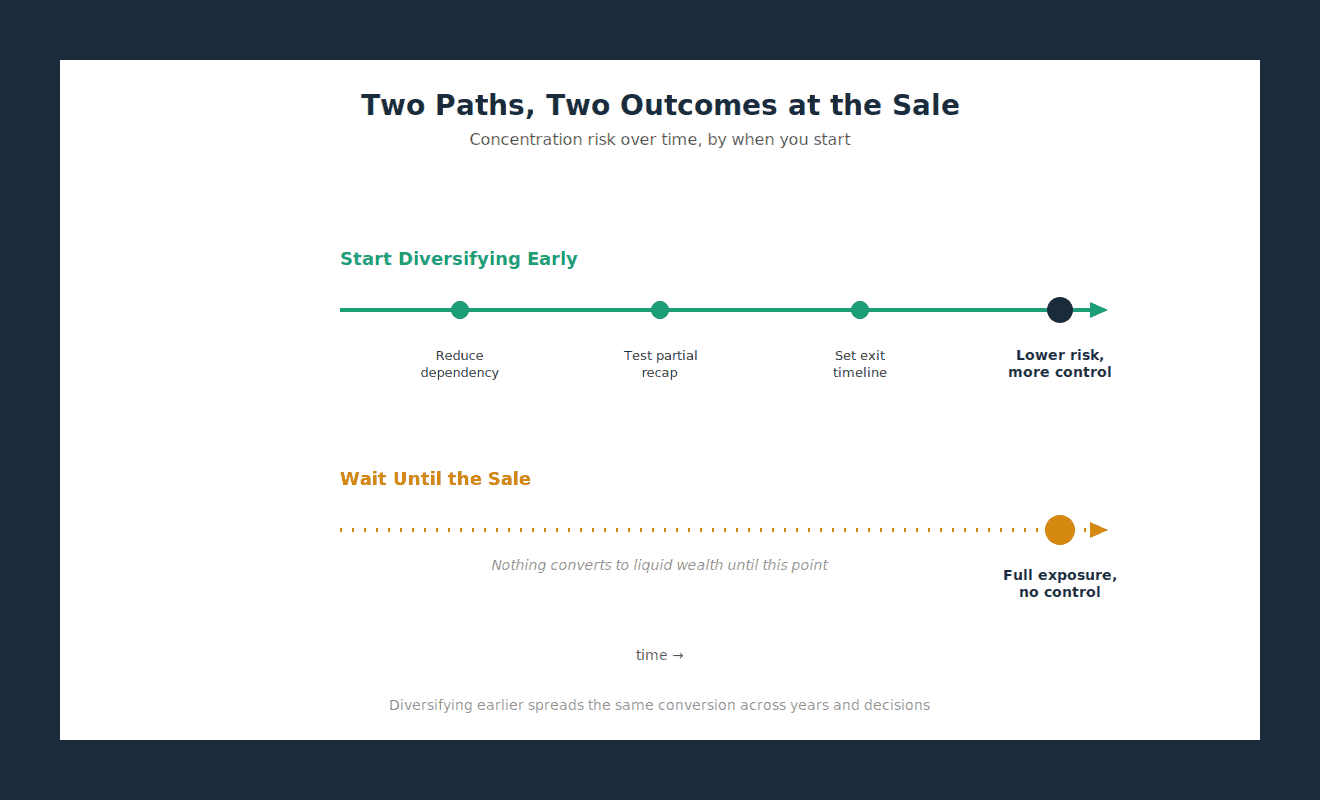
Starting years earlier changes the picture entirely. An owner who reduces dependency, tests a partial recapitalization, or simply commits to a succession timeline spreads the risk of that conversion across years and decisions. That beats betting it all on one transaction. This is exactly the concentration problem covered on our Business Owner Retirement pillar page. The business only works as a pension if the owner actively manages how and when that pension actually pays out.
Diversifying away from a business you built and still run is not an obvious problem to solve alone. It is not the kind of question an accountant or a lawyer is positioned to answer either. It sits in a strategic layer most owners have no one to consult on. Our AI Business Advisor free trial, ten queries, no credit card, is built to be that sounding board while you work out which lever fits your situation.
Frequently Asked Questions
Does this mean I should sell part of my business even if I don’t want to fully exit?
Not necessarily. A partial recapitalization is one option among several. It only makes sense if the terms and the partner are right. The point is knowing it exists as a lever, not treating it as a requirement.
Is diversification only relevant if I’m close to retirement?
No. The earlier an owner starts reducing dependency and building value outside the day-to-day business, the more options they have later. This holds regardless of when the actual transition happens.
How do I know which lever to pursue first?
It usually depends on which one is most feasible given the business’s current structure and the owner’s timeline. That is exactly the kind of judgment call worth pressure-testing before committing to a direction.
 No Credit Card Required For Trial