

Business Valuation & Exit Series
Ask an employee about their retirement plan and they will describe accounts: balances, contributions, allocations. Ask an owner and, sooner or later, honesty arrives at a different answer: the company is the plan. Business owner retirement rarely fails the way employee retirement fails, through undersaving or bad markets. It fails because the plan’s largest asset is a single illiquid business, and nobody managed it like the retirement asset it actually is. This is the pillar guide to that problem: why concentration, not market risk, decides an owner’s outcome, and the four business levers that move it.
The Concentration Problem, Quantified
The pattern is remarkably consistent. An owner starts the company in their thirties with almost nothing. Over twenty years the house gains some equity, the savings accounts grow modestly, and the business grows enormously. Nobody decided to concentrate; the concentration happened because the best-performing asset in the portfolio was the one they went to work in every morning.
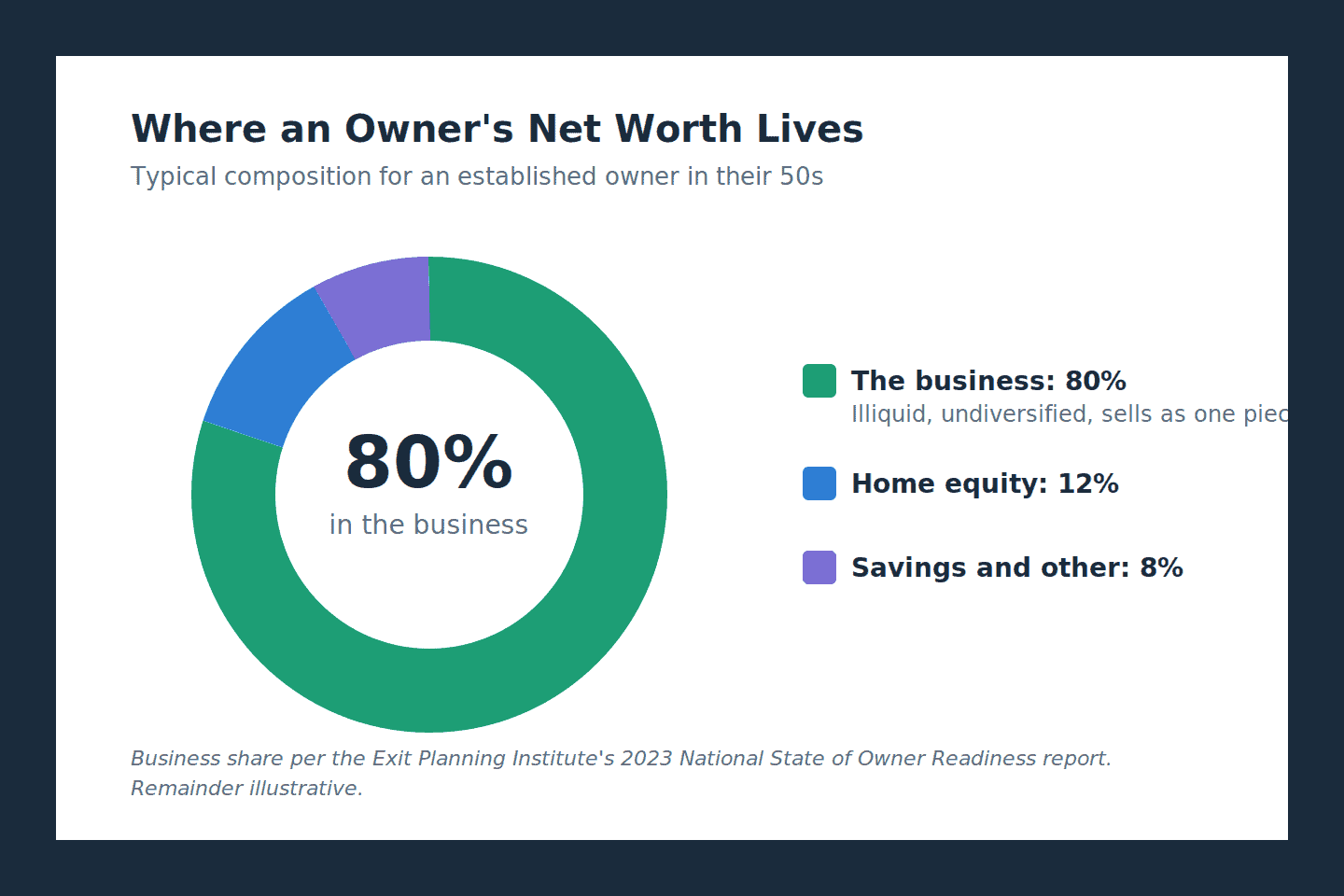
By the time owners reach their fifties, the numbers are stark. According to the Exit Planning Institute’s 2023 National State of Owner Readiness report, a survey of more than 1,100 privately held business owners, roughly 80 percent of the average owner’s net worth sits inside the business. Not 80 percent of income. Eighty percent of everything, wrapped in one asset that cannot be sold in pieces, cannot be rebalanced, and transacts only when a qualified buyer appears and stays at the table.
An employee with that concentration in a single stock would be told, by any advisor, to fix it immediately. Owners live it for decades, and the difference is that their concentrated asset also employs them, carries their debt guarantees, and depends on their daily presence. That combination, concentration plus illiquidity plus dependency, is the actual retirement problem. Everything else is detail.
Why Standard Retirement Advice Fails Owners
Conventional retirement planning is built for the employee balance sheet. It optimizes the liquid portfolio: contribution schedules, account types, withdrawal rates, allocation glide paths. All of it is useful, and all of it addresses, for a typical owner, the minority of their wealth.
The majority sits in an asset most advisors treat as a black box. The questions that actually determine an owner’s retirement, what is the business worth to a real buyer, when can it be sold, what happens to its value if the owner steps back, are not portfolio questions. They are business economics questions: valuation drivers, transferability, margin quality, customer concentration. A retirement plan that has an answer for the 20 percent and a shrug for the 80 percent is not a plan. It is a hope with paperwork.
This is not an argument against saving outside the business. Building liquid assets alongside the company is sensible and reduces the pressure on the eventual exit. It is an argument about where the leverage is. For an owner, a modest improvement in the value or salability of the business moves the retirement outcome more than years of disciplined contributions, because it acts on the largest number on the balance sheet.
Before working through the levers, it helps to know your starting point. The Profit Gap Analysis takes 2 minutes and 8 inputs, and scores your business against the economic fundamentals that drive the outcome.
The Four Levers That Decide an Owner’s Retirement
If the business is the pension, then managing the pension means managing four things about the business. Each lever moves the outcome in dollar terms, each one is inside the owner’s control, and each one has a dedicated guide on this site.
Lever 1: Know the Real Valuation
Every plan needs a balance, and for an owner the balance is the defensible value of the business. Not the number a competitor’s rumored sale implies, and not the round figure that makes the plan work. The number a buyer would defend in diligence.
The gap between believed value and defensible value is where owner retirements quietly break. If the plan assumes $5 million and the market says $3.5 million, the retirement date just moved by years, and the later that gap is discovered, the fewer options remain. Owners who measure early get something invaluable: a list of exactly which value drivers are weak while there is still time to work on them.
Start here, because this lever calibrates the other three. Our guide to business valuation for owners covers what drives the number and what quietly destroys it.
Lever 2: Reduce Owner Dependency
A business that cannot run without its owner is not a transferable asset. It is a well-paid job with equity characteristics, and buyers price it that way, by compressing the multiple applied to every dollar of earnings. On a mid-market business, that compression is routinely worth more than the owner’s entire liquid savings.
Dependency also traps the owner in a circular problem: you cannot diversify out of an asset no one else can operate, and you cannot step back to plan the exit when every decision routes through your desk. Reducing dependency is therefore double leverage. It raises what the business is worth and makes it possible to sell at all.
The work is unglamorous and takes time: documented processes, a management layer with real authority, customer relationships that survive your absence. The full playbook is in our guide to owner dependency.
Lever 3: Set the Diversification Timeline
Concentration is not a moral failing; it is how successful businesses get built. The failure is having no timeline to unwind it. A useful discipline is to track one ratio, the share of net worth inside the business, and to have a dated plan for the direction it should move as the exit window approaches. Wealth built in the business gets systematically converted, through distributions, through de-risking, and ultimately through the sale, into assets the owner controls outright.
A timeline converts vague intentions into decisions with deadlines. It answers questions owners otherwise defer indefinitely: how much should the business be distributing versus reinvesting at this stage, how large should the liquid reserve be before the exit year, what has to be true by age 60 for retirement at 62 to be real.
If you are not sure whether your current trajectory holds up, check yourself against the five warning signs a business owner’s retirement plan will fail. Two or more means the timeline conversation is overdue.
Lever 4: Prepare the Exit
The exit is where the pension pays out, and it pays out at whatever the business is worth on the day a buyer closes. Exit preparation is the multi-year process of making that day come sooner, at a higher number, with fewer surprises: financials a buyer can trust, revenue that is not dangerously concentrated, margins that hold up under scrutiny, a story that survives diligence.
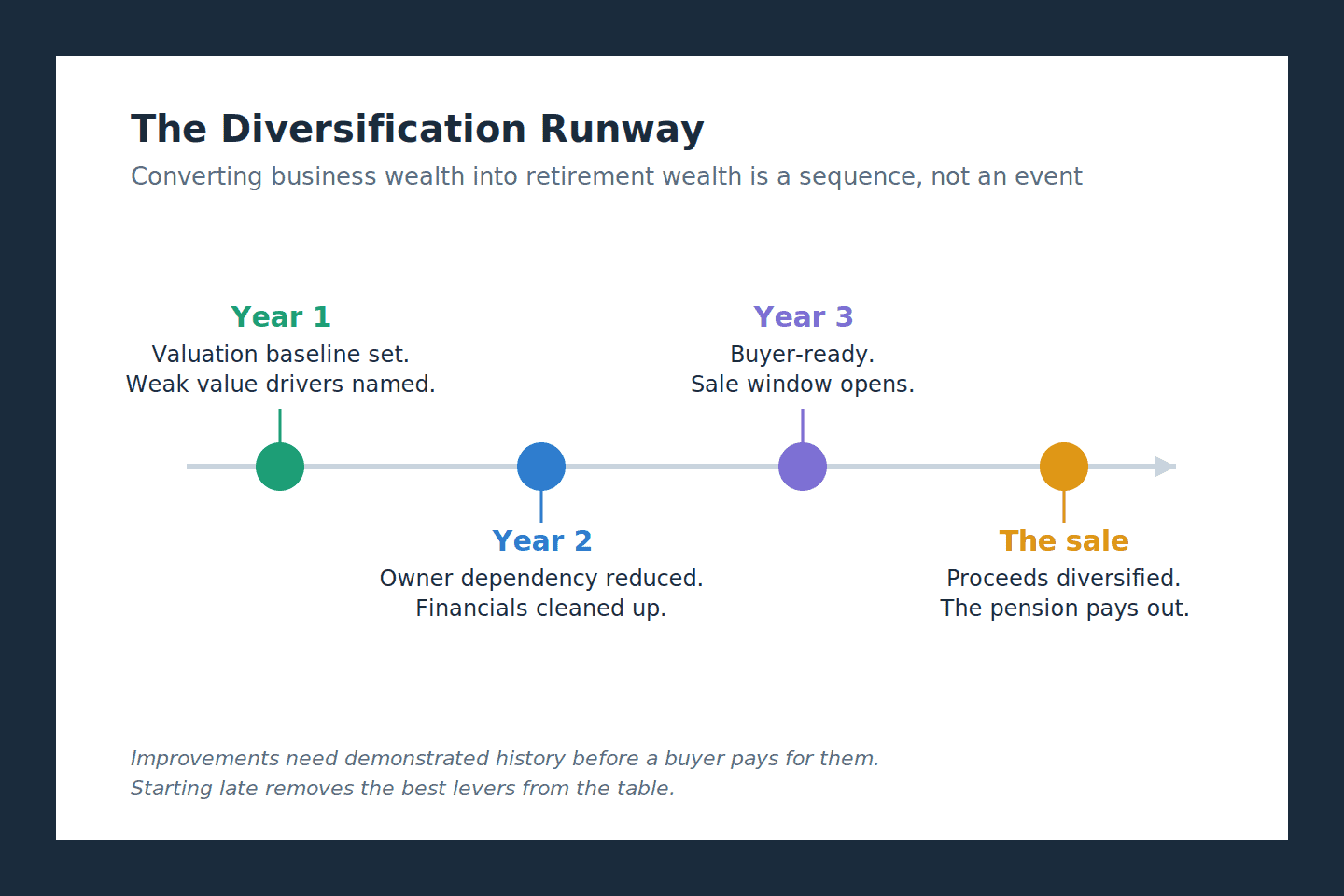
Runway is the scarce resource. The improvements that move valuation most need two to three years of demonstrated history before a buyer will pay for them. Owners who start preparing at the decision to sell discover that the best levers are already out of reach, and owners forced to sell on someone else’s schedule pay the urgency discount on top.
Work the sequence deliberately. The 3-year exit prep checklist lays out what belongs in each year of the runway.
What Retirement Ready Looks Like for an Owner
Readiness is not an account balance. For an owner it is the ability to answer a short list of questions without guessing. You know the defensible value of the business, and you know which drivers you are currently working on. The business can operate, sell, and collect for a month without you. Your financials would survive a buyer’s diligence today. You have a target exit window, and the share of your net worth inside the business is on a planned path downward as that window approaches. And the retirement number itself is calculated from the defensible valuation, not the hoped-for one.
Most owners can answer one or two of these. The gap between that and answering all of them is not luck or market timing. It is a set of business decisions, made early enough to matter, and every one of them is the kind of decision worth pressure-testing with economic rigour before you commit. The Econblox AI Business Advisor is built for exactly that work, and your first 10 questions are free, no credit card required.
Retirement planning that ignores the business isn’t really a plan. The full valuation and exit-readiness picture that determines what your business can actually fund is covered in Build and Realize Value.
Frequently Asked Questions
Is it bad that my business is my retirement plan?
It is normal, and it is manageable, but only if the business is managed as a retirement asset and not just as a job. That means knowing its defensible value, making it transferable, and having a dated plan to convert business wealth into liquid wealth. The danger is not the concentration itself; it is concentration with no valuation baseline, no timeline, and no exit preparation.
How much of a business owner’s retirement should depend on selling the business?
Less than it currently does, for most owners. Research from the Exit Planning Institute indicates roughly 80 percent of the average owner’s net worth sits in the business, and many owners depend on a sale for the majority of their retirement funding. The practical goal is to reduce that dependence over time through distributions and outside savings, so the exit improves the retirement rather than solely determining it.
When should a business owner start planning retirement?
The valuation baseline and dependency work should start at least five years before the target exit, and the formal exit preparation at least three. Buyer-facing improvements need years of demonstrated history to be credible, and starting late removes the highest-value fixes from the table. If retirement is even a decade away, the concentration ratio and the timeline should already be on paper.
What is the biggest mistake business owners make with retirement?
Planning around an unverified number. Owners routinely build the entire retirement plan on a guessed valuation, then discover the defensible number in diligence, with no runway left to close the gap. The second biggest is the mirror image: spending years building value while remaining so central to operations that the value cannot transfer to a buyer.
 No Credit Card Required For Trial