

Business Valuation & Exit Series
Here are five warning signs that can cause a business owner retirement plan to fail. Traditional retirement advice is written for employees relying on a steady paycheck, a 401(k), and a diversified portfolio. It rarely fits a business owner, whose single largest retirement asset is often the business itself. When an owner’s plan falls short, it almost never happens because of a market crash—it fails for business reasons that were visible years earlier and never addressed. If your company is your primary nest egg, a situation we cover in depth in When Your Business IS Your Pension, these are the five warning signs to check yourself against today. Each one is detectable now and correctable with a specific first step.
1. Your Business Is More Than 70 Percent of Your Net Worth and You Have No Timeline to Change That
As a working rule of thumb, when a single illiquid asset makes up 70 percent or more of your net worth, concentration is no longer a footnote in your plan. It is the plan. Most owners pass that threshold without noticing, because the business grew while everything else stayed flat.
The damage shows up in dollars at the moment you need liquidity. Consider an owner counting on a $4 million business sale to fund retirement. If the sale happens two years late, at a price 25 percent below expectation, that is a $1 million hole plus two years of lost compounding, and there is no portfolio large enough on the side to absorb it. Employees can ride out a bad market year. An owner whose net worth is the business cannot ride out a bad exit.
The warning sign is not the concentration itself. It is the absence of a timeline to reduce it. First step: put a diversification date on the calendar, even a rough one, and work backward. Every other decision in this article gets easier once that date exists.
2. You Have Never Had a Defensible Valuation Done
Ask an owner what the business is worth and you will get a number. Ask where the number came from and the answer is usually a rumor: what a competitor supposedly sold for, what a broker once suggested, what the industry multiple was a decade ago. Planning retirement around that number is planning around a guess.
The dollar consequence is the gap between believed value and market value, and the gap is usually discovered at the worst possible moment, in diligence, with a real buyer across the table. If you believe the business is worth $5 million and the defensible number is $3.5 million, your retirement date just moved by years, and you found out with no runway left to fix it. The owners who close that gap are the ones who measure it early, while the value drivers can still be worked on.
First step: get a real valuation baseline. Not a certified report for a transaction, but a defensible number built the way a buyer would build it. Our pillar guide to business valuation for owners walks through what actually drives and destroys that number.
3. The Business Cannot Run 30 Days Without You
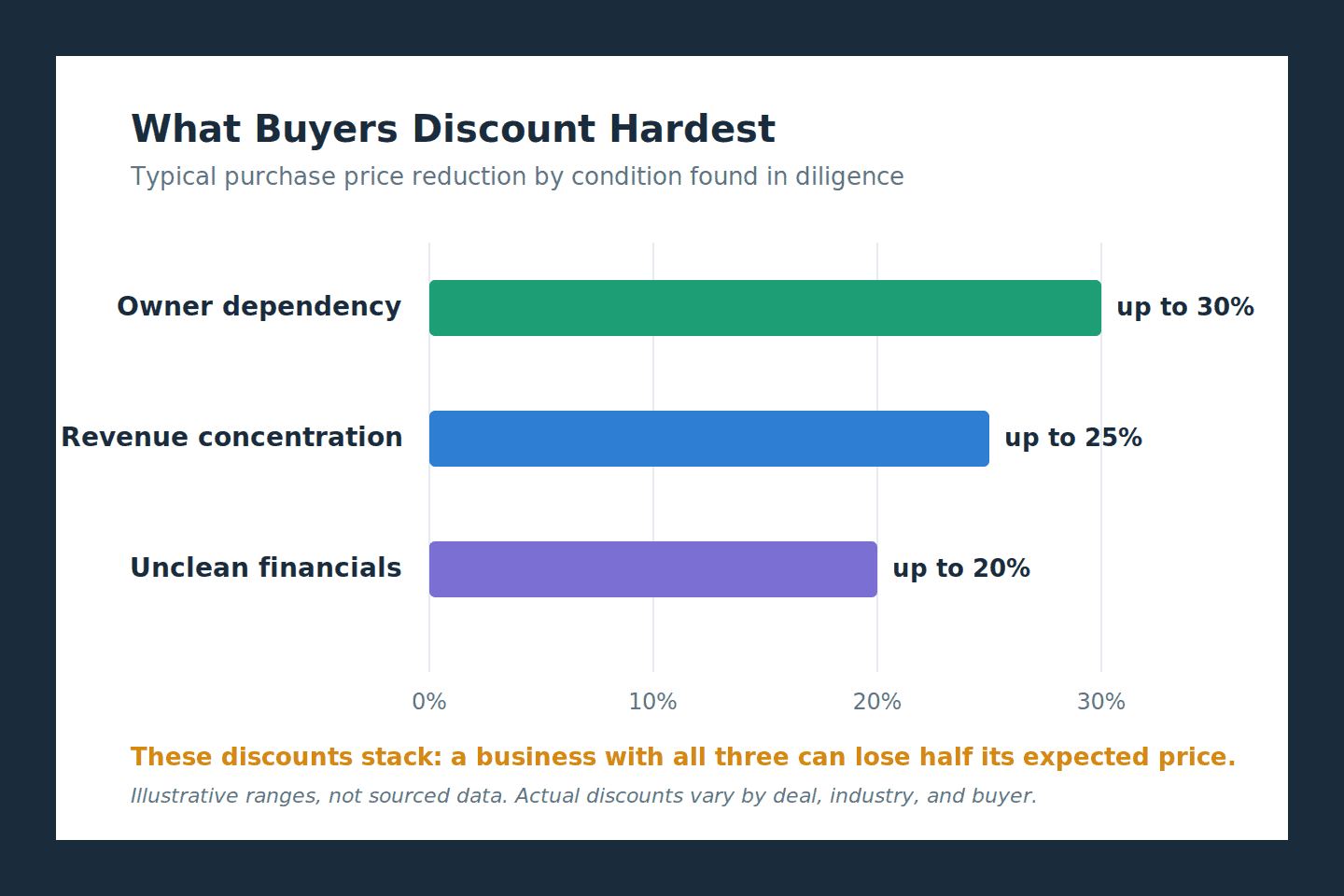
This is the discount buyers apply hardest, and they apply it without sentiment. If revenue depends on your relationships, if approvals bottleneck at your desk, if no one else can quote a job or calm the biggest customer, then a buyer is not purchasing a business. They are purchasing a job that you are about to leave, and they price it accordingly.
In dollar terms, owner dependency does not shave a valuation. It compresses the multiple itself, and on a mid-market business a single turn of multiple is often worth more than the owner’s entire liquid savings. The same dependency also quietly blocks the earlier warning signs from being fixed: you cannot diversify out of an asset no one else can operate.
First step: pick one owner-only function this quarter, document the process, and delegate it. Then repeat. A useful test is the 30-day absence: could the business operate, sell, and collect while you were unreachable?
Before moving to the last two signs, it is worth getting an objective read on where you stand. The Profit Gap Analysis takes 2 minutes and 8 inputs, and scores your business against economic fundamentals, including the dimensions these warning signs measure.
4. Your Exit Date Is a Feeling, Not a Plan With a Prep Runway
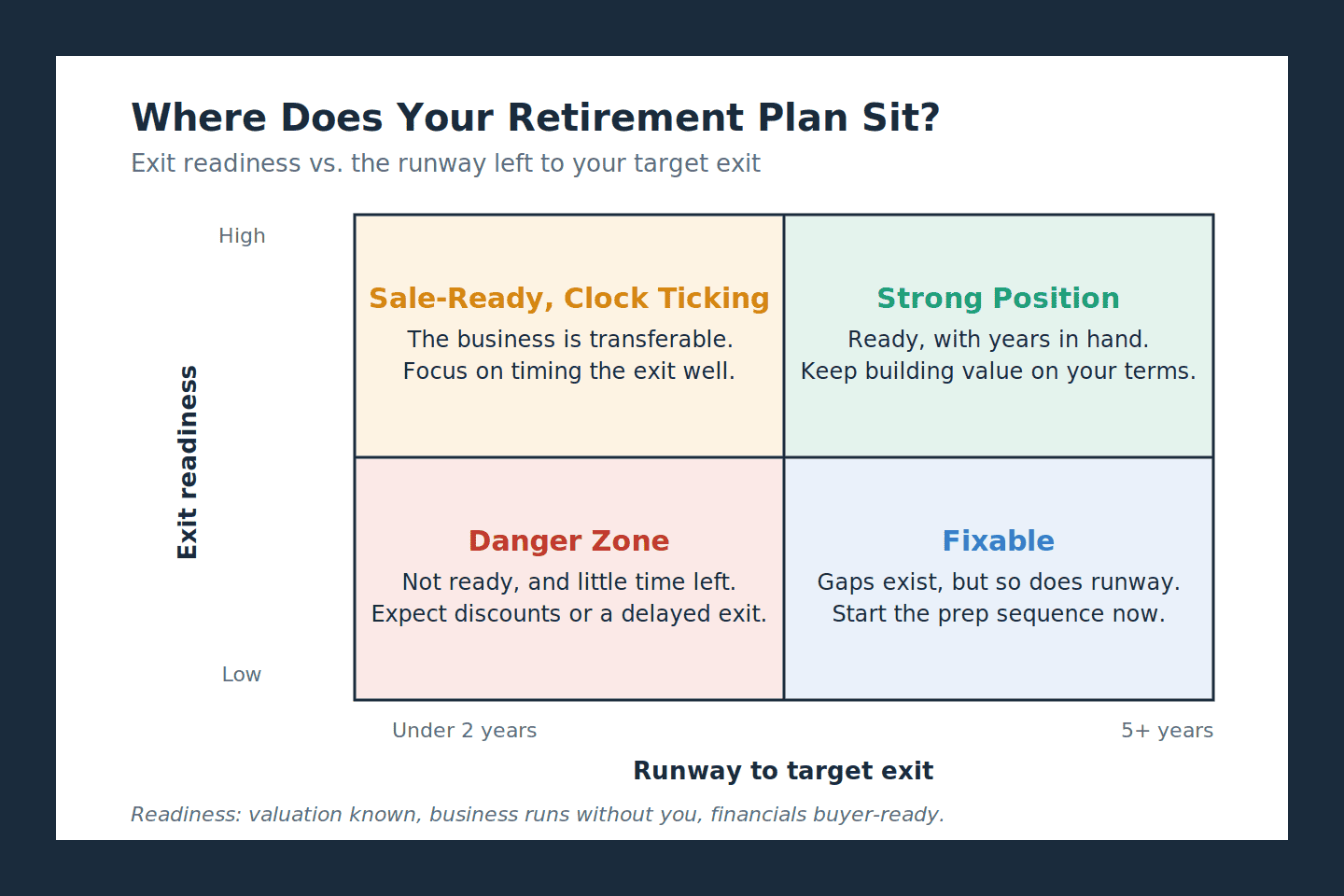
“Sometime in the next five years or so” is not an exit plan. It is a mood. The problem with a mood is that exit preparation consumes years, and the runway determines which value-building levers are still available to you. Cleaning up financials, reducing customer concentration, building a management layer, and demonstrating margin discipline each take one to three years to show up credibly in the numbers a buyer will study.
The dollar cost of a missing runway is paid in two ways. Owners forced to sell on someone else’s schedule, because of health, burnout, or a partner dispute, take the discount that comes with urgency. And owners who start preparation late discover that the highest-value improvements are exactly the ones they no longer have time to make.
First step: pick a target exit window and map it against a structured prep sequence. The 3-year exit prep checklist lays out what belongs in each year of that runway.
5. Your Financials Are Not Buyer-Ready
The final warning sign is the one owners see last, because the business feels healthy from the inside. Then a buyer runs diligence and the retirement plan meets reality: revenue concentrated in two customers, personal expenses tangled through the statements, add-backs that cannot be documented, margins that swing without explanation. Every one of those findings becomes either a price reduction or a dead deal.
The dollar mechanics are unforgiving because they compound. Concentration risk lowers the multiple, unclean statements shrink the earnings the multiple is applied to, and both together erode buyer confidence, which is the real currency of any deal. A business generating the same cash as its competitor can transact hundreds of thousands of dollars apart purely on the quality of its records and revenue base.
First step: run the diligence on yourself before a buyer does, starting with your revenue base and including a customer concentration audit.
Scoring Your Business Owner Retirement Plan
Count honestly. One sign is a to-do item. Two or more means your retirement outcome is currently being decided by conditions inside the business rather than by any plan, and the order of operations matters: the valuation baseline comes first, because it tells you how large the problem is, and the timeline comes second, because it tells you how long you have to fix it.
None of this requires a market forecast. Every warning sign above is a business condition you can measure and move this year. If you want to work through the fixes with economic rigour, the Econblox AI Business Advisor is built for exactly these decisions, and your first 10 questions are free, no credit card required.
Frequently Asked Questions
What should a business owner retirement plan include that a normal one does not?
It must plan the business, not just the portfolio. That means a defensible valuation baseline, a target exit window with a multi-year prep runway, a plan to reduce owner dependency, and a timeline for converting business equity into liquid assets. Standard retirement planning covers the liquid minority of an owner’s wealth and leaves the majority unmanaged.
How much of my net worth should be in my business as I approach retirement?
There is no universal number, but the direction matters more than the threshold. If the business is above roughly 70 percent of net worth and the share is not falling as your exit window approaches, the plan depends entirely on one illiquid asset selling well, on schedule. The closer you get to exit, the more each year should shift value from the business into assets you control.
When should a business owner start retirement exit planning?
At least three years before the target sale, and five is better. Buyer-facing improvements such as clean financials, reduced customer concentration, and a functioning management layer need multiple years of history to be credible in diligence. Starting late does not just add stress. It removes the highest-value fixes from the table.
Why do buyers pay less for owner-dependent businesses?
Because the thing that produces the profits, the owner, leaves with the sale. Buyers price the risk that revenue, key relationships, and operational knowledge walk out the door, and they price it by compressing the valuation multiple. Reducing owner dependency is one of the few levers that raises value and makes the business easier to sell at the same time.
 No Credit Card Required For Trial