

Business Valuation & Exit Series
Most owners think about succession planning as a single event: the day they hand over the keys. But the path you choose long before that day quietly decides what your business is worth when you finally leave. It also decides how much control you keep on the way out. And it decides whether the transition protects the value you spent years building, or erodes it. Business succession planning is not a form you fill out near retirement. It is a decision with financial consequences that start compounding the moment you make it. That puts it at the center of building and realizing the value of your business.
Business owners make that decision alone more often than not. They have accountants for the tax filing and lawyers for the transfer documents. But neither is positioned to help an owner think through which succession path actually protects the number on the valuation report. That gap shows up in the data. According to a 2025 Gallup survey of U.S. business owners, 74% of owners with employees have some plan to sell or transfer their business. But a third of all owners, employer and non-employer alike, describe their long-term plan as unsure or not yet formed. Having “a plan” and having a plan that protects value are two different things.
Why Business Succession Planning Can’t Wait Until You’re Ready to Retire
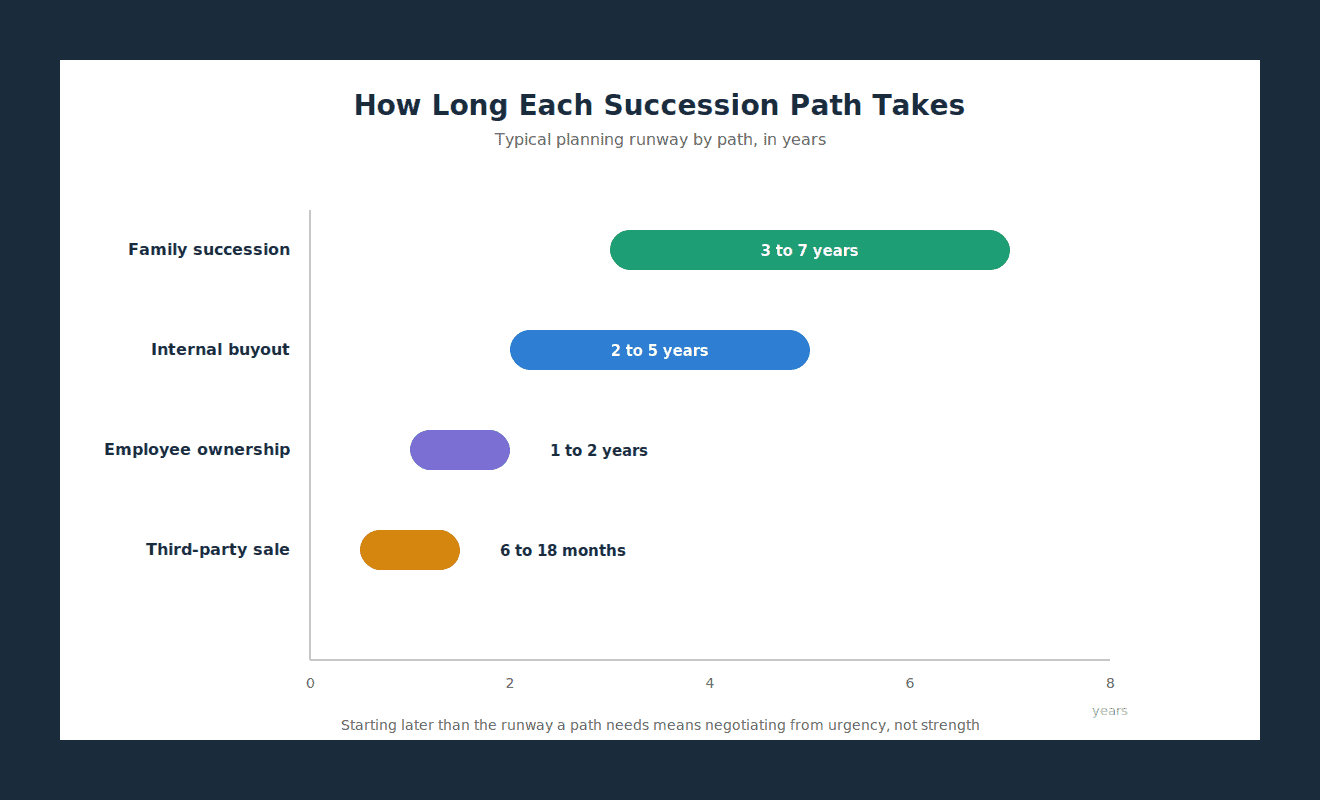
Succession planning gets treated as a retirement-adjacent task, something to think about once an owner starts picturing the exit. That timing works against the owner. Every succession path, family transfer, internal buyout, employee ownership, or outside sale, takes years to execute well. Financing has to be arranged and the next leader has to be developed or found. The business often has to be restructured so it does not depend entirely on the current owner. Start that process with two years of runway and you are negotiating from urgency. Start it with five, and you are negotiating from strength.
The owners who get hurt are not the ones without a plan. They are the ones who assumed the plan was obvious, a son, a daughter, a longtime manager, without ever pressure-testing it. Does that person actually want the role? Can they finance it? Are they ready to run the company? Succession planning is therefore where that assumption gets tested early, while there is still time to build a different plan if it fails.
Four Paths, Four Very Different Outcomes for Value
The succession route you choose is not just a personnel decision. It changes the valuation multiple a buyer or successor will actually pay. It also changes how the deal gets financed, and how long you stay involved after the transition.
| Path | Typical effect on value | Timeline | Owner’s role after |
|---|---|---|---|
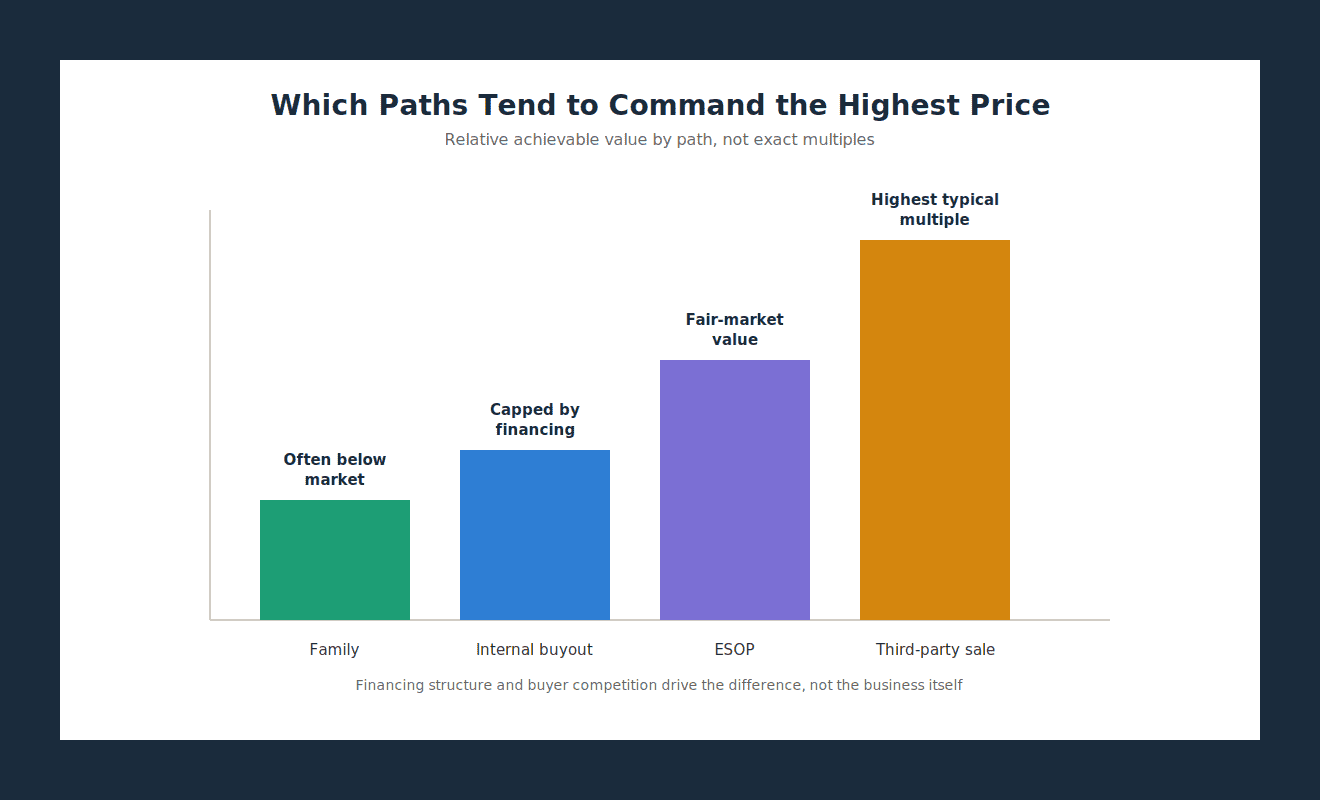
| Family succession | Often financed with seller notes or gifted equity; price can be secondary to keeping the business in the family | 3 to 7 years to develop the successor | Frequently stays involved as an advisor or minority owner |
| Internal buyout (management or key employees) | Financing constraints usually cap the price below open-market value | 2 to 5 years, dependent on the buyer’s ability to raise capital | Often a phased exit tied to earnout or note payments |
| Employee ownership (ESOP or similar) | Can command a fair-market valuation with tax advantages for the seller | 1 to 2 years to structure, longer to fully transition leadership | Usually a clean exit once the structure is funded |
| Third-party sale | Highest achievable multiple in most cases, driven by strategic or financial buyer competition | 6 to 18 months once the business is prepared for sale | Typically a full exit, sometimes with a short transition period |
None of these paths is universally better. A family succession that keeps the business intact for the next generation is a legitimate goal. It does not have to maximize price to be the right call. But that has to be a choice the owner makes deliberately, not a default that happens because no one considered the alternatives.
Why the Business Succession Plan You Choose Changes the Number
Buyers and successors do not pay for what a business could theoretically be worth. They pay for what it is worth to them, given the risk they are taking on. A management team buying out an owner is usually financing the deal with the business’s own future cash flow. That caps what they can offer, regardless of the “fair” value on paper. A third-party strategic buyer, by contrast, may pay a premium if the business fills a gap in their own operations.
The owner’s own involvement in the business factors into every one of these paths. Our breakdown of owner dependency and its effect on valuation covers this in more detail. The short version: a business a buyer or successor believes cannot run without the current owner gets discounted, no matter which succession route you pick. Reducing that dependency before you start the succession process improves the outcome across every path at once.
Where Succession Planning Fits Into Your Exit Timeline
Succession planning is not a separate project from exit planning. It is the decision that determines which exit plan you actually need. Once you know whether you are grooming a family member, developing an internal buyer, or preparing for a market sale, the rest of the preparation work changes. That includes what records a buyer will want, what the business needs to look like without you in the room, and how long the whole process realistically takes.
That is where a structured runway matters. Our 3-year exit prep checklist lays out what to have in place well before a transition, and it works alongside whichever succession path you choose. The owners who avoid the worst outcomes treat succession as the first decision in a multi-year process, not the last step before the door closes.
This is also the point where succession planning connects to a bigger, less comfortable number. How much of an owner’s personal net worth is actually sitting inside the business, waiting on this transition to become real, liquid wealth? That is the concentration problem covered on our Business Owner Retirement pillar page. It is a big part of why the succession decision matters for the owner’s own financial security, not just the business’s future.
Succession planning forces a decision most owners would rather defer: who actually takes this over, and what does that choice cost or protect in real dollars. Defaulting to whichever option was easiest to avoid thinking about is not a strategy. Working through the decision with a real strategic sounding board is therefore worth doing before you commit to a path. That is exactly the gap our AI Business Advisor free trial is built to fill: ten queries, no credit card, and a place to pressure-test the succession path first.
Frequently Asked Questions
Do I need a written succession plan even if I’m not planning to retire soon?
Yes. A written plan does not commit you to a date. It forces you to name a path and identify gaps, such as a successor who is not ready or financing that is not in place, while you still have years to close them.
Can I change my business succession plan later?
Plans should change as circumstances do. The value of writing one down early is that you are adjusting a real plan, not improvising one under time pressure.
What if none of the four paths fit my situation?
Most real transitions blend elements of more than one path, such as a partial internal sale followed by a third-party sale of the remaining stake. The framework is a starting point for evaluating tradeoffs, not a menu you have to pick a single item from.
 No Credit Card Required For Trial