

Business Valuation & Exit Series
In private equity and lower-middle-market M&A, an ebitda multiple valuation is the universal benchmark used to price operating businesses. Business owners often hear about generic industry multiples, but deal values vary wildly in practice. Two companies in the exact same sector, generating identical revenue, can command multiples that differ by 30% to 50%. Most owners never test which of their own qualitative factors are quietly compressing that number until a buyer’s diligence team already has.
To understand what drives these valuation gaps, owners must look beyond static industry averages. Building real, defensible enterprise value means examining the market dynamics, deal size tiers, and strategic levers that institutional buyers use to set price.
Real-World EBITDA Multiple Valuation Benchmarks by Transaction Size
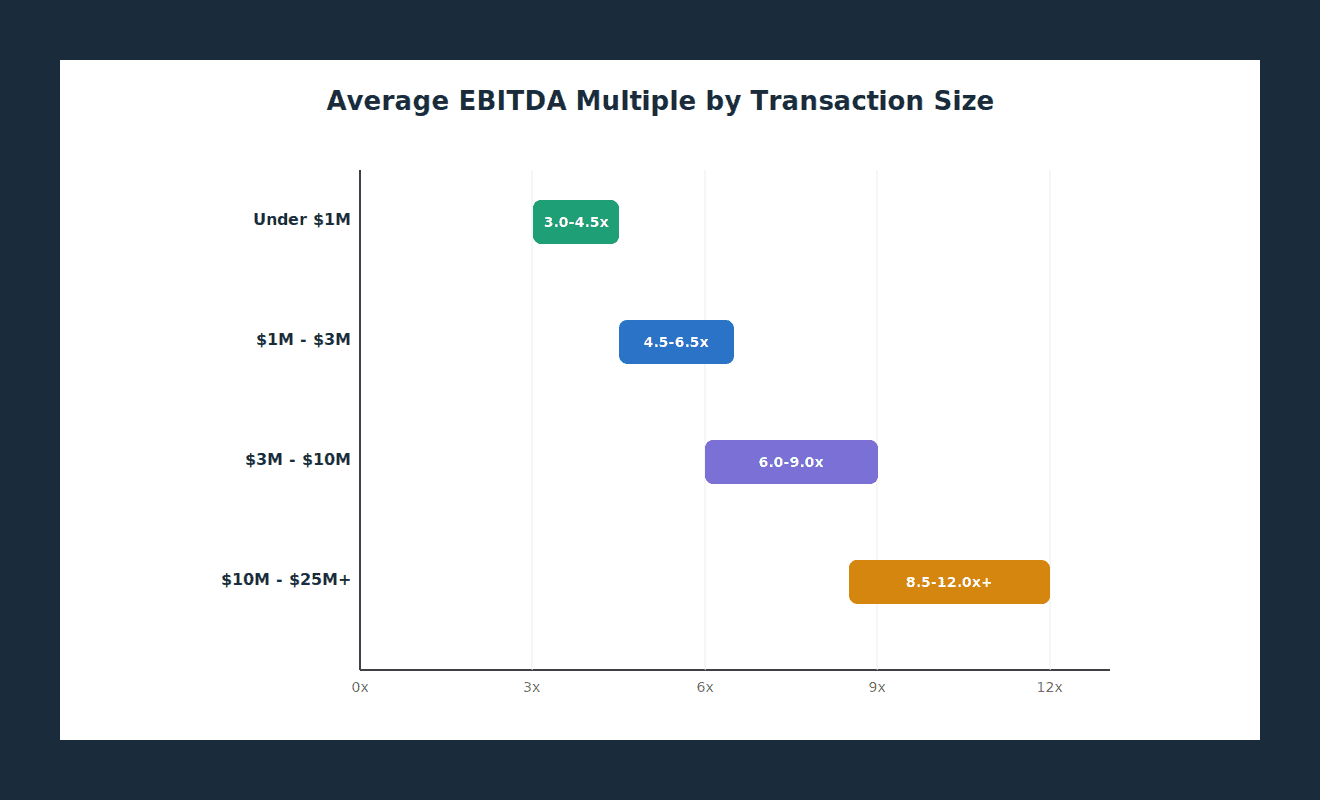
Institutional buyers evaluate deal size when assigning an enterprise multiple. Smaller operations carry higher operational risks, making their cash flow less predictable and resulting in lower baseline multiples. Larger companies benefit from scale, access to capital, and executive redundancy, which commands a premium.
| EBITDA Tier | Multiple Range | Primary Buyer Type | Key Valuation Drivers |
|---|---|---|---|
| Under $1M | 3.0x – 4.5x | Individual Buyers, Local Operators | SDE add-backs, lease terms, owner transition |
| $1M – $3M | 4.5x – 6.5x | Search Funds, Family Offices, Micro-PE | Clean financials, recurring revenue, management stability |
| $3M – $10M | 6.0x – 9.0x | Lower-Middle-Market Private Equity | Differentiated IP, low churn, scalable systems |
| $10M – $25M+ | 8.5x – 12.0x+ | Institutional Private Equity & Strategic Buyers | Platform potential, international reach, high pricing power |
These ranges serve as general market guidelines. For sector level context, NYU Stern publishes enterprise value to EBITDA multiples by industry, updated annually. Those figures come from public companies and run above private market pricing, so treat them as directional rather than as an offer range. If you need the underlying step-by-step arithmetic, see our guide on EBITDA multiple calculation mechanics to compute enterprise value from operating cash flow.
Know Your Margin Before You Know Your Multiple
Buyers price the multiple, but they underwrite the margin behind it. The Profit Gap Analysis takes 2 minutes and 8 inputs to show where your own numbers stand before you take them to a buyer.
Why Private Equity Multiples Expand or Contract
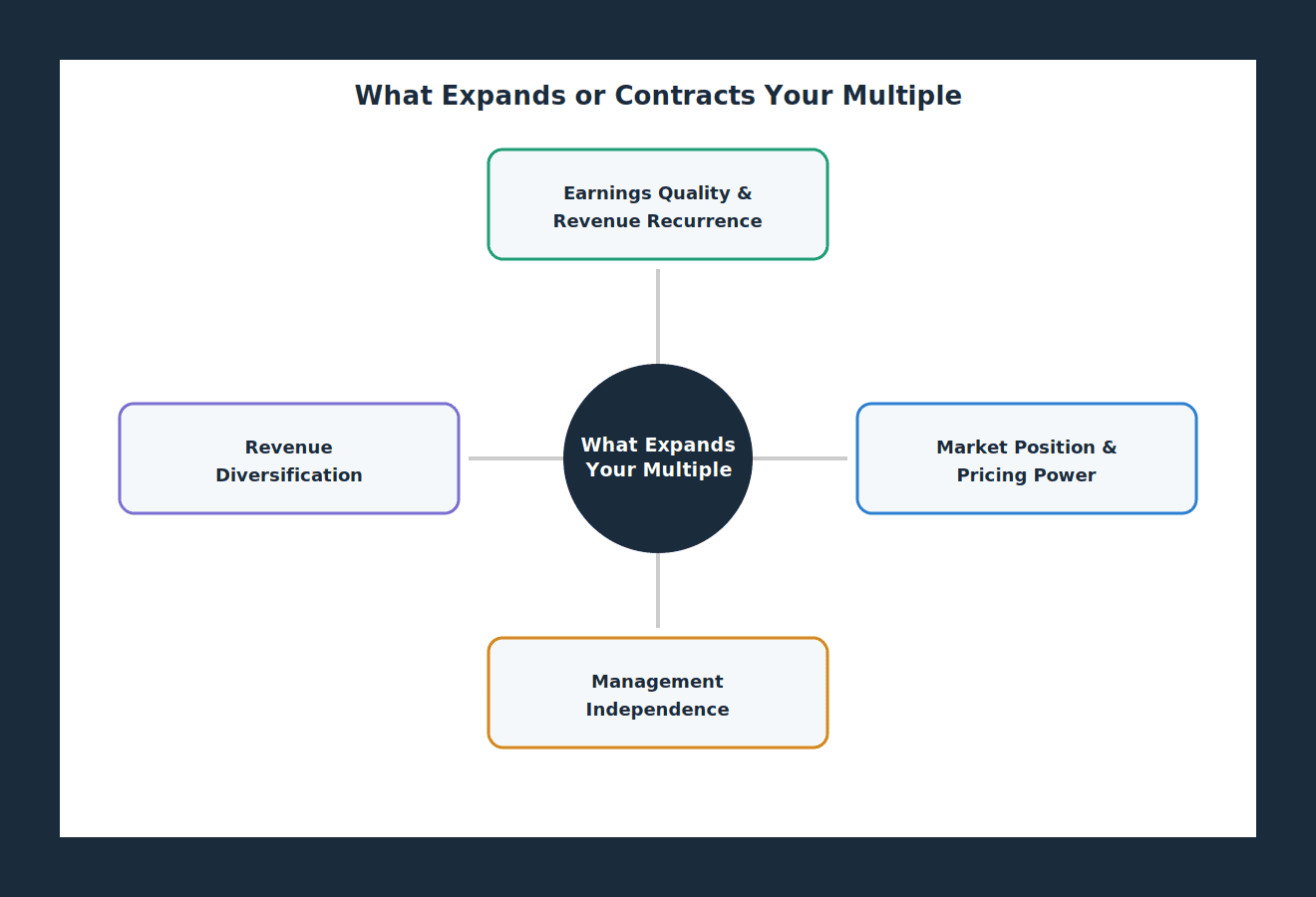
When financial and strategic buyers submit letters of intent, they adjust baseline industry multiples up or down based on specific qualitative indicators. Understanding these dynamics allows owners to position their businesses for maximum valuation expansion long before going to market.
1. Earnings Quality & Revenue Recurrence
Buyers pay top dollar for predictable earnings streams. Recurring project revenue or long-term service contracts reduce buyer risk and justify higher transaction multiples. Ad-hoc transactional revenue, by contrast, introduces volatility that compresses the multiple.
2. Market Position and Pricing Power
A business that can raise prices without sacrificing client retention demonstrates a strong competitive moat. Maintaining high bottom-line quality by establishing a pricing power business model reassures buyers that operating margins will remain resilient during inflationary cycles.
3. Management Independence
One of the most frequent reasons buyers discount purchase prices is a company’s inability to operate without its founder. Unresolved owner dependency penalties force institutional buyers to budget for replacement C-suite talent, directly reducing the offer price.
4. Revenue Diversification
If a significant portion of your annual revenue relies on a small cluster of accounts, financial buyers will apply severe risk discounts. Mitigating customer concentration risk prior to launching a sale process protects your valuation from steep diligence haircuts.
Strategic vs. Financial Buyers: The EBITDA Multiple Valuation Gap
The identity of your buyer dictates the upper limit of your valuation multiple:
- Financial Buyers (Private Equity / Family Offices): Evaluate companies on a standalone ROI basis. They anchor offers on historical cash flows and typical debt service coverage, usually keeping multiples within standard market bounds.
- Strategic Buyers (Competitors / Industry Peers): Price acquisitions based on post-merger synergies, cross-selling opportunities, and cost rationalization. Because strategic buyers can immediately eliminate redundant overhead, they frequently pay a premium multiple well above financial baseline averages.
Buyer mix is not static. It shifts with credit conditions and sector demand. The IBBA and M&A Source Market Pulse survey tracks buyer type and deal terms quarterly for transactions up to $50 million, which is the segment most owner-operators actually sell into.
How to Increase Your EBITDA Multiple Before Exit
Multiple expansion is the fastest way to compound equity value. To build enterprise value systematically before going to market, consider taking these core steps:
- Run a Rigorous Baseline Appraisal: Establish a realistic baseline valuation grounded in market data rather than arbitrary expectations by reviewing a comprehensive business valuation for owners framework.
- Eliminate Operational Red Flags: Systematically address buyer discount factors, clean up unverified add-backs, and lock in key operational leadership to ensure your company passes quality-of-earnings checks.
- Prepare an Exit Readiness Roadmap: Work through a structured exit prep checklist to align personal, financial, and operational timelines well in advance of a transaction.
Therefore, a multiple you read in a benchmark table is a starting range, not your number. Your actual multiple is set by earnings quality and buyer type. It also depends on how many of these qualitative factors you have already fixed before a buyer ever sees your numbers.
Determine Your Valuation Tier & Value Drivers
Don’t leave your transaction multiple to chance. Evaluate your operational readiness, pricing power, and exit timeline directly with the Econblox AI Business Advisor, free, no credit card required.
 No Credit Card Required For Trial