

When sales slow, many business owners cut prices. The logic seems simple: lower the price, sell more units, hit the revenue target. But the math rarely works out that way. Every price cut trades future profit for a present dollar, and that dollar is often worth less than you think. This article gives you a framework to decide when to hold your price and when cutting is actually justified.
This article uses established economic theory to provide a framework for business owners who want to stop reflexively cutting prices and start making disciplined, value-preserving decisions. The concepts discussed here are the same ones used by economists and policymakers to evaluate long-term investments and public projects. For a subscription service like Econblox, the aim is to put that same rigor into everyday strategic choices.
The Economics of Discounting: What It Really Means
Discounting has two meanings. In finance, it is when a borrower pays a fee to delay a payment. In economics, it means converting a future dollar into today’s equivalent. The economic definition is what matters for pricing strategy. It forces a simple question: is a dollar earned today worth more than a dollar earned next year? Usually yes, but by how much matters enormously.
Discount rates determine how much you value money today versus money later. A high discount rate means you strongly prefer cash now. A low rate means you are willing to wait. When you cut prices, you are implicitly using a very high discount rate. You are treating future margin as nearly worthless. That is often the wrong call, especially for a growing business.
The Opportunity Cost of Cutting Prices
Every dollar of margin you give up has an alternative use. You could reinvest it in product improvements, marketing, or hiring. That is the opportunity cost. If your business generates strong returns over time, the cost of a price cut compounds. You are not just losing $10 per unit today. You are losing everything that $10 could have become.
Here is the math. A product priced at $100 with a 50% margin earns $50 per unit. Cut the price 10% and that margin drops to $40. To earn the same total profit, you now need to sell 25% more units. That extra volume rarely materializes. And even if it does, you have worked harder for the same result with less margin to reinvest. Explore our pricing strategy prompts to model these trade-offs before making any price change.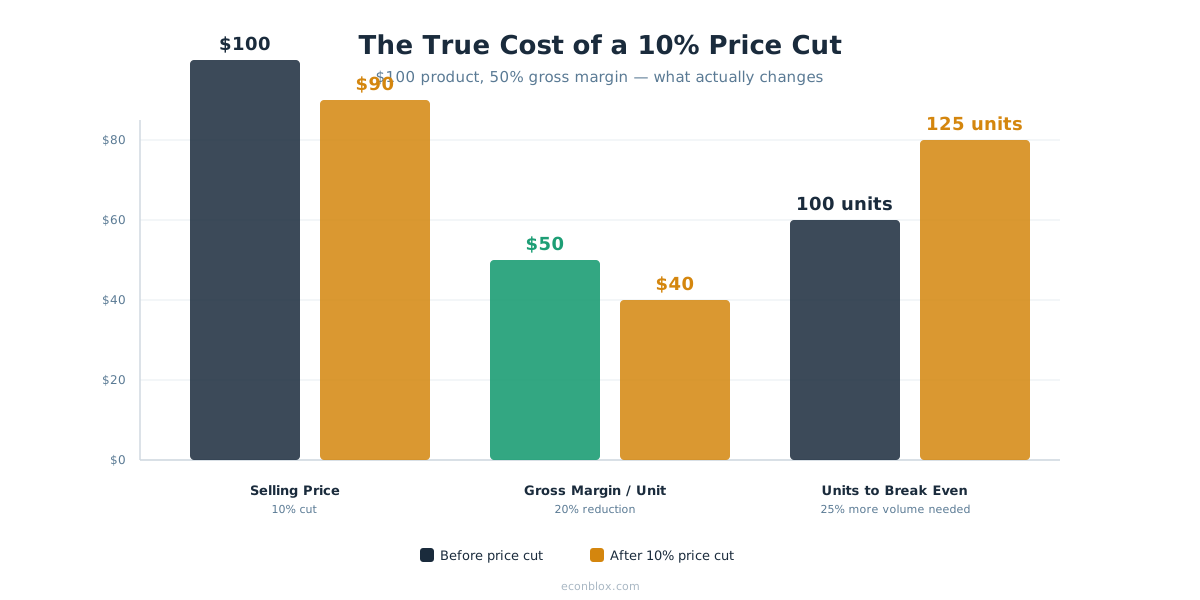
How Discount Rates Shape Business Decisions
The consumption discount rate is driven by the utility discount rate, the form of the utility function, and the technology of the economy. Although these terms come from macroeconomics, they translate directly to business: the utility discount rate is how impatient you are for profits today, the utility function captures how much you value incremental gains, and the technology of the economy represents your ability to reinvest capital productively. A business owner with a high utility discount rate will be tempted to cut prices aggressively, sacrificing long-term brand health for short-term cash.
A useful way to think about this is through your hurdle rate. This is the minimum return your business requires before committing capital. If your hurdle rate is 15%, then any use of funds that returns less than 15% destroys value. A price cut that generates incremental volume at thin margins rarely clears that bar. More importantly, a healthy growing business should apply a lower effective discount rate to its future earnings, because those earnings are expected to be larger. Treating future margin as nearly worthless is inconsistent with any rational hurdle rate framework. An ad hoc price cut implies exactly that.
When Discounting Destroys Value
Economists use discount rates to decide if long-term policies are worth pursuing. The same logic applies to your pricing. When you offer a discount, you are making an implicit bet that today’s revenue is more valuable than tomorrow’s margin. That bet has predictable consequences, and most of them damage your business over time.
- Signal of low quality. Customers interpret persistent discounting as a sign that your product is overpriced or that demand is weak. Once the perceived baseline price drops, raising it later becomes difficult.
- Training customers to wait. Frequent discounts teach buyers to delay purchases until the next sale. This reduces full-price sales and compresses revenue into promotional windows.
- Margin spiral. When you cut price, competitors often follow. That triggers a race to the bottom. Margins compress across the industry. Nobody wins, not you, not your competitors, not customers who eventually lose product quality and innovation. Once prices fall industrywide, they rarely recover.
- Erosion of brand equity. Premium brands rely on a price signal that indicates quality. Cutting price undermines that signal, reducing the consumer’s willingness to pay for the full-priced product.
Each of these outcomes is a consequence of failing to apply a proper discounting framework. The economics of discounting teaches that a dollar earned next year is worth less than a dollar today, but that relationship is driven by a rational discount rate, not by panic. When you cut price without a structured analysis, you are effectively using an astronomically high implicit discount rate that makes future profits nearly worthless. See how margin erosion compounds these effects over time.
Alternatives to Price Cuts: Preserving Future Value
Saying no to price cuts does not mean standing still. The economics of discounting points toward strategies that preserve the present value of revenue without sacrificing future margins.
- Value bundling. Combine products or services at a slight discount to the individual sum, but keep the core price unchanged. This increases perceived value without lowering the per-unit price of your main offering.
- Payment terms. Offer net-30 or net-60 terms instead of a discount. This allows customers to delay payment without reducing the invoice amount, preserving your margin while giving them time value.
- Volume incentives. Reward larger purchases with a lower per-unit price, but only after the first unit is sold at full price. This maintains the price anchor while encouraging higher order values.
- Subscription or membership models. Convert one-time buyers into recurring revenue streams. The discounting framework actually supports this: future subscription payments can be discounted to present value, and if the retention rate is high, the net present value of the customer exceeds the one-time sale.
Each of these alternatives respects the economic principle that future benefits should be translated to the present using a rational discount rate, not an emotionally driven one. They allow you to say no to price cuts while still addressing customer value concerns. For related tactics, review our guide on how to raise prices without losing customers.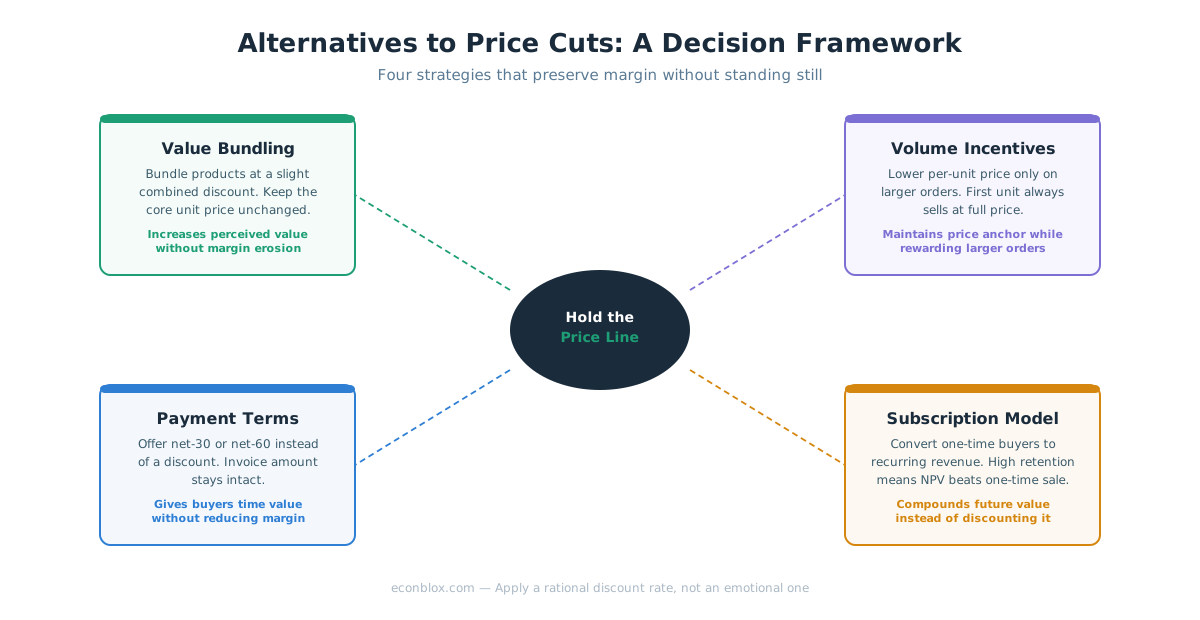
Frequently Asked Questions
What is the economic definition of discounting?
In economics, discounting is the process of converting a value received in a future time period to an equivalent value received immediately. It addresses the problem of translating values across time and is used to compare costs and benefits that occur at different dates. The larger the discount rate, the more weight is given to present consumption over future consumption.
What is the opportunity cost of a price cut?
The opportunity cost is the forgone benefit of the best alternative use of the margin you sacrifice. If you cut price by 10% on a product with a 50% margin, you lose 20% of your gross profit per unit. Those funds could have been reinvested in product development, marketing, or employee growth. The opportunity cost is often hidden but can be larger than the immediate revenue gain.
How does a business hurdle rate relate to pricing decisions?
A hurdle rate is the minimum return a business requires before deploying capital. When you cut price, you are implicitly allocating margin to generate incremental volume. If the return on that trade-off falls below your hurdle rate, the price cut destroys value even if it increases unit sales. Businesses with strong reinvestment opportunities have high hurdle rates, which makes the opportunity cost of discounting especially large.
When is it acceptable to offer a price cut?
A price cut may be acceptable when it is part of a deliberate strategy that accounts for the discount rate and opportunity cost. For example, clearing obsolete inventory, entering a new market segment, or responding to a competitive threat that would permanently erode market share. Without a structured analysis, ad hoc price cuts generally destroy more value than they create.
What are the two definitions of discounting mentioned in economic literature?
The first definition is the financial mechanism in which a debtor obtains the right to delay payments to a creditor in exchange for a fee. The second, more commonly used in policy and economics, is the process of converting future values to present values. Business owners should be aware of both meanings but focus on the economic definition when evaluating pricing strategies.
Price cuts feel like action. But they are often a costly shortcut. Every discount is a trade-off between present revenue and future margin. Apply a rational discount rate, account for opportunity cost, and explore alternatives before you reduce price. The businesses that hold the line on price tend to build more durable, profitable enterprises. A pattern of frequent discounting is also one of the primary factors causing buyers to discount purchase price during due diligence. Habitual margin cuts signal weak pricing discipline to any acquirer. Saying no to discounts is not stubbornness. It is discipline. Constant price-cut pressure is frequently a signal of high customer concentration risk. When one or two customers dominate your revenue, they gain leverage to demand concessions you cannot afford to refuse.
 No Credit Card Required For Trial