

Business Valuation & Exit Series
When you prepare to sell your business, the final purchase price rarely matches your initial expectation. Buyers apply discounts for a range of reasons, and understanding those reasons gives you leverage at the negotiation table. Generally, seven broad factors influence price negotiations, and five of those factors consistently lead to downward adjustments. By identifying these discount drivers, you can address them before a buyer raises them, protect your valuation, and close at a stronger price. To defend against these discount factors, start with a realistic business valuation for owners.
1. Type of Buyer and Their Motivations
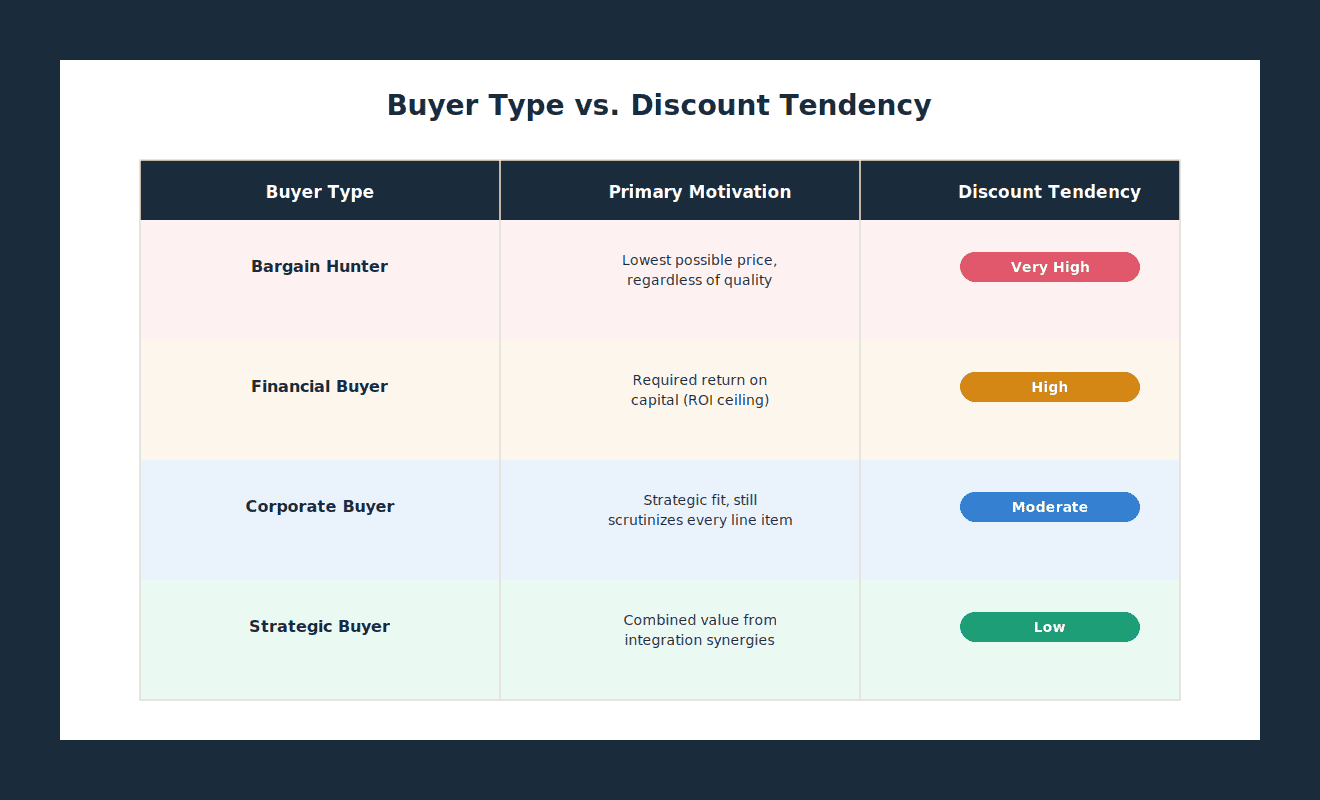
Not every buyer approaches a deal with the same willingness to pay. The type of buyer you engage determines how much discount pressure you face. Bargain hunters, for example, actively seek the lowest possible price and will push for steep discounts regardless of the company’s quality. Financial buyers, such as private equity firms, calculate a ceiling based on their required return on capital and rarely exceed it. Corporate or industry buyers consider strategic objectives and may pay a premium if the acquisition aligns with their growth plans, but they still scrutinize every line item. Strategic or synergistic buyers, who anticipate combining operations to generate extra value, are the most likely to pay a premium and the least likely to demand discounts, yet even they will discount if they perceive integration risks or a mismatch in culture.
The practical takeaway is that you must identify your buyer’s category early. A bargain hunter will always discount your price, so you may want to disqualify them unless your business is distressed. Financial buyers will anchor on ROI models, so your job is to demonstrate how your future earnings justify a higher multiple. Know your audience and tailor your narrative accordingly. Demonstrating an established pricing power business model commands a premium in any market.
2. Financial Parameters and Risk Profile
Buyers apply a systematic discount to account for financial risk. They evaluate your financial statements for irregularities, unsustainable growth, or hidden liabilities. Common discount triggers include customer concentration risk. If one client accounts for more than 20% of revenue, buyers may see a single point of failure. If that one client includes 20 branches, each with their own buyer, that is a lesser risk. Proactively run an internal customer concentration audit to prevent a post-LOI write-down. Competitive threats also weigh heavily; a new entrant or a price war in your industry will cause a buyer to reduce their offer. Reliance on key employees, especially the founder who is leaving after the sale, raises execution risk and prompts a discount. At the top of every buyer’s checklist is the level of owner dependency business valuation risk. These factors are not random; buyers use them to adjust future cash flow projections downward.
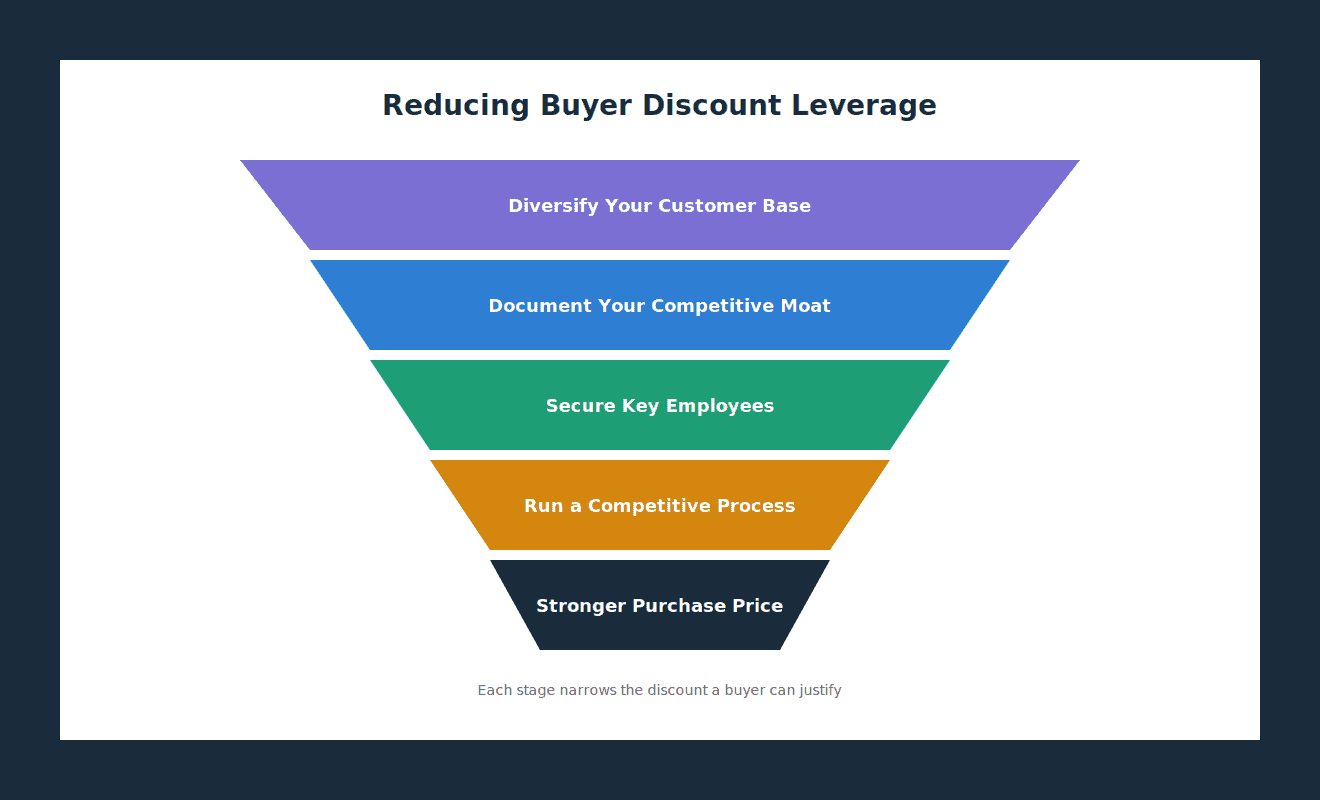
To reduce this discount, you can diversify your customer base before listing, document your competitive moat, and lock in key employees with retention agreements. Each structural risk directly compresses your EBITDA multiple calculation. The goal is to shrink the risk bucket that the buyer uses to lower your price.
3. General Attractiveness of the Business
Attractiveness is a broad composite of growth trajectory, market position, brand strength, and operational efficiency. Research indicates that attractive acquisition candidates command higher premiums because they have stronger future earnings support and draw a larger pool of buyers. Conversely, businesses that appear stagnant, commoditized, or dependent on a single product line are less attractive and invite aggressive discounts.
Buyers assess attractiveness through both rational and emotional lenses. On the rational side, they look at price, quality, functionality, and performance data. On the emotional side, they factor in brand reputation, customer loyalty, and the identity the company brings. If your business is perceived as a commodity, the buyer has no incentive to pay a premium. Differentiating your value proposition and cleaning up operational inefficiencies before a sale can raise your attractiveness and reduce the discount the buyer tries to apply. You can also remove buyer skepticism with a decision vault ROI tracking system that documents your historical strategic choices.
4. Market and Economic Conditions
The broader environment sets the tone for discounting. In a hot M&A market with ample capital and high buyer confidence, sellers hold more power and buyers are less eager to discount. But when interest rates rise, credit tightens, or a recession looms, buyers become cautious. They factor general economic uncertainty into their models and systematically reduce offers.
Timing your sale to coincide with favorable economic conditions can yield a higher price, but that is not always within your control. What you can control is how you present your business as resilient. If your company has performed well during previous downturns or has recurring revenue that is uncorrelated with the economic cycle, highlight that evidence. Buyers who see lower risk in their base case will have a harder time justifying a market-driven discount.
5. Relative Negotiation Leverage and Buyer Experience
Negotiation skill and leverage are not soft factors: they have a direct, measurable impact on price. A buyer who has completed many acquisitions knows exactly which pressure points to target. They will use their experience to request financial details that reveal weaknesses, or to cite industry norms to justify a discount. On the seller side, a lack of preparation or limited deal experience leads to concessions.
Leverage also depends on how many interested buyers exist. If only one party is willing to negotiate, that buyer holds more control and can discount with impunity. Running a competitive process with multiple qualified buyers shifts the leverage back to you. Even if you cannot create a bidding war, understanding the buyer’s own constraints, such as deal deadlines, funding milestones, or internal approval thresholds, gives you points at which to hold your line. Experienced sellers bring in advisors who have negotiated similar transactions, which counterbalances the buyer’s expertise and reduces the discount they successfully demand.
How to Apply This Knowledge Before You Sell
The five factors above do not operate in isolation. A buyer’s type influences which financial parameters they prioritize, and market conditions affect how aggressively they wield their negotiating leverage. Your strategy should be proactive: address each factor before the buyer can use it to discount your price. Diversify your customer base and revenue streams, document your competitive advantages, secure key employees, and run a controlled process that attracts multiple offers. The more you reduce perceived risk, the less room a buyer has to discount.
Frequently Asked Questions
Which buyer type is most likely to discount my purchase price?
Bargain hunters are the most likely to discount because their core objective is to pay the lowest possible price. Financial buyers also discount heavily when projected returns fall below their required threshold. Corporate and strategic buyers may still negotiate, but they are more open to paying a premium for strategic fit.
Can I eliminate all discounts from a buyer’s offer?
Eliminating every discount is unrealistic because buyers always factor in risk and uncertainty. However, you can significantly reduce discounts by strengthening your company’s attractiveness, documenting financial stability, diversifying your customer base, and creating competitive tension among multiple buyers.
How does customer concentration affect my business’s purchase price?
High customer concentration, for example, one client providing more than 20% of revenue, signals vulnerability. Buyers discount heavily because losing that single client would crater earnings. Reducing that dependency before listing improves your negotiation position and limits the discount.
Should I hire an advisor to help negotiate the purchase price?
Yes, especially if you lack M&A experience. A skilled advisor counters the buyer’s deal experience and helps you prepare financials, identify risk factors early, and run a competitive process. Advisors can also help you time the sale to align with favorable market conditions.
Do emotional factors like brand reputation really influence the discount amount?
Yes. Buyers evaluate both rational criteria (price, quality, performance) and emotional factors like brand identity, customer trust, and company culture. A strong reputation can reduce the perceived risk of customer attrition, which leads to a smaller discount in the final price.
 No Credit Card Required For Trial