

Business Valuation & Exit Series
Selling a business that generates substantial revenues is not a transaction that happens in a few weeks. Most advisory firms recommend beginning the process at least 12 to 24 months before the target sale date. A structured three-year approach gives owners time to address financial documentation, operational improvements, and team transitions without rushing decisions that can reduce valuation. Included in this process is a business valuation for owners. This exit prep checklist synthesizes guidance from multiple professional advisors, including wealth management firms, accounting practices, and business transaction specialists, into a practical timeline for owners of mid-market companies.
The opportunity cost of delaying exit preparation is significant. Without early planning, owners often accept lower multiples, face tax surprises, or lose key employees during the transition. Following a phased checklist year by year helps maximize the value of the business and the financial outcome for the owner.
3 Years Before Exit: Assemble Your Team and Define Your Goals
The earliest phase of exit preparation focuses on clarity of purpose and professional support. Multiple checklists agree that this period is for strategy, not execution.
- Define personal and business goals. Owners must decide whether they want to retire, fund a new venture, or transfer the business to family or management.
- Select a core advisory team. Choose your advisors early. Include a valuation expert, tax accountant, and transaction attorney.
- Obtain a preliminary business valuation for owners. Understanding the current market value helps set realistic expectations for improvements.
- Identify the right exit strategy. Understand the exit path. Options include selling to a third party, transferring to a family member, or creating an employee stock ownership plan.
- Start a buy-sell agreement if one does not exist. This as a critical early step for businesses with multiple owners.
During this period, owners should also begin gathering three years of financial statements. CPA-reviewed profit and loss statements, balance sheets, and tax returns form the foundation of deal preparation. The earlier these are in order, the less disruption occurs later.
2 Years Before Exit: Enhance Value and Strengthen Financials
The second year is the busiest phase. Most operational and financial improvements must be completed now to show sustained performance in the final year.
- Prepare comprehensive financial documents. CT Acquisitions details the required items: three years of CPA-reviewed P&L statements, balance sheets, tax returns, adjusted EBITDA calculation, revenue breakdown by service line, customer concentration analysis, and an accounts receivable aging report. These documents are required by almost every buyer.
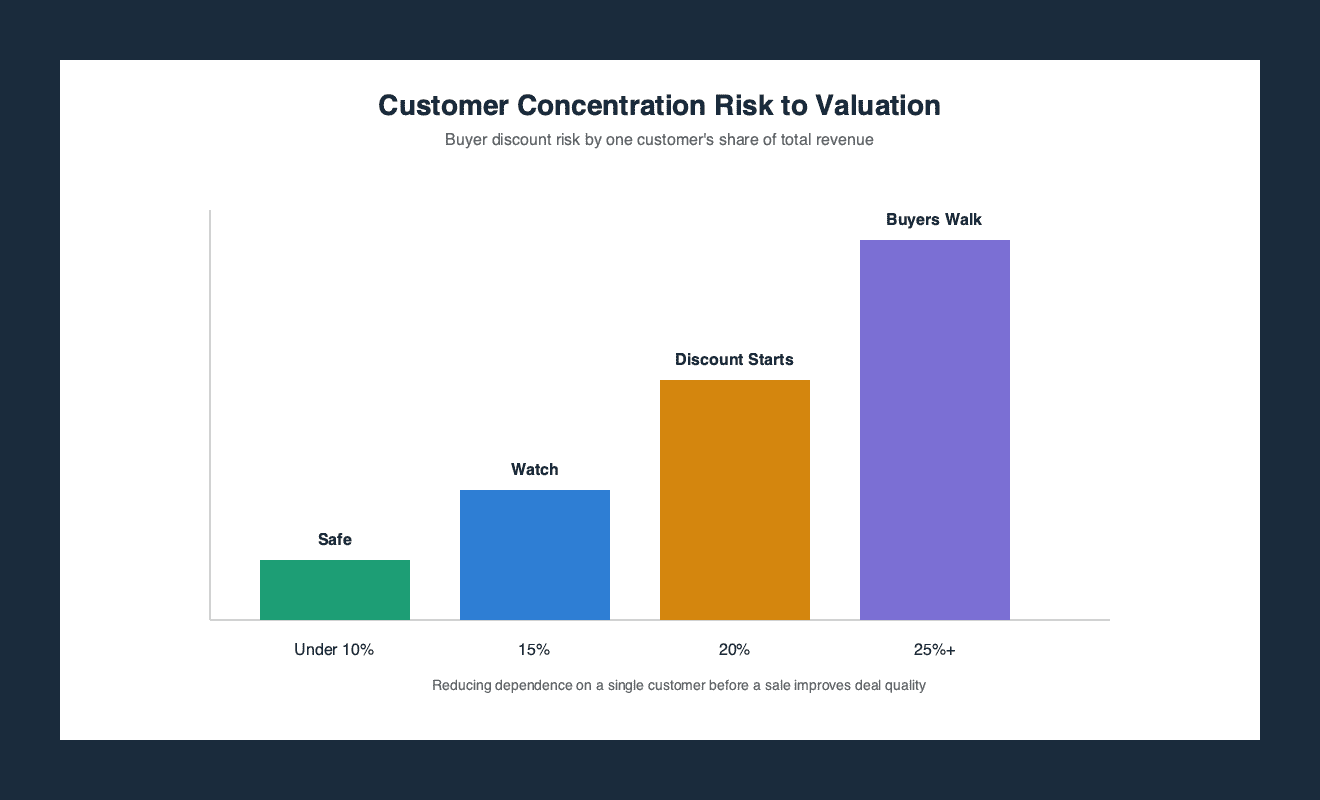
- Address customer concentration risk. A single customer representing more than 20% of revenue can reduce valuation. CT Acquisitions lists customer-concentration scrubbing as a high-impact step, consistent with the broader pattern of factors buyers use to discount a purchase price. Owners can quantify this and execute a dedicated customer concentration audit using Econblox’s Customer Concentration Audit prompt, which estimates the valuation gap between a concentrated revenue base and a diversified one.
- Plan for tax efficiency. Include tax planning as a distinct step, and incorporate it into your succession planning. Working with a tax advisor early can reduce capital gains exposure and structure the sale favorably.
- Make operational improvements. This includes documenting standard operating procedures, investing in technology, and systematically resolving owner dependency business valuation issues so that the enterprise can run independently. OwnersEdge also highlights selecting and training leaders for succession.
- Review real estate and lease agreements. CT Acquisitions mentions that real estate and lease documentation should be organized. If the business owns property, separate valuations may be needed.
- Ensure technology and systems continuity. Buyers expect reliable software, customer management systems, and field service continuity. CT Acquisitions rates technology/FSM continuity as a high-impact item.
At this stage, owners should be able to produce clean financial statements showing consistent profitability. Any one-time expenses or unusual revenue should be explained. The goal is to present a business that has been professionally managed for years, demonstrating that you can reliably raise prices without losing customers to protect margins long before listing.
Final Year Before Exit: Execute, Mitigate Risk, and Transition
The final year is about execution and risk management. All preparation leads to this period, and the pace of work intensifies.
- Finalize the succession plan. Gresham Partners dedicates a step to business succession, and GMA-CPA treats it as a core category. If key employees will take over, their training should be complete. If the buyer is external, a management continuity plan reassures investors.
- Consider risk management and insurance. Gresham Partners is the only checklist in the research pack that explicitly includes risk management as its own step. Ensure general liability, professional liability, and any industry-specific coverage are current.
- Execute the sale strategy. Hancock Whitney’s final step is to implement the sale of the business. This involves marketing the business, responding to buyer due diligence, and negotiating terms. OwnersEdge similarly calls for executing the plan.
- Address legal and financial considerations. OwnersEdge lists this as its fifth step. This includes finalizing contracts, reviewing representations and warranties, and confirming that all tax filings are up to date.
- Plan for personal financial future after the sale. Gresham Partners includes planning for the owner’s financial future as a step. Hancock Whitney also suggests a retirement funding analysis. Owners should understand how post-sale income will be structured, particularly if they are shifting to a business owner retirement pension framework.
Most home services business owners who achieve strong valuations started preparation more than 12 months in advance. Buyers typically require a 60- to 120-day due diligence period, so the majority of the legwork must be done before a buyer is engaged. Owners who want a structured way to pressure-test their own timeline can use tools like Econblox’s AI-powered business advisor, including its Exit Readiness Assessment prompt, rather than waiting until the final year to find gaps. A thorough final year ensures that the business is not only saleable but also commands a premium multiple.
Comparing Exit Planning Checklists from Various Advisors
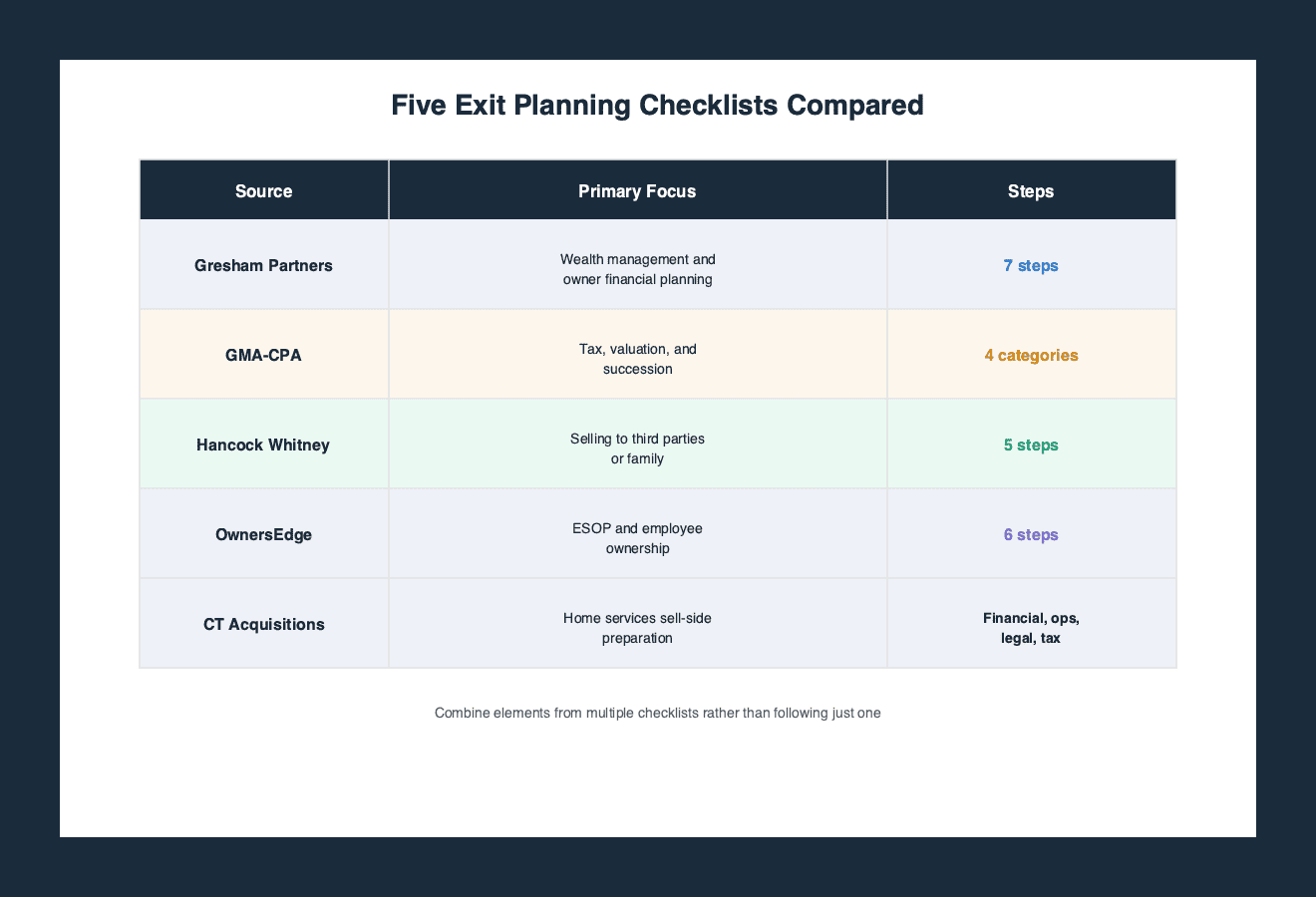
Several professional firms offer free downloadable exit planning checklists. Each has a slightly different emphasis based on the firm’s expertise. The following table summarizes the key differences among the checklists referenced in this article.
| Source | Primary Focus | Number of Steps or Categories | Industry Specificity | Publication Date |
|---|---|---|---|---|
| Gresham Partners | Wealth management and owner financial planning | 7 steps | General business owners | May 8, 2024 |
| GMA-CPA | Tax, valuation, and succession | 4 categories with sub-items | General business owners | Not specified |
| Hancock Whitney | Selling to third parties or family | 5 steps | General business owners | March 13, 2024 |
| OwnersEdge | ESOP and employee ownership | 6 steps | General business owners, values alignment | June 16, 2025 |
| CT Acquisitions | Home services (HVAC, plumbing, etc.) and sell-side prep | Financial, operational, legal, and tax items | Home services industry | Not specified |
Businesses generating substantial revenues can use any of these checklists as a starting point, but the most effective approach combines elements from multiple sources. For instance, CT Acquisitions provides the most granular financial preparation detail, while Gresham Partners and Hancock Whitney offer strong guidance on goal setting and personal financial planning. Matching the checklist to the specific industry and exit strategy is more important than following any single one.
Frequently Asked Questions
How far ahead should I start exit planning?
Many advisors recommend beginning at least 12 months in advance. Business owners who achieve strong valuations typically start more than a year before the target sale date. A three-year timeline allows for thorough financial cleanup, operational improvements, and team training without pressure.
What financial documents do I need to prepare for a sale?
Buyers expect three years of CPA-reviewed profit and loss statements, balance sheets, and tax returns. You also need an adjusted EBITDA calculation, a revenue breakdown by service line, a customer concentration analysis, and an accounts receivable aging report. These documents must be clean and consistent.
Should I hire a team of advisors for exit planning?
Yes. Several leading checklists list selecting your advisory team as the first step. A typical team includes a valuation expert, a tax accountant, a transaction attorney, and a wealth planner. Engaging them early reduces last-minute surprises and improves the quality of the deal.
What is the most common oversight business owners make in exit planning?
Failing to start early is a frequent mistake. Additionally, many owners neglect customer concentration risk or fail to have a buy-sell agreement in place with minority-share partners. Early work on financials, risk mitigation, and operational succession successfully avoids these pitfalls, protecting long-term enterprise value and ensuring a seamless, high-multiple transfer.
 No Credit Card Required For Trial