

Business Valuation & Exit Series
An online business valuation calculator offers an irresistible promise. Plug in two or three numbers, click a button, and immediately see what your life’s work is worth. For business owners contemplating a transition or exit, these free tools provide a fast baseline, but a fast baseline is not a defensible number. Most owners carry the bulk of their net worth in the business itself for years. No one tests whether that number would survive real due diligence until an offer is already on the table. Relying on a generic calculator to price a private enterprise is one of the most dangerous moves a founder can make.
While generic web tools answer basic arithmetic questions, they consistently fail to account for operational risk, capital market conditions, and buyer due diligence. To protect your equity, you need to understand where standard web math works, where it breaks down, and how to arrive at a true valuation.
How Online Business Valuation Calculators Work (The Underlying Math)
Most free valuation tools use simplified financial formulas based on trailing twelve-month (TTM) performance. Depending on the industry and revenue tier, they typically run on one of three core frameworks:
- Seller’s Discretionary Earnings (SDE) Multiple: Used for small businesses with under $1M in earnings.
Valuation = SDE × Multiple
(Calculates value by taking SDE, meaning net income plus the owner’s salary and personal perks, and multiplying it by an earnings multiple.)
- EBITDA Multiple Method: Used for mid-market companies ($1M–$20M+ EBITDA).
Enterprise Value = EBITDA × Multiple
(Calculates total company value by taking normalized operational earnings before tax, interest, and depreciation, and multiplying it by an industry benchmark multiple.)
- Revenue Multiple Method: Used primarily in high-growth software sectors.
Valuation = Revenue × Multiple
(Calculates value directly from total top-line sales, though it is unreliable for traditional middle-market operating companies.)
Note: Total company debt is deducted from the preliminary valuation figure to calculate the net value of the owner’s equity.
While these formulas serve as useful conceptual starting points, standard web tools populate them using static, generic industry averages that rarely reflect real-world M&A transactions.
The 5 Blind Spots of Generic Online Business Valuation Calculators
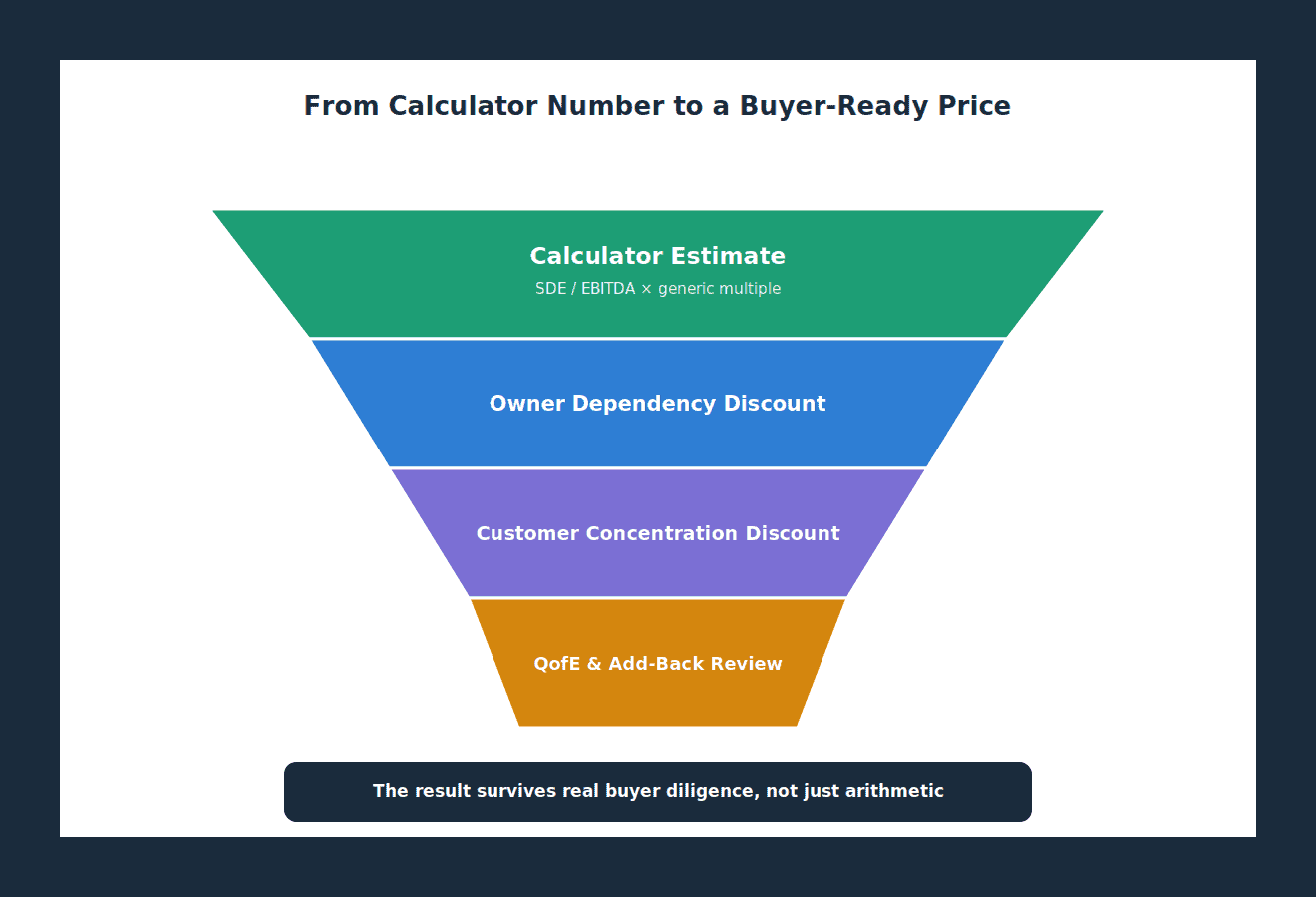
When buyers present a letter of intent (LOI), they do not rely on generic internet calculators. They perform rigorous due diligence to identify operational liabilities and apply purchase price haircuts. Online calculators consistently miss five critical risk factors:
1. Operational Founder & Owner Dependency
If your company cannot generate revenue or execute daily operations without your direct intervention, buyers will heavily discount your multiple. A generic web tool calculates value based strictly on historical income, ignoring key operational dependencies. If you are tied to daily execution, high owner dependency business valuation penalties will directly drag down your exit payout.
2. Hidden Customer Concentration Risk
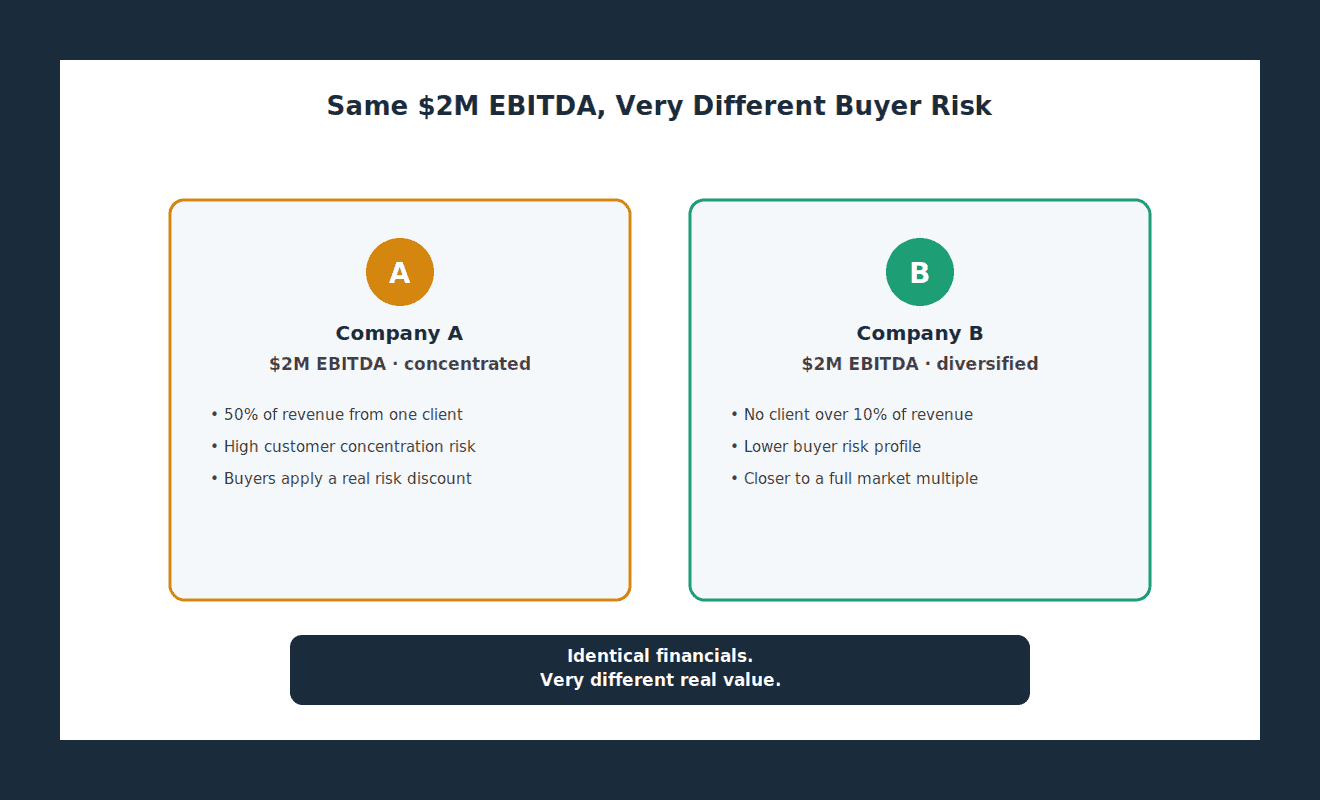
Two businesses with identical $2M EBITDA profiles do not carry identical market value. If Company A derives 50% of its revenue from a single client, institutional buyers consider that revenue high-risk. A standard online business valuation calculator treats both companies as equal, completely missing severe customer concentration risk.
3. Margin Quality and Pricing Power
Top-line growth without margin defensibility is a strategic liability. Buyers evaluate whether your profit margins stem from structural advantage or short-term cost reduction. Demonstrating a repeatable, institutionalized ability to raise prices without losing customers expands your bottom-line quality and commands a valuation premium.
4. SDE & EBITDA Add-Back Accuracy
Web calculators take user-submitted financial add-backs at face value. During actual M&A negotiations, quality-of-earnings (QofE) audits frequently strip out unverified add-backs, reducing normalized earnings and compressing the overall purchase price.
5. Macroeconomic and Capital Market Headwinds
A static web tool uses fixed multiplier tables that fail to adjust for interest rates, debt financing availability, or sector contractions, even though a real baseline must account for them.
Your Profit Gap
The Profit Gap Analysis takes 2 minutes and 8 inputs to show where these blind spots cost you margin.
Valuation Tool Comparison: Web Calculators vs. Strategic Economics
To understand where standard online tools fit into your exit planning, compare the primary valuation methods available to business owners:
| Valuation Method | Speed & Cost | Primary Strength | Major Limitation |
|---|---|---|---|
| Basic Web Calculators | Instant / Free | Quick back-of-the-envelope ballpark | Ignores operational risk & customer concentration |
| Brokerage Intake Estimates | 1–3 Days / Free | Incorporates recent regional listing data | Lead-generation focus; often inflates estimates |
| Certified Appraisal (CBV / ASA) | 3–6 Weeks / $5k–$25k+ | Legally defensible for tax, estate, or litigation | Backward-looking static snapshot; expensive |
| Econblox Strategic Reasoning | Interactive / Dynamic | Identifies value gaps & multi-year risk factors | Requires active owner input on operational metrics |
Protecting Your Equity: Moving Beyond Static Math
In order to defend your equity, you must identify and neutralize the key factors buyers use to discount purchase price during diligence. Simply running financial figures through a basic web form will not prepare you for buyer scrutiny or contract terms.
Owners who maximize exit value take a multi-year, systematic approach to building transferrable enterprise value. Therefore, treat a business valuation calculator as a starting question, not a final answer. Establish an accurate baseline instead with a first-principles business valuation for owners assessment, not unverified internet software.
Furthermore, owners can streamline operational decision-making and eliminate strategic bottlenecks by incorporating automated, data-driven AI business strategy decisions into their management routine.
 No Credit Card Required For Trial