

Business Valuation & Exit Series
Net worth trapped in your business: it’s a phrase most owners recognize the moment they hear it. But almost none of them have actually run the number. Ask most owners what their business is worth and they can give you a figure, even a rough one. Ask what share of their total net worth that figure represents, and most go quiet. It is not that the math is hard. It is that almost no one runs it. The business is not a line item you check like a brokerage balance. It is the thing you show up to every day. That makes it easy to feel wealthy on paper while being dangerously exposed in practice.
That gap between “the business is worth a lot” and “I know exactly how exposed I am” is where owners get hurt. Not because the business fails, but because everything else in their financial life was quietly built around one assumption. The business would eventually convert into liquid, usable wealth, on schedule and at the price they expected. That conversion, turning years of built-up equity into real, spendable value, is therefore the whole point of building and realizing the value of a business, not just growing it on paper.
The Concentration Number, and Why It’s Not Rare
This is not a fringe problem affecting a handful of overleveraged owners. According to CNBC, citing estimates from the Exit Planning Institute, 80% to 90% of business owners have their financial wealth locked up in the companies they run. That is a level of concentration almost no financial advisor would recommend for any other asset. A portfolio that is 80% invested in a single, illiquid, unlisted position is not a diversified portfolio. It is a bet. For most owners it is a bet they never consciously chose to make. It is simply what happens when every reinvested dollar and every hour of sweat equity goes back into the same company, year after year.

Net Worth Trapped in Your Business: How to Calculate Your Number
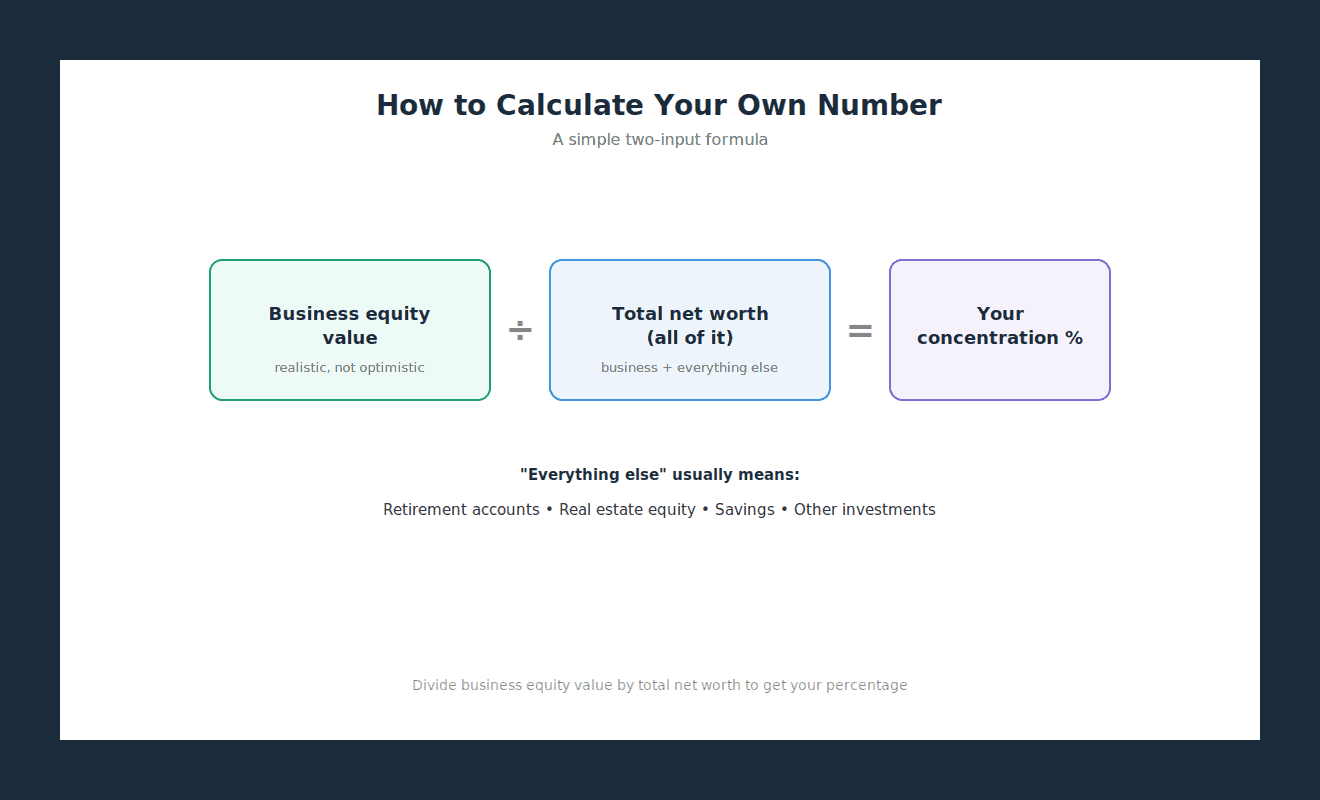
The calculation itself is simple, even if the inputs take some honesty to gather. Add up your personal net worth outside the business: retirement accounts, real estate equity, savings, other investments. Then estimate what your ownership stake in the business is actually worth. Use a realistic valuation, not an optimistic one. Divide the business figure by your total net worth, business plus everything else, and you have your concentration percentage.
Getting a realistic business valuation is the part most owners get wrong, usually by overestimating it. A revenue multiple from an industry rule of thumb, or a number from an online calculator, rarely reflects what a buyer would actually pay. Factors like customer concentration, owner dependency, and financing terms all come into the picture. Our piece on why your business valuation calculator number is wrong walks through why the quick-math number usually overstates reality. That means the concentration percentage most owners calculate is actually understating their real exposure.
Why This Number Is Riskier Than It Looks
A high concentration percentage is not automatically a crisis. Plenty of owners run that risk successfully for years. But it changes the stakes of every other business and financial decision in three specific ways.
First, it is illiquid. You cannot sell 10% of your business on a Tuesday afternoon the way you could sell shares in a public company. Second, it is a single point of failure. A downturn in your industry, the loss of a key customer, or your own health all threaten the same asset. That asset happens to represent most of your net worth, all at once. Third, and most overlooked, the value is not fully yours to control. It depends heavily on whether the business can run without you, a factor covered in our piece on owner dependency as a silent valuation killer. An owner-dependent business is worth less to a buyer. That concentrated value is simply harder for the next owner to rely on.
What This Number Should Actually Trigger
Calculating the number is the diagnostic step, not the fix. But it does change what an owner should prioritize. A concentration figure above 80% or 90% is a signal. Start treating the business’s eventual conversion into liquid wealth as a planned, multi-year project, not something that happens automatically at the finish line. That means building the case for a higher valuation now. Reduce owner dependency, diversify the customer base, and strengthen the numbers a buyer will actually diligence, well before a sale or transition is imminent.
It also means the timeline matters more than most owners assume. Our Business Owner Retirement pillar page covers why “the business is my pension” is a riskier plan than it sounds, precisely because of this concentration problem. Knowing your number is therefore the first step toward changing it, while you still have the runway to do so.
Knowing the number is uncomfortable for a reason. It turns an abstract sense of “the business is doing fine” into a concrete measure of exposure. Working through what that number means for your situation is a real judgment call. It is not one an owner should have to make with a search engine and no second opinion. Our AI Business Advisor free trial, ten queries, no credit card, gives you a place to run that thinking through before deciding what comes next.
Frequently Asked Questions
Is there a “safe” percentage to have tied up in the business?
There is no universal threshold. But the higher the number, the more a single event, a bad year, a lost customer, a health issue, can affect your entire financial picture. The number itself matters less than whether you have a plan for what happens if the business’s value does not convert on schedule.
Does paying myself a higher salary reduce this risk?
It helps build assets outside the business, but it does not address the concentration in the business’s equity value itself. Both matter, and they are solved differently.
What should I do first once I know my number?
Start with what is driving the business’s value down relative to what it could be. That is most often owner dependency and customer concentration. Fixing those improves both the eventual sale price and how quickly the business could convert to liquid wealth if you needed it to.
 No Credit Card Required For Trial