

The New Era of AI-Driven Business Strategy Decisions
Business leaders today face a landscape where changes that once took decades now unfold in months. The speed of market shifts, competitive threats, and technological disruption demands strategic thinking that can keep pace. Artificial intelligence is emerging as a practical tool that helps owners and executives make faster, more informed business strategy decisions without relying on expensive consulting firms or lengthy executive programs.
The Speed of Strategic Change Has Been Redefined
The processing cost of frontier AI models has dropped more than ten-fold in just the last year, according to PwC. This dramatic reduction means that sophisticated analysis once available only to large corporations is now accessible to businesses of nearly any size. AI-driven systems can quickly analyze vast datasets, automate complex tasks, and enable real-time decision-making at unprecedented scale.
For any established business owner, this represents a genuine opportunity to apply economics-based reasoning to everyday strategic choices. Strategy development no longer requires waiting for quarterly board reviews or expensive consultant reports. With on-call systems like the AI business advisor available 24/7, leaders can test pricing scenarios, evaluate market expansion options, and assess competitive responses in minutes rather than weeks. This constant availability allows businesses to adapt execution in real time, aligning goals with shifting market conditions before competitors can react.
AI as a Real-Time Decision Support Layer
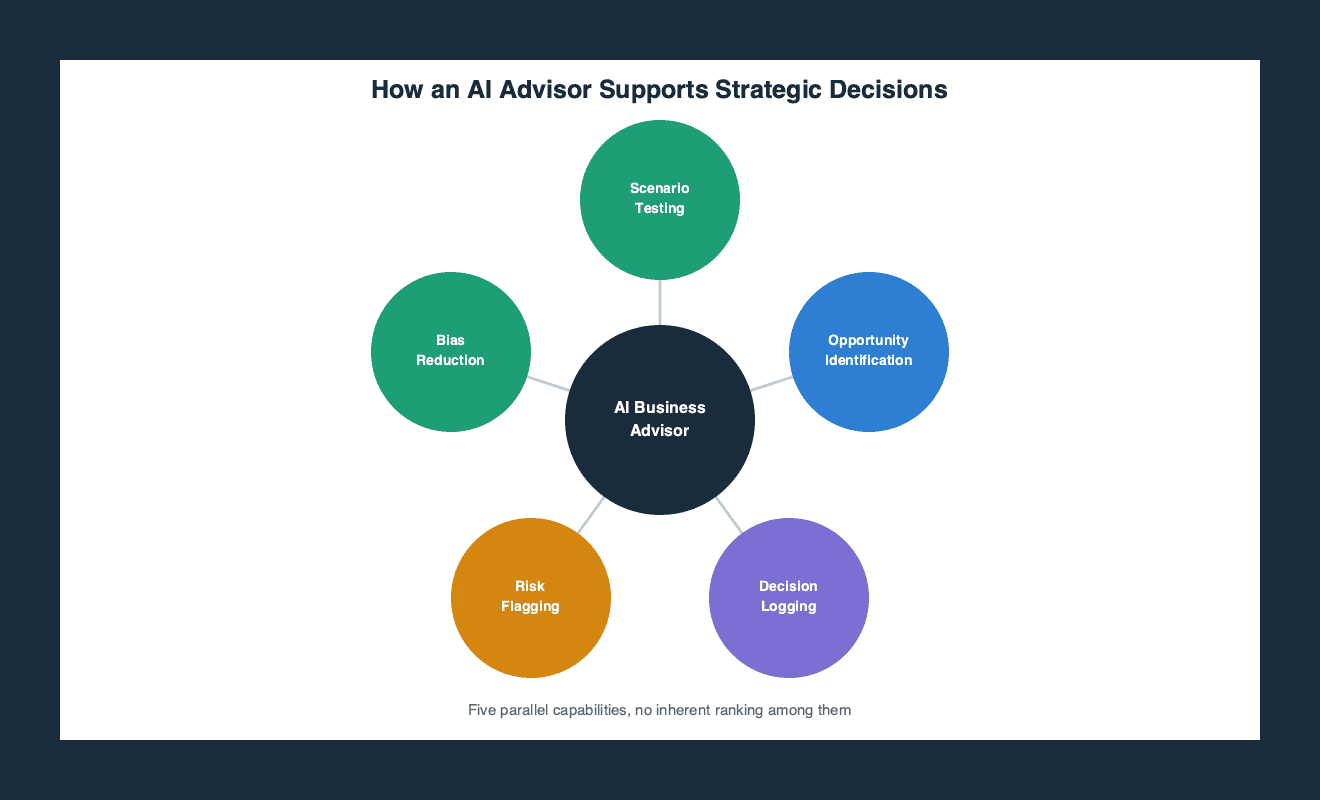
Many business owners struggle with uncertainty when making high-stakes decisions about pricing, hiring, or expansion. AI in business strategy helps leaders align goals, surface risk early, and adapt execution in real time. This is not about replacing human judgment but rather augmenting it with data-driven analysis that reveals hidden relationships and potential outcomes.
An AI-powered advisor can serve as a continuous brainstorming partner, speeding up idea generation and helping counter business leaders’ potential biases or blind spots, a use case McKinsey has explored in its research on AI and cognitive bias in strategy work. When a founder is considering whether to cut prices to defend market share, an AI tool models the likely impact on margins, customer retention, and long-term brand perception based on economic principles rather than gut instinct. Combining technology with economic analysis allows you to execute better business decisions economics frameworks consistently across your operation.
PwC’s analysis of AI in business strategy also frames the technology in terms of defensive and offensive strategies. Defensively, AI can flag emerging risks in supply chains or pricing structures before they become critical. This analytical leverage is particularly powerful when analyzing demand and deciding whether to raise prices without losing customers. Offensively, it can identify underserved customer segments, optimal pricing tiers, and timing for market entry that human analysis might overlook.
Identifying Risk and Opportunity with AI
Traditional strategic planning often relies on backward-looking data and linear projections. AI introduces the ability to run hundreds of scenarios simultaneously, testing assumptions about demand elasticity, competitor behavior, and macroeconomic shifts. For a business making expansion decisions, this means understanding not just the best-case scenario but the full range of possible outcomes and their probabilities.
Technology is particularly effective at identifying cognitive biases that can derail strategic planning. Business leaders tend to overweight recent events, ignore base rates, and anchor on initial assumptions. An AI system that presents objective, economics-based reasoning helps counteract these tendencies, leading to more disciplined decision-making.
Crucially, an effective strategy also requires long-term accountability. This is where platforms featuring a dedicated log shift the paradigm. By securely recording management choices alongside the AI’s underlying economic reasoning using a specialized decision vault ROI tracking system, organizations can systematically review past decisions, identify why certain assumptions worked or failed, and continuously refine their implementation framework. Institutionalizing your analysis reduces owner dependency and systematically improves your long-term business valuation for owners.
The Strategic Frameworks Behind AI Adoption
Multiple leading institutions have studied how AI can reshape business strategy, each offering a distinct lens on the opportunity. Understanding these frameworks helps business owners choose the approach that fits their needs.
| Source | Focus of AI Strategy Guidance |
|---|---|
| PwC | Emphasis on speed, multiple futures, defensive and offensive strategies |
| IBM | Structured step-by-step approach for implementation and objective setting |
| Econblox | Continuous 24/7 economics-based decision-making backed by a permanent Decision Vault |
| McKinsey | AI as a tool to counter bias and speed up idea generation |
| Gartner | Dynamic, evolving strategy that adapts to business priorities and market trends |
Each framework reinforces the same core insight: AI is not a one-time implementation but a continuous capability that must evolve alongside the business. Gartner stresses that a successful AI strategy must be dynamic, evolving alongside business priorities, market trends, and the risk landscape. A static strategy document quickly becomes obsolete in a fast-moving environment.
The Cost Barrier Is Dropping
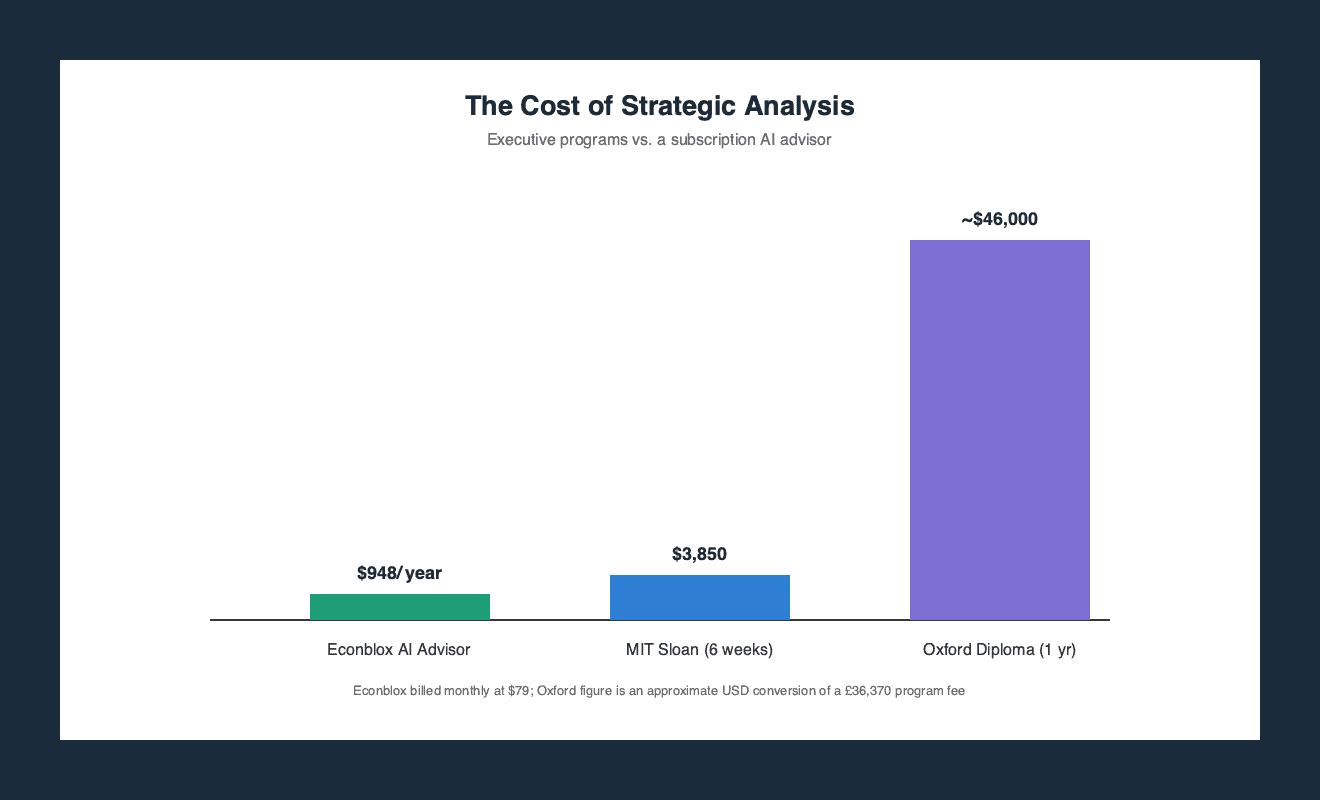
Historically, accessing high-level strategic analysis meant enrolling in expensive executive education programs or hiring legacy consulting firms. The MIT Sloan Executive Education course titled “Artificial Intelligence: Implications for Business Strategy” costs $3,850, runs for 6 weeks, and requires 6 to 8 hours per week. While valuable, such programs represent a significant investment of both time and money. The Oxford Executive Diploma in Strategy and Innovation costs £36,370 and is aimed at experienced professionals with at least five years in a leadership role.
In contrast, dedicated platforms like the Econblox AI Business Advisor offer continuous, 24/7 access to specialized economics-based strategic analysis for a mere fraction of what these traditional programs and larger consulting firms charge.
The global AI market is projected to reach roughly $1.81 trillion by 2030, according to Grand View Research, growing at a compound annual rate of more than 36 percent. Some of that growth is tied to AI infrastructure investment, where analysts still debate whether current demand reflects a permanent structural shift or a more fragile competitive race. Whichever way that debate resolves, the cost of accessing frontier-level business reasoning has continued to decline. The key is finding a purpose-built tool that delivers unbiased reasoning backed by transparent sources, not just generic answers.
How Executives Are Already Adapting
The adoption of AI for strategic purposes is accelerating, though results are uneven. PwC’s 2026 Global CEO Survey found that 30 percent of CEOs report AI has already contributed to revenue increases, but only 12 percent saw both lower costs and higher revenue at the same time, and 56 percent saw neither benefit yet. The gap separates disciplined adopters from the rest: companies that apply AI broadly across products, services, and customer experience report profit margins nearly four percentage points higher than those that do not, and CEOs with strong AI foundations in place, such as clear governance and systems built for enterprise-wide use, are about three times more likely to see meaningful financial returns.
IBM research shows that a large majority of C-suite executives expect to digitize workflows and use AI-powered automation in the near term. This widespread intention signals a fundamental shift in how strategy is developed and executed. Business owners who delay adoption risk falling behind competitors who are already using AI to surface opportunities and risks more quickly, though the PwC data suggests that adopting the technology with discipline matters more than simply adopting it early.
AI adoption is not limited to large enterprises. The decreasing cost of processing power makes it feasible for companies in the $1 million to $50 million revenue range to access sophisticated strategic analysis. The key differentiator is no longer budget or company size, but the willingness to integrate data-driven reasoning into daily decision-making.
Building a Dynamic AI Strategy That Lasts
Effective use of AI in business strategy requires more than simply purchasing a tool. It demands a commitment to using the insights generated to challenge assumptions and guide action. A successful AI strategy must be dynamic, evolving alongside business priorities, market trends, and the risk landscape. A static document is insufficient when the environment shifts monthly.
Leaders should start by identifying the specific strategic decisions where AI can add the most value. Common starting points include pricing analysis, market entry feasibility, competitive response modeling, and resource allocation. As confidence in the tool grows, the scope of analysis can expand to cover broader strategic questions such as long-term positioning and innovation investment.
One practical approach is to leverage an affordable, specialized service to test the quality of reasoning on a real, current decision. Comparing an AI’s economics-backed analysis against the team’s assumptions often reveals blind spots and new alternatives. Over time, tracking the outcomes of those choices inside a digital ledger builds a clear record of ROI that reinforces the value of data-driven leadership.
A better decision-making process is the method, not the model itself. See how the Advisor, the Decision Vault, and structured economic modeling work together in Business Advisor.
Frequently Asked Questions
How does AI account for business-specific goals and context?
AI tools designed for strategy analysis allow users to input their specific business parameters, industry conditions, and objectives. Systems like Econblox apply targeted economic principles and market data to generate tailored reasoning, while providing clear citations so users can verify the assumptions and logic behind each recommendation.
Can small and mid-market businesses benefit from AI strategy tools?
Yes. The processing cost of frontier AI models has dropped more than ten-fold in the last year, making sophisticated analysis affordable for companies generating $1 million to $50 million in revenue. Subscription-based platforms provide institutional-grade reasoning for a fraction of what larger consulting firms charge, putting high-level strategic reasoning within reach of growing firms.
Do I need technical AI expertise to use a strategy tool?
No. AI strategy tools designed for business owners focus on organizational and managerial implications rather than technical aspects. Solutions like the Econblox AI Business Advisor operate through an accessible, conversational interface available 24/7. No coding or data science background is required to receive economics-based analysis and supporting evidence.
How do I measure the ROI of using AI in strategy decisions?
Track specific decisions made with AI support and compare actual outcomes against your initial projections. Utilizing a specialized Decision Vault feature allows management to securely log decisions, revisit the baseline reasoning behind them, and quantify the financial impact over time. This builds a measurable record of how AI contributed to better strategic outcomes.
 No Credit Card Required For Trial